
Authored by the expert who managed and guided the team behind the United Kingdom Property Pack
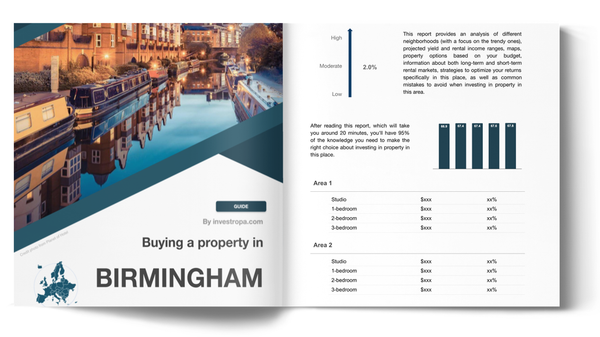
Yes, the analysis of Birmingham's property market is included in our pack
If you are a foreigner looking at buying property in Birmingham, the most common question is simple: what can I actually afford at my budget level?
Birmingham is the UK's second-largest city and its property market is one of the most dynamic in the country, but prices and what you get for your money vary widely depending on your starting point.
This blog post covers what you can realistically buy in Birmingham at $100k, $200k, $300k, $500k, and beyond, plus the real costs you will face as a foreign buyer in 2026.
And if you're planning to buy a property in this place, you may want to download our pack covering the real estate market in Birmingham.
What can I realistically buy with $100k in Birmingham right now?
Are there any decent properties for $100k in Birmingham, or is it all scams?
At around $100,000, which converts to roughly £74,000 in early 2026 using the current exchange rate near 0.74 GBP per USD, you are looking at entry-level properties in Birmingham, typically small one-bedroom flats or studios in older buildings, often ex-council stock.
The neighborhoods in Birmingham that offer the best value and most legitimate options at this budget include Erdington (B23/B24), Aston (B6), parts of Handsworth (B20/B21), and Perry Barr (B42), where older flats and smaller units appear more frequently on the market.
It is technically possible to buy in more popular or upscale areas of Birmingham for $100k, but you would be limited to tiny studios or properties with complications like short lease terms, cladding issues, or high service charges, so you need to be very careful with your due diligence.
What property types can I afford for $100k in Birmingham (studio, land, old house)?
For $100,000 (around £74,000) in Birmingham in 2026, you can realistically afford a studio flat, a small one-bedroom flat in an older building, or occasionally a shared ownership stake, but standalone houses at this price are extremely rare within the city boundaries.
At this budget level, buyers should typically expect properties that need at least cosmetic work (£3,000 to £10,000), with many requiring medium-level renovation (£10,000 to £30,000) for things like kitchen and bathroom updates, rewiring, or boiler replacement.
For long-term value in Birmingham at the £74,000 level, small one-bedroom flats in well-connected areas like Erdington or Perry Barr tend to offer the best combination of rental demand and gradual appreciation, particularly those with reasonable service charges and lease lengths above 80 years.


Got a question about a property in United Kingdom?
Found a place and not sure about it? Tell us about it and we'll tell you what we'd check. Free, within 12 hours.
Ask us your question →
What's a realistic budget to get a comfortable property in Birmingham as of 2026?
As of early 2026, the realistic minimum budget to get a comfortable property in Birmingham starts around £180,000 (approximately $240,000 or €225,000), which is below the city's average of £233,000 but enough to access decent two-bedroom flats or small terraced houses in respectable areas.
Most buyers looking for a comfortable standard in Birmingham need to budget between £180,000 and £260,000 (roughly $240,000 to $350,000 or €225,000 to €325,000) to reach properties that do not require significant immediate work and are in neighborhoods with good amenities.
In Birmingham, "comfortable" generally means a property with at least two bedrooms, modern or recently updated kitchen and bathroom, double glazing, gas central heating, and a lease length above 80 years for flats, located in areas with decent transport links and local shops.
The required budget can vary significantly depending on the neighborhood in Birmingham, with areas like Harborne, Moseley, and Edgbaston requiring closer to £260,000 or more for the same comfort level, while Erdington, Selly Oak, or Kings Norton might deliver similar quality closer to £180,000.
Get fresh and reliable information about the market in Birmingham
Don't base significant investment decisions on outdated data. Get updated and accurate information.

What can I get with a $200k budget in Birmingham as of 2026?
What "normal" homes become available at $200k in Birmingham as of 2026?
As of early 2026, a $200,000 budget (approximately £149,000) opens the door to what most people would call a "normal" home in Birmingham, including one to two-bedroom flats in a wider range of neighborhoods and two-bedroom terraced houses in value-focused suburbs.
At this budget level in Birmingham, you can typically expect properties ranging from 50 to 75 square meters (540 to 800 square feet) for flats, and 70 to 95 square meters (750 to 1,020 square feet) for terraced houses, which provides enough space for singles, couples, or small families.
By the way, we have much more granular data about housing prices in our property pack about Birmingham.
Still have a question about United Kingdom?
If this article didn't answer it, ask us. A real person replies within 12 hours, for free.
Ask us your question →
What places are the smartest $200k buys in Birmingham as of 2026?
As of early 2026, the smartest neighborhoods to buy at $200,000 (around £149,000) in Birmingham include Selly Oak (B29), Kings Norton (B30), Northfield (B31), and Yardley (B25/B26), where you can find good-quality terraced houses or spacious flats with strong transport links.
What makes these areas smarter buys compared to other £149,000 options in Birmingham is their combination of established amenities, proximity to employment centers like the city center and the Queen Elizabeth Hospital, and consistent rental demand from students and young professionals.
The main growth factor driving value in these smart-buy areas of Birmingham is ongoing regeneration and infrastructure investment, particularly the expansion of the tram network and the city's broader HS2 connectivity plans, which are increasing accessibility and attracting new residents.
Stuck somewhere in the process? Tell us where you're at.

We have made this infographic to give you a quick and clear snapshot of the property market in the UK. It highlights key facts like rental prices, yields, and property costs both in city centers and outside, so you can easily compare opportunities. We’ve done some research and also included useful insights about the country’s economy, like GDP, population, and interest rates, to help you understand the bigger picture.
What can I buy with $300k in Birmingham in 2026?
What quality upgrade do I get at $300k in Birmingham in 2026?
As of early 2026, moving from a $200,000 to a $300,000 budget (from £149,000 to £223,000) in Birmingham upgrades you from entry-level suburbs to more consistently desirable streets, better property condition, and a meaningful increase in space or bedroom count.
At £223,000 in Birmingham, you can often buy a property in a newer building, particularly modern apartment developments in areas like the Jewellery Quarter or parts of Digbeth, though you should always verify service charges and any cladding or EWS1 documentation before committing.
Specific features that typically become available at this budget include updated kitchens with integrated appliances, renovated bathrooms, parking spaces or driveways, small gardens for terraced houses, and generally better energy efficiency ratings.
Can $300k buy a 2-bedroom in Birmingham in 2026 in good areas?
As of early 2026, a $300,000 budget (around £223,000) can definitely buy you a two-bedroom property in good areas of Birmingham, including well-maintained flats in sought-after neighborhoods like the Jewellery Quarter, Edgbaston, and parts of Harborne.
Specific good areas in Birmingham where two-bedroom options become accessible at £223,000 include the Jewellery Quarter (B18) for modern apartments, Edgbaston (B15) for a mix of period conversions and newer builds, and Kings Heath (B14) or Hall Green (B28) for two-bedroom terraced houses.
A typical two-bedroom property at the £223,000 price point in Birmingham offers between 55 and 80 square meters (590 to 860 square feet) for flats and 70 to 95 square meters (750 to 1,020 square feet) for houses, which is comfortable for couples or small families.
Got a question about the market in United Kingdom?
Prices, areas, rentals: ask us what you'd ask a friend who knows. Free reply within 12 hours.
Ask us your question →Which places become "accessible" at $300k in Birmingham as of 2026?
At the $300,000 price point (roughly £223,000) in Birmingham, neighborhoods that were previously out of reach start to become accessible, including the Jewellery Quarter (B18), Edgbaston (B15), parts of Harborne (B17), and the more desirable streets in Moseley (B13) and Kings Heath (B14).
What makes these newly accessible areas desirable compared to lower-budget options is their combination of character housing stock, walkable amenities like independent shops and restaurants, green spaces, better school catchments, and a stronger sense of community identity that Birmingham's trendier neighborhoods are known for.
For £223,000 in these newly accessible areas, buyers can typically expect well-maintained two-bedroom flats in period conversions, smaller two-bedroom terraced houses, or occasionally a house that needs updating but sits on a good street with strong resale potential.
Get to know the market before buying a property in Birmingham
Better information leads to better decisions. Get all the data you need before investing a large amount of money.
What does a $500k budget unlock in Birmingham in 2026?
What's the typical size and location for $500k in Birmingham in 2026?
As of early 2026, a $500,000 budget (approximately £372,000) in Birmingham typically buys you a three to four-bedroom semi-detached or larger terraced house in strong family areas, or a high-specification apartment in prime central locations like the Jewellery Quarter or Edgbaston.
At £372,000 in Birmingham, you can absolutely buy a family home with outdoor space, including properties with gardens, driveways, and sometimes garages, particularly in established suburbs like Moseley, Harborne, Kings Heath, and the fringes of Sutton Coldfield.
The typical property at this budget offers three to four bedrooms and one to two bathrooms, with floor areas ranging from 100 to 150 square meters (1,080 to 1,615 square feet) for houses, providing genuine family-sized accommodation.
Got a question nobody's answered?
Buying in United Kingdom and can't find a clear answer anywhere? Ask us. Free reply within 12 hours.
Ask us your question →Which "premium" neighborhoods open up at $500k in Birmingham in 2026?
At the $500,000 price point (around £372,000), the premium neighborhoods that open up to buyers in Birmingham include Moseley (B13), Harborne (B17), Edgbaston (B15), and parts of Sutton Coldfield (B72 to B76), as well as the most desirable streets in Kings Heath (B14).
What makes these neighborhoods considered premium in Birmingham is their combination of Victorian and Edwardian housing stock with character features, tree-lined streets, excellent local schools, independent shops and restaurants, green spaces like Cannon Hill Park, and a reputation for being safe and family-friendly.
For £372,000 in these premium Birmingham neighborhoods, buyers can realistically expect well-maintained three-bedroom period houses, larger terraces with gardens, or spacious two-bedroom apartments in sought-after developments, though the most desirable detached houses typically require a higher budget.
Torn between areas? Tell us what you're after and we'll help you narrow it down.

We did some research and made this infographic to help you quickly compare rental yields of the major cities in the UK versus those in neighboring countries. It provides a clear view of how this country positions itself as a real estate investment destination, which might interest you if you’re planning to invest there.
What counts as "luxury" in Birmingham in 2026?
At what amount does "luxury" start in Birmingham right now?
In Birmingham in early 2026, luxury real estate typically starts around £600,000 (approximately $800,000 or €700,000) for houses with premium locations and high-quality finishes, or around £450,000 ($600,000 or €525,000) for top-tier apartments with views, concierge services, or prime micro-locations.
The specific features that define the entry point to luxury real estate in Birmingham include period properties on the most sought-after roads in Edgbaston or Moseley, large detached houses with substantial gardens, high-specification new builds with smart home technology, or penthouse apartments with city views and premium amenities.
Compared to London where luxury typically starts above £1.5 million, Birmingham's luxury threshold is significantly more accessible, though it aligns roughly with other major regional UK cities like Manchester and Leeds, making it an attractive option for buyers seeking value without compromising on quality.
The typical price range for mid-tier luxury in Birmingham runs from £600,000 to £1.2 million ($800,000 to $1.6 million or €700,000 to €1.4 million), while top-tier luxury properties on the best roads in Edgbaston or the finest detached houses in Sutton Coldfield can reach £1.5 million to £3 million ($2 million to $4 million or €1.75 million to €3.5 million).
Which areas are truly high-end in Birmingham right now?
The truly high-end neighborhoods in Birmingham as of early 2026 include select roads in Edgbaston (particularly around Westbourne Road and Carpenter Road), the most desirable parts of Harborne and Moseley, heritage conservation areas in Bournville, and the prime detached-house territory in Sutton Coldfield's Four Oaks.
What makes these areas truly high-end in Birmingham is their combination of large period or architect-designed homes, generous plot sizes with mature gardens, proximity to top-performing schools and private clubs, excellent privacy, and an established community of affluent families and professionals.
The typical buyer profile for these high-end Birmingham areas includes senior business executives, successful entrepreneurs, medical consultants from the nearby hospitals, professional athletes, and international buyers seeking UK property outside London, often purchasing in cash or with substantial deposits.
Don't buy the wrong property, in the wrong area of Birmingham
Buying real estate is a significant investment. Don't rely solely on your intuition. Gather the right information to make the best decision.
How much does it really cost to buy, beyond the price, in Birmingham in 2026?
Buying real estate in United Kingdom?
Ask us anything about your purchase: taxes, contracts, banks, permits. A real person replies within 12 hours, for free.
Ask us your question →What are the total closing costs in Birmingham in 2026 as a percentage?
As of early 2026, the total closing costs in Birmingham for a foreign buyer typically range from 2.5% to 8% of the purchase price, depending on whether you are buying with cash or a mortgage and whether you qualify for any surcharges.
The realistic low-to-high percentage range that covers most standard transactions in Birmingham is 3% to 6.5% for cash buyers and 4% to 8% for those taking out a mortgage, with the higher end reflecting non-resident surcharges and lender-related fees.
The specific fee categories that make up this total percentage in Birmingham include Stamp Duty Land Tax (SDLT), the 2% non-resident surcharge if applicable, conveyancing and legal fees, Land Registry registration fees, surveys, and searches, with SDLT being by far the largest component for most buyers.
To avoid hidden costs and bad surprises, you can check our our pack covering the property buying process in Birmingham.
Taxes are where people get surprised. Tell us your situation and we'll tell you what to expect.
How much are notary, registration, and legal fees in Birmingham in 2026?
As of early 2026, the combined cost for conveyancing, registration, and legal fees in Birmingham typically ranges from £1,500 to £2,500 (approximately $2,000 to $3,400 or €1,750 to €2,900), noting that England does not use notaries for standard property purchases but instead relies on conveyancing solicitors.
These fees typically represent between 0.5% and 1.5% of the property price in Birmingham, with the percentage being higher for lower-value properties and lower for more expensive ones due to the semi-fixed nature of many legal costs.
Of these three fee types in Birmingham, the conveyancing and legal fees are usually the most expensive, ranging from £1,200 to £1,800 including VAT for a straightforward purchase, while Land Registry registration fees are capped at fixed amounts by price band (for example, £150 for electronic applications on properties between £200,000 and £500,000).
Got a question about taxes in United Kingdom?
Buying costs, yearly taxes, rental income: ask us and get a clear answer within 12 hours. Free.
Ask us your question →What annual property taxes should I expect in Birmingham in 2026?
As of early 2026, the annual property tax (Council Tax) for a typical family home in Birmingham ranges from around £1,500 to £2,500 (approximately $2,000 to $3,400 or €1,750 to €2,900) per year, with the exact amount depending on which Council Tax band your property falls into (Bands A through H).
Council Tax in Birmingham represents a fixed annual charge based on property bands rather than a percentage of property value, but as a rough guide, it equates to approximately 0.5% to 1.5% of a property's value each year, with lower-value homes paying proportionally more than higher-value ones.
Council Tax varies significantly based on property type and location within Birmingham, with Band D properties (the standard reference band) paying around £2,237 per year in 2025/26, while Band A properties pay approximately £1,491 and Band H properties pay around £4,474, plus additional precepts in areas like New Frankley or Sutton Coldfield.
There are exemptions and reductions available for certain buyers in Birmingham, including a 25% discount for single-occupancy households, full exemptions for properties occupied solely by students, and Council Tax Support for low-income households, though non-resident foreign owners typically pay the full amount.
Want us to check the numbers for your case? Write to us, it's free.
Is mortgage a viable option for foreigners in Birmingham right now?
Getting a mortgage as a foreigner in Birmingham in early 2026 is viable but comes with extra hurdles, as most mainstream UK lenders apply stricter criteria for non-resident buyers, including larger deposit requirements, more extensive documentation, and sometimes restrictions on the currencies in which income can be earned.
Foreign buyers in Birmingham can typically access loan-to-value ratios of 50% to 75% (meaning deposits of 25% to 50%), with interest rates currently around 4.5% to 6% for non-resident mortgages, compared to the Bank of England's base rate of 3.75% following the December 2025 cut.
The documentation requirements for foreign buyers to qualify for a UK mortgage in Birmingham typically include proof of income (translated and certified if not in English), tax returns from your home country, passport copies, proof of address, bank statements, and evidence of your deposit source, with some lenders also requiring you to be physically present in the UK to complete certain stages.

We made this infographic to show you how property prices in the UK compare to other big cities across the region. It breaks down the average price per square meter in city centers, so you can see how cities stack up. It’s an easy way to spot where you might get the best value for your money. We hope you like it.
What should I predict for resale and growth in Birmingham in 2026?
What property types resell fastest in Birmingham in 2026?
As of early 2026, the property types that resell fastest in Birmingham are well-priced two to three-bedroom houses in good school catchments and commuter-friendly locations, along with clean two-bedroom flats in prime walkable areas where service charges are reasonable and building documentation is complete.
The typical time on market to sell a property in Birmingham in early 2026 is around 8 to 14 weeks from listing to agreed sale for correctly priced homes, with an additional 8 to 12 weeks for conveyancing through to completion, though overpriced properties can sit much longer.
What makes certain property types sell faster than others in Birmingham is primarily their appeal to the largest buyer pools: family houses near schools like those in Kings Heath or Harborne attract competing bidders quickly, while flats in the Jewellery Quarter benefit from strong young professional demand and investor interest.
The property types that tend to be slowest to resell in Birmingham are flats with unclear cladding or EWS1 certification issues, properties with very short remaining lease terms (under 80 years), homes with unusually high service charges, and those in locations with limited transport links or weaker rental demand.
If you're interested, we cover all the best exit strategies in our real estate pack about Birmingham.
Make a profitable investment in Birmingham
Better information leads to better decisions. Save time and money. Download our data.
What sources have we used to write this blog article?
Whether it's in our blog articles or the market analyses included in our property pack about Birmingham, we always rely on the strongest methodology we can, and we don't throw out numbers at random.
We also aim to be fully transparent, so below we've listed the authoritative sources we used, and explained how we used them and the methods behind our estimates.
| Source | Why it's authoritative | How we used it |
|---|---|---|
| ONS Birmingham House Prices Dashboard | It's the UK's official statistics office using UK House Price Index methodology. | We used it as the anchor for Birmingham's current average price level. We sanity-checked all budget recommendations against this official baseline. |
| GOV.UK UK House Price Index England | It's an accredited official statistics release based on administrative transaction data. | We used it to confirm the national and England-wide market context for early 2026. We avoided relying solely on asking-price data. |
| GOV.UK SDLT Residential Rates | It's the government's canonical guidance on Stamp Duty Land Tax. | We used it to calculate baseline SDLT at each budget level. We layered the non-resident surcharge on top for accurate foreign buyer costs. |
| HMRC SDLT Non-Resident Rates | It's HMRC guidance defining the legal 2% surcharge and residency test. | We used it to add the correct surcharge for non-resident buyers. We explained the 183-day test and refund options. |
| Birmingham City Council Tax Bands | It's the local authority's official billing schedule for Birmingham. | We used it to anchor annual property tax expectations for Birmingham. We explained how band differences affect ongoing costs. |
| Bank of England December 2025 Decision | It's the primary source for UK policy rates that influence mortgage pricing. | We used it to anchor the early 2026 mortgage rate environment. We kept financing guidance current rather than historical. |
| Rightmove Birmingham Sold Prices | It's the UK's largest property portal with extensive market coverage. | We used it to cross-check Birmingham's typical price levels and transaction patterns. We grounded neighborhood examples in actual sold data. |
| Birmingham City Observatory Ward Data | It's a city data platform built from HM Land Registry price-paid data. | We used it to identify cheaper versus pricier areas at ward level. We made neighborhood recommendations more specific than citywide averages. |
| ExchangeRates.org.uk USD/GBP History | It's a transparent publisher of daily FX history with clear date stamping. | We used it to convert USD budgets into realistic GBP purchasing power. We ensured budget bands reflect January 2026 currency reality. |
| HSBC UK Non-Resident Mortgages | It's a major bank whose criteria reflects real-world lending constraints. | We used it to set realistic expectations on mortgage viability for foreigners. We explained why many overseas buyers choose cash or specialists. |
| HM Land Registry Fees | It's the official fee table for registering property ownership changes. | We used it to estimate registration fees by price band. We included these in closing cost totals. |

We created this infographic to give you a simple idea of how much it costs to buy property in different parts of the UK. As you can see, it breaks down price ranges and property types for popular cities in the country. We hope this makes it easier to explore your options and understand the market.
