
As of June 2026, a realistic apartment budget in Birmingham is about £165,000 to £175,000 for an average flat, or roughly $223,000 to $236,000 and €195,000 to €207,000, but the real result depends a lot on the building, the lease, the service charge and the exact Birmingham neighborhood.
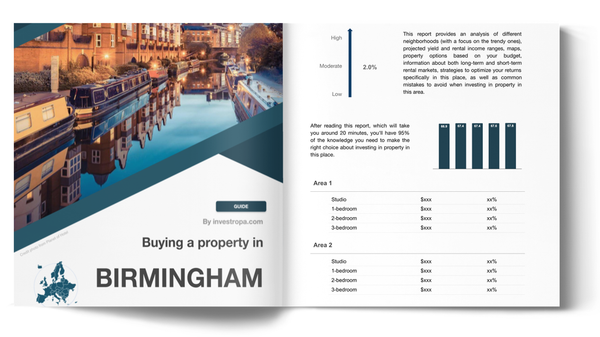
Get all the data you need about the real estate market in Birmingham
We constantly update this blog post so the Birmingham apartment prices, taxes and ownership costs stay useful for buyers reading it in 2026.
Birmingham is still one of the more affordable large UK cities for apartment buyers, but the cheapest flat is not always the safest buy.
The main thing to understand is simple: in Birmingham in 2026, service charges, lease quality and neighborhood choice can change the real cost more than the asking price alone.
And if you’re planning to buy a property in this place, you may want to download our pack covering the real estate market in Birmingham.
Insights
- Birmingham apartments in 2026 are cheaper than many UK big-city flats, but Birmingham flat prices are not rising evenly, so buyers must choose the building carefully.
- ONS data shows Birmingham flat prices were down 3.7% year on year to March 2026, which makes buyer negotiation more realistic than in stronger house segments.
- A normal two-bedroom apartment in Birmingham in 2026 costs about £185,000, but a premium city-centre new-build two-bed can easily pass £300,000.
- The biggest hidden cost for Birmingham apartment buyers is usually the service charge, especially in city-centre blocks with lifts, concierge areas or complex shared systems.
- Studios in Birmingham can look attractive because entry prices are low, but small studios can be harder to resell than one-bedroom or two-bedroom apartments.
- For many foreign buyers, the safest Birmingham apartment product is a clean resale two-bedroom flat near transport, hospitals, universities or large office areas.
- Digbeth, Perry Barr and the Jewellery Quarter have strong buyer interest, but each area is very block-specific, so street-level research matters.
- In Birmingham in 2026, a foreign non-resident buyer should not only check the apartment price, because SDLT surcharges can change the all-in budget quickly.
- A cheap Birmingham apartment with a short lease, cladding issue or large future works bill can become more expensive than a better flat bought at a higher price.
How much do apartments really cost in Birmingham in 2026?
What's the average and median apartment price in Birmingham in 2026?
As of June 2026, the average apartment price in Birmingham is about £165,000 to £175,000, or about $223,000 to $236,000 and €195,000 to €207,000, while the median apartment price is closer to £145,000 to £155,000, or about $196,000 to $209,000 and €171,000 to €183,000.
For Birmingham apartments in 2026, the average price per square meter is roughly £3,200 to £3,500, or about $4,300 to $4,700 and €3,800 to €4,100, which is about £300 to £325 per square foot, or about $405 to $440 and €355 to €385 per square foot.
Most standard apartments in Birmingham in 2026 sit between about £110,000 and £230,000, or about $149,000 to $311,000 and €130,000 to €271,000, with cheaper outer-area flats below that and prime city-centre flats above it.
Found a place and not sure about the price? Ask us.
Sources and methodology: we used UK House Price Index, ONS Birmingham housing prices and Rightmove sold prices.
We used official sold-price data as the base and portals only for local apartment detail.
We then checked the result against our own Birmingham apartment model and live-market observations.
How much is a studio apartment in Birmingham in 2026?
As of June 2026, a typical studio apartment in Birmingham costs about £110,000, or about $149,000 and €130,000, if the unit is usable, mortgageable and not in a problem block.
In Birmingham in 2026, entry-level to mid-range studios usually cost £90,000 to £125,000, or about $122,000 to $169,000 and €106,000 to €148,000, while better central or Jewellery Quarter studios can reach £125,000 to £150,000, or about $169,000 to $203,000 and €148,000 to €177,000.
A normal Birmingham studio apartment is often around 25 to 35 square meters, and very small studios below 25 square meters need extra caution because resale demand can be thinner.
Sources and methodology: we used Rightmove sold prices, Hutch Birmingham price guide and GetAgent Birmingham data.
We treated portals as local evidence, not as the official citywide trend.
We adjusted studio estimates for size, lease quality, location and our own rentability checks.
How much is a one-bedroom apartment in Birmingham in 2026?
As of June 2026, a typical one-bedroom apartment in Birmingham costs about £130,000, or about $176,000 and €153,000, for a normal resale flat in a practical location.
In Birmingham in 2026, entry-level to mid-range one-bedroom flats usually cost £95,000 to £165,000, or about $128,000 to $223,000 and €112,000 to €195,000, while high-end one-bedroom apartments in places like Brindleyplace, Mailbox and the Jewellery Quarter can reach £170,000 to £220,000, or about $230,000 to $297,000 and €201,000 to €260,000.
A typical one-bedroom apartment in Birmingham is often around 40 to 55 square meters, with compact city-centre units at the lower end and older suburban flats sometimes larger.
Sources and methodology: we used UK HPI, Rightmove and GetAgent.
We started with completed-sale direction and then added bedroom-level apartment evidence.
We also used our internal Birmingham checks to avoid overvaluing glossy city-centre listings.


Got a question about a property in United Kingdom?
Found a place and not sure about it? Tell us about it and we'll tell you what we'd check. Free, within 12 hours.
Ask us your question →
How much is a two-bedroom apartment in Birmingham in 2026?
As of June 2026, a typical two-bedroom apartment in Birmingham costs about £185,000, or about $250,000 and €218,000, which makes it the main apartment type many foreign buyers should study first.
In Birmingham in 2026, entry-level to mid-range two-bedroom apartments usually cost £125,000 to £230,000, or about $169,000 to $311,000 and €148,000 to €271,000, while high-end two-bedroom flats in Edgbaston, the Jewellery Quarter, Mailbox or canal-side schemes can cost £230,000 to £375,000, or about $311,000 to $506,000 and €271,000 to €443,000.
By the way, you will find much more detailed price ranges for apartments in our property pack covering the property market in Birmingham.
Not sure the price you're looking at is fair? Send it to us.
Sources and methodology: we used ONS Birmingham housing prices, Hutch and Rightmove sold prices.
We used two-bedroom evidence because it is usually the deepest Birmingham apartment segment.
We then compared resale, new-build and neighborhood results with our own apartment underwriting.
How much is a three-bedroom apartment in Birmingham in 2026?
As of June 2026, a typical three-bedroom apartment in Birmingham costs about £245,000, or about $331,000 and €289,000, but this segment is less liquid than one-bedroom and two-bedroom flats.
In Birmingham in 2026, entry-level to mid-range three-bedroom apartments usually cost £170,000 to £325,000, or about $230,000 to $439,000 and €201,000 to €384,000, while premium three-bedroom apartments in Edgbaston, Mailbox, Brindleyplace or strong canal-side buildings can reach £325,000 to £500,000 or more, or about $439,000 to $675,000 and €384,000 to €590,000.
A typical three-bedroom apartment in Birmingham is often around 75 to 100 square meters, and the best ones usually need parking, sensible service charges and a family-friendly layout.
Sources and methodology: we used Rightmove, GetAgent and UK HPI.
We treated three-bedroom flats separately because they compete with Birmingham houses at similar budgets.
We adjusted our estimate for scarcity, parking, lease quality and likely resale depth.
What's the price gap between new and resale apartments in Birmingham in 2026?
As of June 2026, new-build apartments in Birmingham usually cost about 15% to 25% more than comparable resale apartments, and the premium is highest in branded central schemes.
New-build apartments in Birmingham in 2026 often cost about £4,500 to £5,500 per square meter, or about $6,075 to $7,425 and €5,310 to €6,490, which is about £420 to £510 per square foot, or about $565 to $690 and €495 to €600.
Resale apartments in Birmingham in 2026 often cost about £3,200 to £4,200 per square meter, or about $4,320 to $5,670 and €3,775 to €4,955, which is about £300 to £390 per square foot, or about $405 to $525 and €355 to €460.
Sources and methodology: we used UK HPI, Rightmove and Hutch.
We compared central new-build asking levels with resale flats in similar locations.
We reduced the value of high new-build premiums when service charges looked too heavy.
Get to know the market before buying a property in Birmingham
Better information leads to better decisions. Get all the data you need before investing a large amount of money.

Can I afford to buy in Birmingham in 2026?
Got a question about the market in United Kingdom?
Prices, areas, rentals: ask us what you'd ask a friend who knows. Free reply within 12 hours.
Ask us your question →
What's the typical total budget (all-in) to buy an apartment in Birmingham in 2026?
As of June 2026, a typical all-in budget to buy a standard Birmingham apartment is about £191,000 to £198,000, or about $258,000 to $267,000 and €225,000 to €234,000, before thinking about how much mortgage debt you use.
That Birmingham all-in budget usually includes the apartment price, SDLT if due, legal fees, searches, Land Registry fees, survey, mortgage costs, leasehold checks, first repairs and a small cash buffer.
We go deeper and try to understand what costs can be avoided or minimized (and how) in our Birmingham property pack.
Stuck somewhere in the process? Tell us where you're at.
Sources and methodology: we used HMRC SDLT rates, HM Land Registry fees and ONS Birmingham prices.
We built typical purchase budgets around studio, one-bed, two-bed and three-bed price points.
We added cautious buyer costs because Birmingham leasehold flats often need deeper due diligence.
What down payment is typical to buy in Birmingham in 2026?
As of June 2026, a typical down payment for a Birmingham apartment is about 25%, which means around £46,000 on a £185,000 two-bedroom flat, or about $62,000 and €54,000.
Most UK lenders may accept lower deposits from some owner-occupiers, but foreign income buyers and buy-to-let buyers in Birmingham often need at least 25% and sometimes 30% to 40%.
A 25% to 30% down payment is usually the more comfortable target in Birmingham in 2026 because mortgage stress tests, service charges and landlord costs can make high-debt flat purchases fragile.
Sources and methodology: we used Bank of England, HMRC SDLT guidance and ONS Birmingham prices.
We used common UK mortgage practice for owner-occupier, foreign buyer and buy-to-let cases.
We then stress-tested the deposit against Birmingham rents, service charges and flat-level costs.
Buying real estate in Birmingham can be risky
An increasing number of foreign investors are showing interest. However, 90% of them will make mistakes. Avoid the pitfalls with our comprehensive guide.

Which neighborhoods are cheapest or priciest in Birmingham in 2026?
How much does the price per m² for apartments vary by neighborhood in Birmingham in 2026?
As of June 2026, apartment prices across Birmingham neighborhoods range from about £2,000 to £6,000 per square meter, or about $2,700 to $8,100 and €2,360 to €7,080, because location and building quality vary a lot.
The most affordable Birmingham apartment areas are usually Aston, Handsworth, Lozells, Erdington, Perry Barr, Northfield and Longbridge, where typical flats often sit around £2,000 to £3,200 per square meter, or about $2,700 to $4,320 and €2,360 to €3,775.
The most expensive Birmingham apartment areas are usually the City Centre core, Jewellery Quarter, Edgbaston, Harborne, Brindleyplace and Mailbox, where typical flats often sit around £3,800 to £6,000 per square meter, or about $5,130 to $8,100 and €4,485 to €7,080.
Sources and methodology: we used Rightmove sold prices, GetAgent and Hutch.
We used official data for city direction and private data for neighborhood detail.
We also checked block-level risk because Birmingham leasehold quality changes prices street by street.
Got a question nobody's answered?
Buying in United Kingdom and can't find a clear answer anywhere? Ask us. Free reply within 12 hours.
Ask us your question →What neighborhoods are best for first-time buyers on a budget in Birmingham in 2026?
As of June 2026, the top three Birmingham neighborhoods for first-time apartment buyers on a budget are Erdington, Perry Barr and Northfield or Longbridge, because entry prices are lower and everyday rental demand is still practical.
In these budget-friendly Birmingham areas, a realistic apartment price range is about £95,000 to £165,000, or about $128,000 to $223,000 and €112,000 to €195,000, depending on size, lease and building condition.
Erdington, Perry Barr and Northfield or Longbridge offer lower prices, rail or road links, shops, local tenants and more normal buildings than many high-service-charge city-centre blocks.
The trade-off is that resale growth can be more uneven, so a buyer should avoid weak blocks, poor management, short leases and streets with thin buyer demand.
Torn between areas? Tell us what you're after and we'll help you narrow it down.
Sources and methodology: we used ONS Birmingham housing prices, Rightmove and GetAgent.
We ranked areas by price, transport, rentability, resale depth and leasehold risk.
We kept the recommendation practical for foreign buyers who may not know Birmingham street by street.
Which neighborhoods have the fastest-rising apartment prices in Birmingham in 2026?
As of June 2026, the Birmingham neighborhoods with the strongest apartment-price momentum are likely Digbeth, Perry Barr and the Jewellery Quarter, although official neighborhood-level HPI is not detailed enough to prove exact flat growth.
Good flats in Digbeth may be up about 5% to 8% year on year, Perry Barr may be up about 3% to 6%, and the Jewellery Quarter may be up about 2% to 5%, but weak blocks can perform much worse.
The main growth drivers are regeneration, transport access, city-centre jobs, university and hospital demand, and buyer preference for walkable Birmingham neighborhoods with stronger lifestyle appeal.
Sources and methodology: we used ONS Birmingham data, Rightmove sold prices and GetAgent market data.
We used ONS as the control because citywide flat prices were not strongly rising.
We treated neighborhood growth as an estimate and checked it against regeneration and local demand.
Don't lose money on your property in Birmingham
100% of people who have lost money there have spent less than 1 hour researching the market. We have reviewed everything there is to know. Grab our guide now.
What extra costs will I pay on top of the apartment price in Birmingham in 2026?
What are all the buyer closing costs when you buy an apartment in Birmingham?
For a typical Birmingham apartment purchase in 2026, buyer closing costs are often about £6,000 to £8,000 for a normal owner-occupier two-bed purchase, or about $8,000 to $11,000 and €7,000 to €9,000, before the mortgage deposit.
The main Birmingham buyer costs are SDLT where applicable, legal fees, local searches, Land Registry fees, mortgage fees, survey, broker fees, leasehold pack costs and the first cash buffer for repairs or furnishing.
The largest closing cost is usually SDLT, especially if the buyer is a foreign non-resident, already owns another property, or buys the apartment as an investment.
Some costs can vary, including solicitor fees, survey level, broker fees, mortgage arrangement fees and furniture budgets, but SDLT is set by tax rules rather than negotiation.
Sources and methodology: we used HMRC SDLT, HM Land Registry fees and ONS Birmingham prices.
We calculated closing costs around typical Birmingham flat prices, not national averages only.
We added leasehold-specific costs because apartments require extra management-company checks.
Got a question about taxes in United Kingdom?
Buying costs, yearly taxes, rental income: ask us and get a clear answer within 12 hours. Free.
Ask us your question →On average, how much are buyer closing costs as a percentage of the purchase price for an apartment in Birmingham?
For a standard Birmingham apartment purchase in 2026, a normal owner-occupier should often budget about 3% to 4.5% of the purchase price for closing costs, before the mortgage deposit.
The realistic range is about 2% to 5% for many owner-occupiers, but a foreign buyer purchasing an additional property can face total buyer costs closer to 8% to 11% once SDLT surcharges are included.
We actually cover all these costs and strategies to minimize them in our pack about the real estate market in Birmingham.
Want us to check the numbers for your case? Write to us, it's free.
Sources and methodology: we used HMRC residential SDLT rates, HMRC higher rates guidance and ONS Birmingham prices.
We separated owner-occupier, additional-property and non-resident cases.
We used rounded percentages because exact SDLT depends on each buyer’s legal position.
Thinking of buying real estate in Birmingham?
Acquiring property in a different country is a complex task. Don't fall into common traps – grab our guide and make better decisions.
What are the ongoing monthly and yearly costs of an apartment in Birmingham in 2026?
What are typical HOA fees in Birmingham right now?
HOA fees are not the normal term in Birmingham, because apartment owners usually pay a leasehold service charge instead, and a normal Birmingham apartment service charge in 2026 is often about £125 to £210 per month, or about $170 to $285 and €150 to €250.
For Birmingham apartments in 2026, basic buildings may charge about £75 to £135 per month, or about $100 to $180 and €90 to €160, while city-centre lift, concierge or gym buildings can charge £210 to £375 per month, or about $285 to $505 and €250 to €445.
Sources and methodology: we used GOV.UK leasehold service charge guidance, Rightmove listings and GetAgent.
We used listing evidence because official datasets do not publish clean Birmingham service-charge averages.
We checked charges against building type, amenities, lift risk and likely major-works exposure.
What utilities should I budget monthly in Birmingham right now?
As of June 2026, a typical Birmingham apartment utility budget is about £170 to £240 per month for a two-bedroom flat, or about $230 to $325 and €200 to €285.
The realistic Birmingham apartment utility range is about £120 to £160 per month for a studio, £140 to £190 for a one-bed, £170 to £240 for a two-bed and £220 to £300 for a larger three-bed.
This Birmingham monthly utility budget normally includes electricity, gas where used, water and sewerage, broadband and small household media costs, but not council tax.
The most expensive utility is usually electricity and gas, especially if the apartment is all-electric, poorly insulated or has old storage heating.
Sources and methodology: we used Ofgem, Severn Trent charges and ONS Birmingham data.
We scaled the typical household energy cap down for smaller flats.
We used Severn Trent because it is the main water and wastewater supplier for Birmingham.
Buying real estate in United Kingdom?
Ask us anything about your purchase: taxes, contracts, banks, permits. A real person replies within 12 hours, for free.
Ask us your question →How much is property tax on apartments in Birmingham?
As of June 2026, the typical annual property tax for a Birmingham apartment is council tax of about £1,570 to £2,090 per year for Bands A to C, or about $2,120 to $2,820 and €1,850 to €2,470.
Birmingham council tax is not a simple percentage of the apartment value, because the charge is based on the property’s council tax band and the yearly rate set by Birmingham City Council.
The realistic annual council tax range for Birmingham apartments in 2026/27 is about £1,570 for Band A to about £2,350 for Band D, or about $2,120 to $3,175 and €1,850 to €2,775, with premium flats sometimes higher.
Sources and methodology: we used Birmingham City Council, GOV.UK council tax bands and ONS Birmingham housing prices.
We mapped typical Birmingham flats to Bands A, B and C.
We separated council tax from investor costs because tenants usually pay it in normal rentals.
What's the yearly building maintenance cost in Birmingham?
As of June 2026, a typical Birmingham apartment owner should budget about £800 to £1,500 per year for owner-level maintenance, or about $1,080 to $2,025 and €945 to €1,770, on top of the service charge.
The realistic yearly range is about £500 to £900 for a simple modern flat, £800 to £1,500 for a normal resale flat and £1,200 to £2,000 for an older or tenanted Birmingham flat.
These costs usually cover internal repairs, appliances, small plumbing or electrical issues, redecorating, tenant wear and tear, and a reserve for surprises.
For leasehold Birmingham apartments, building-level maintenance is normally included in the service charge, but major works can still create extra bills through the leasehold process.
Sources and methodology: we used GOV.UK leasehold guidance, Rightmove listings and ONS Birmingham prices.
We separated owner repairs from block service charges to avoid double counting.
We added caution for lifts, roofs, cladding, windows and Section 20 major-works risk.
How much does home insurance cost in Birmingham?
As of June 2026, a typical Birmingham apartment owner may pay about £150 to £300 per year for direct insurance cover, or about $200 to $405 and €175 to €355, if block buildings insurance is already inside the service charge.
The realistic annual range is about £90 to £180 for contents-only cover, £120 to £250 for landlord contents or fixtures cover and £300 to £450 for wider combined cover where needed.
Home insurance is not always legally mandatory for a Birmingham flat owner, but lenders usually expect suitable cover, and leasehold buildings insurance is often arranged by the freeholder or management company.
Sources and methodology: we used ABI insurance data, ABI home insurance update and GOV.UK leasehold guidance.
We adjusted UK home-insurance benchmarks for Birmingham flats and leasehold buildings cover.
We treated landlord insurance separately because investors need different protection from owner-occupiers.
Get the full checklist for your due diligence in Birmingham
Don't repeat the same mistakes others have made before you. Make sure everything is in order before signing your sales contract.
What sources have we used to write this blog article?
Whether it’s in our blog articles or the market analyses included in our property pack about Birmingham, we always rely on the strongest methodology we can, and we don’t throw out numbers at random.
We also aim to be fully transparent, so below we’ve listed the authoritative sources we used, and explained how we used them and the methods behind our estimates.
| Source | Why this source matters | How we used it |
|---|---|---|
| UK House Price Index / HM Land Registry | It is the official sold-price index for England. | We used it to anchor Birmingham price direction to completed sales. We did not use asking prices as the main trend. |
| ONS housing prices in Birmingham | It republishes official HPI data in a local format. | We used it to check Birmingham flat-price movement. We used the March 2026 release as the latest housing-price anchor for this article date. |
| ONS UK HPI monthly price statistics | It provides the downloadable official HPI dataset. | We used it to cross-check timing and national context. We used it to avoid relying only on property portals. |
| Rightmove sold prices in Birmingham | It republishes recent Land Registry sold-price records. | We used it for local comparable sales and neighborhood texture. We did not use it alone for citywide trends. |
| Rightmove Birmingham flat listings | It shows live asking prices and service-charge clues. | We used it to understand current stock and buyer choice. We treated listing prices as market color, not final sale values. |
| Hutch Birmingham price guide | It gives apartment-specific local market estimates. | We used it for bedroom-level apartment pricing. We cross-checked its figures against official sold-price direction. |
| GetAgent Birmingham market data | It aggregates local agent and market data. | We used it as a private-sector check on flat values. We used it only where official data was too broad. |
| ONS Price Index of Private Rents | It is the official UK private-rent dataset. | We used it to benchmark rent levels and rent inflation. We used rent evidence to sense-check yields. |
| VOA private rental market statistics | VOA rent officers collect official rental evidence. | We used it to validate bedroom-level rent assumptions. We treated it as a key evidence base behind rent estimates. |
| Home.co.uk Birmingham rental prices | It gives live asking-rent market detail. | We used it to understand current asking-rent pressure. We did not treat asking rents as guaranteed achieved rents. |
| Zoopla rental market report | It tracks current rental-market conditions across the UK. | We used it for rental-market context. We used official ONS data where we needed stronger rent anchoring. |
| HMRC SDLT residential rates | HMRC is the UK tax authority for SDLT. | We used it for stamp duty bands and buyer tax costs. We separated owner-occupier, additional-property and non-resident cases. |
| HMRC higher rates for additional dwellings | It explains the extra SDLT rules for second homes. | We used it to estimate additional-property costs. We made clear that buyer status changes the total bill. |
| Birmingham City Council council tax bands | It is the local billing authority for council tax. | We used it for 2026/27 yearly council tax costs. We mapped typical Birmingham apartments to Bands A to C. |
| Ofgem energy price cap | Ofgem is the official energy regulator for Great Britain. | We used it to estimate electricity and gas budgets. We adjusted the typical-household cap down for smaller flats. |
| Severn Trent household charges | Severn Trent is Birmingham’s main water supplier. | We used it for water and sewerage costs. We converted yearly household charges into a monthly apartment budget. |
| Association of British Insurers industry data | ABI is the UK insurance industry’s main data body. | We used it for home-insurance benchmarks. We adjusted the averages for Birmingham leasehold flats. |
| GOV.UK leasehold service charge guidance | It explains service charges for leasehold property. | We used it to explain how apartment service charges work. We separated service charges from owner-level maintenance. |
Get fresh and reliable information about the market in Birmingham
Don't base significant investment decisions on outdated data. Get updated and accurate information.
