
Authored by the expert who managed and guided the team behind the United Kingdom Property Pack
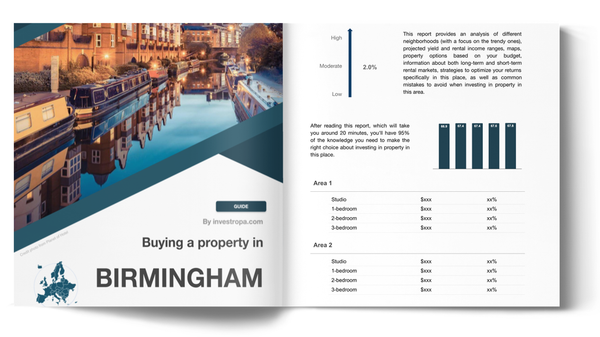
Yes, the analysis of Birmingham's property market is included in our pack
Buying property in Birmingham as a foreigner comes with extra costs that can catch you off guard if you're not prepared.
We constantly update this blog post to reflect the latest tax rates, fees, and market conditions in Birmingham.
This guide breaks down every cost, tax, and fee you'll face when purchasing residential property in Birmingham in 2026.
And if you're planning to buy a property in this place, you may want to download our pack covering the real estate market in Birmingham.
Overall, how much extra should I budget on top of the purchase price in Birmingham in 2026?
How much are total buyer closing costs in Birmingham in 2026?
As of early 2026, total buyer closing costs in Birmingham typically range from 3% to 10% of the purchase price (around £7,000 to £23,500, or $8,900 to $29,850 USD, or €8,250 to €27,700 EUR on a typical £235,000 Birmingham property), depending heavily on your residency status and whether you already own property elsewhere.
If you keep expenses to the bare minimum as a UK-resident cash buyer purchasing your only home in Birmingham, you could get away with around £2,000 to £5,000 (roughly $2,500 to $6,350 USD or €2,350 to €5,900 EUR) in closing costs excluding Stamp Duty.
However, if you're a non-UK resident buying an additional property in Birmingham, you should realistically plan for £15,000 to £22,000 (approximately $19,000 to $27,950 USD or €17,700 to €26,000 EUR) in total closing costs including the stacked Stamp Duty surcharges.
The main factors that push your Birmingham closing costs toward the low or high end include your UK residency status, whether this is your only property worldwide, whether you're buying leasehold or freehold, the survey level you choose, and whether you need mortgage-related fees.
What's the usual total % of fees and taxes over the purchase price in Birmingham?
For foreign buyers purchasing property in Birmingham in 2026, the usual total percentage of fees and taxes ranges from about 3% to 10% of the purchase price, with most non-UK resident buyers landing somewhere around 5% to 7%.
This range covers most standard Birmingham property transactions, though UK-resident first-time buyers at the lower end might pay closer to 1% to 3%, while non-resident investors buying second homes could exceed 10% on higher-value properties.
Government taxes (primarily Stamp Duty Land Tax) typically make up the largest share at 60% to 80% of your total extra costs in Birmingham, while professional service fees like conveyancing, surveys, and Land Registry account for the remaining 20% to 40%.
By the way, you will find much more detailed data in our property pack covering the real estate market in Birmingham.
What costs are always mandatory when buying in Birmingham in 2026?
As of early 2026, the mandatory costs when buying property in Birmingham include conveyancing solicitor fees, local authority searches and disbursements, HM Land Registry registration fees, Stamp Duty Land Tax (if your purchase triggers it), and VAT at 20% on most professional services.
While technically optional, a professional home survey is highly recommended in Birmingham (especially for older Victorian terraces and properties in areas like Moseley, Kings Heath, or Bournville), along with specialist checks for damp, electrics, or roof issues if the survey flags concerns, and translation or interpreter services if English is not your first language.
Don't lose money on your property in Birmingham
100% of people who have lost money there have spent less than 1 hour researching the market. We have reviewed everything there is to know. Grab our guide now.

What taxes do I pay when buying a property in Birmingham in 2026?
What is the property transfer tax rate in Birmingham in 2026?
As of early 2026, the property transfer tax in Birmingham (called Stamp Duty Land Tax or SDLT) is charged in bands: 0% up to £125,000, then 2% on the portion from £125,001 to £250,000, 5% from £250,001 to £925,000, 10% from £925,001 to £1.5 million, and 12% above £1.5 million.
Yes, foreign buyers who are not UK-resident face an extra 2% SDLT surcharge on top of every band, which on a typical £235,000 Birmingham property adds roughly £4,700 (around $5,970 USD or €5,550 EUR) to your tax bill.
Buyers generally do not pay VAT on the sale price of a residential home in Birmingham (resale properties are VAT-exempt), but you will pay 20% VAT on related professional services like solicitors, surveyors, and some search fees.
Stamp Duty in Birmingham is due after completion, and your conveyancing solicitor handles the filing and payment on your behalf using funds from your completion money, so you don't need to pay it separately yourself.
Are there tax exemptions or reduced rates for first-time buyers in Birmingham?
First-time buyers in Birmingham may qualify for First-Time Buyers' Relief, which can reduce or eliminate SDLT on properties up to certain price thresholds, though specific relief amounts depend on the rules in force at your purchase date.
If you buy property in Birmingham through a company rather than as an individual, you may face different SDLT regimes and potentially higher effective rates, plus different taxation on rental income and capital gains, making professional tax advice essential.
There is no SDLT difference between buying a new-build property versus a resale property in Birmingham, as the tax is based purely on the transaction price and your buyer status rather than the property's age.
To qualify for first-time buyer relief in Birmingham, you must never have owned property anywhere in the world before, you must intend to live in the property as your main residence, and you must stay within the applicable price caps, which your conveyancing solicitor will verify during the transaction.

We did some research and made this infographic to help you quickly compare rental yields of the major cities in the UK versus those in neighboring countries. It provides a clear view of how this country positions itself as a real estate investment destination, which might interest you if you’re planning to invest there.
Which professional fees will I pay as a buyer in Birmingham in 2026?
How much does a notary or conveyancing lawyer cost in Birmingham in 2026?
As of early 2026, a conveyancing solicitor or licensed conveyancer in Birmingham typically costs between £1,000 and £2,500 (roughly $1,270 to $3,175 USD or €1,180 to €2,950 EUR) including VAT and standard disbursements, with leasehold properties adding around £300 or more to that total.
Conveyancing fees in Birmingham are usually charged as a combination of a flat legal fee plus variable disbursements (like search fees), rather than as a straight percentage of the property price.
Translation or interpreter services for foreign buyers in Birmingham typically cost between £150 and £500 (around $190 to $635 USD or €175 to €590 EUR), depending on the language, urgency, and whether you need certified document translations.
If you're a non-UK resident buying in Birmingham, a short tax consultation is often worthwhile and typically costs £200 to £600 (roughly $255 to $760 USD or €235 to €710 EUR) for initial advice, with more complex structuring work costing additional fees.
We have a whole part dedicated to these topics in our real estate pack about Birmingham.
What's the typical real estate agent fee in Birmingham in 2026?
As of early 2026, buyers in Birmingham typically pay nothing in estate agent fees because the seller, not the buyer, covers the agent commission in almost all English property transactions.
This means that as a foreign buyer purchasing property in Birmingham, you can budget £0 ($0 USD, €0 EUR) for buyer-side agent commission, which is a significant difference from many other countries where buyers share this cost.
Seller-paid estate agent fees in Birmingham typically range from 0.75% to 3% of the sale price plus VAT, but again, this is the seller's expense and not something that directly affects your closing cost budget as a buyer.
How much do legal checks cost (title, liens, permits) in Birmingham?
Legal checks in Birmingham, including title search, local authority search, water and drainage searches, and environmental checks, typically cost between £300 and £700 (roughly $380 to $890 USD or €355 to €825 EUR) when bundled as part of your conveyancing disbursements.
A property valuation in Birmingham costs nothing to around £500 ($635 USD, €590 EUR) if your mortgage lender charges for their valuation, while an independent buyer's survey ranges from £400 to £1,500 (approximately $510 to $1,905 USD or €470 to €1,770 EUR) depending on the survey level and property complexity.
The most critical check you should never skip in Birmingham is the local authority search, which reveals planning restrictions, nearby developments, road adoption status, and other issues that could significantly affect your property's value or your ability to use it as intended.
Get the full checklist for your due diligence in Birmingham
Don't repeat the same mistakes others have made before you. Make sure everything is in order before signing your sales contract.
What hidden or surprise costs should I watch for in Birmingham right now?
What are the most common unexpected fees buyers discover in Birmingham?
The most common unexpected fees buyers discover in Birmingham include leasehold administration charges (notice fees, deed of covenant fees, management pack fees), survey-triggered repair costs for damp or roof issues in older properties, unadopted road charges, and bank transfer fees of £25 to £50 per CHAPS payment.
While you generally won't inherit the previous owner's Council Tax arrears in Birmingham, you can inherit property-attached problems like lease disputes, service charge arrears, or charges that must be cleared at completion, which your conveyancer should identify and resolve before you take ownership.
Scams do occur in Birmingham's property market, most commonly through fake "landlord abroad" stories pressuring quick deposits, or fraudulent bank detail changes sent right before completion, so you should always verify payment details by phone using a number you trust rather than one provided in an email.
Fees that are often not disclosed upfront in Birmingham include leasehold management pack charges (which can cost £200 to £500), additional legal fees for title defects or missing certificates, and specialist follow-up inspections if your initial survey flags concerns.
In our property pack covering the property buying process in Birmingham, we go into details so you can avoid these pitfalls.
Are there extra fees if the property has a tenant in Birmingham?
If you buy a property with a tenant in place in Birmingham, you may face extra legal fees of £200 to £500 (around $255 to $635 USD or €235 to €590 EUR) for reviewing the existing tenancy agreement and checking compliance documents like gas safety certificates and deposit protection.
When purchasing a tenanted property in Birmingham, you inherit all the landlord's legal obligations including maintaining the deposit in a protected scheme, honoring the existing tenancy terms, and ensuring the property meets all safety and licensing requirements.
You generally cannot terminate an existing tenancy immediately after purchase in Birmingham because you must honor the current lease terms, and even after the fixed term ends, you must follow proper legal notice procedures which typically require at least two months' notice.
A sitting tenant in Birmingham typically reduces the property's market value by 10% to 20% compared to vacant possession, which can give you more negotiating power, but you'll need to factor in the time and potential costs of regaining vacant possession if that's your goal.

We have made this infographic to give you a quick and clear snapshot of the property market in the UK. It highlights key facts like rental prices, yields, and property costs both in city centers and outside, so you can easily compare opportunities. We’ve done some research and also included useful insights about the country’s economy, like GDP, population, and interest rates, to help you understand the bigger picture.
Which fees are negotiable, and who really pays what in Birmingham?
Which closing costs are negotiable in Birmingham right now?
The negotiable closing costs in Birmingham include your conveyancing solicitor's legal fee (not the disbursements), the survey fee if you shop around, and mortgage arrangement fees if you choose a different product with lower upfront costs.
The non-negotiable costs fixed by law in Birmingham include Stamp Duty Land Tax (set by HMRC), Land Registry registration fees (set by government schedule), and most third-party search fees which are charged at fixed rates by local authorities and utility companies.
On negotiable fees in Birmingham, buyers can typically achieve savings of 10% to 20% by getting multiple conveyancing quotes, choosing online conveyancers over high-street firms, or bundling services, though the savings on professional fees rarely exceed a few hundred pounds.
Can I ask the seller to cover some closing costs in Birmingham?
While you can ask a seller to cover closing costs in Birmingham, it's relatively uncommon and most sellers will prefer to negotiate through a price reduction or agree to pay for specific remedial work revealed by your survey rather than writing you a separate cheque for your costs.
Sellers in Birmingham are most commonly willing to contribute toward costs directly linked to the property's condition, such as repairs flagged by the survey, replacing a boiler, or fixing a roof issue, rather than covering your legal or tax costs.
Sellers become more likely to accept covering some closing costs in Birmingham when the property has been on the market for a long time, when there are multiple issues flagged in the survey, when the market is slower (typically winter months), or when they're under time pressure to complete.
Is price bargaining common in Birmingham in 2026?
As of early 2026, price bargaining is fairly common in Birmingham compared to hotter London micro-markets, with most properties having some room for negotiation depending on condition, location within the city, and how long the property has been listed.
Buyers in Birmingham typically negotiate around 2% to 5% below the asking price (roughly £4,700 to £11,750, or $5,970 to $14,920 USD, or €5,550 to €13,865 EUR on a £235,000 property), with discounts of 5% or more possible for properties needing work or those with leasehold complications in areas like Erdington, Kingstanding, or outer suburbs.
Don't sign a document you don't understand in Birmingham
Buying a property over there? We have reviewed all the documents you need to know. Stay out of trouble - grab our comprehensive guide.
What monthly, quarterly or annual costs will I pay as an owner in Birmingham?
What's the realistic monthly owner budget in Birmingham right now?
A realistic monthly owner budget in Birmingham ranges from £300 to £600 (roughly $380 to $760 USD or €355 to €710 EUR) for a typical property, covering Council Tax, utilities, insurance, and a maintenance reserve.
The main recurring expense categories that make up this monthly budget in Birmingham include Council Tax (varies by band), buildings and contents insurance, gas and electricity, water rates, broadband, and if leasehold, your service charge and any ground rent.
Monthly owner costs in Birmingham range from around £200 to £400 ($255 to $510 USD, €235 to €470 EUR) for a small freehold terrace with low Council Tax, up to £600 to £1,000+ ($760 to $1,270+ USD, €710 to €1,180+ EUR) for a larger leasehold apartment with high service charges in areas like the Jewellery Quarter or city centre.
Service charges tend to vary the most in Birmingham because they depend entirely on what the building provides (lifts, concierge, communal gardens, parking) and how well the management company controls costs, with some Birmingham city centre apartments having service charges exceeding £3,000 per year.
What is the annual property tax amount in Birmingham in 2026?
As of early 2026, annual property tax in Birmingham (called Council Tax) ranges from around £1,300 to £4,000+ (roughly $1,650 to $5,080+ USD or €1,535 to €4,720+ EUR) depending on your property's Council Tax band, which Birmingham City Council sets based on the property's 1991 valuation.
The realistic range for annual Council Tax in Birmingham runs from about £1,300 (Band A, the lowest) to over £4,000 (Band H, the highest), with most Birmingham properties falling into Bands A through D, meaning typical annual bills of £1,300 to £2,200 ($1,650 to $2,790 USD, €1,535 to €2,600 EUR).
Council Tax in Birmingham is calculated based on which of eight bands (A through H) your property falls into, with bands determined by the property's estimated market value as of April 1991, not its current market value.
Some exemptions or reductions are available in Birmingham, including a 25% single-person discount if you live alone, potential exemptions for students, disabled persons' reductions, and Council Tax Support for those on low incomes, which your conveyancer or the council can help you assess.

We created this infographic to give you a simple idea of how much it costs to buy property in different parts of the UK. As you can see, it breaks down price ranges and property types for popular cities in the country. We hope this makes it easier to explore your options and understand the market.
If I rent it out, what extra taxes and fees apply in Birmingham in 2026?
What tax rate applies to rental income in Birmingham in 2026?
As of early 2026, rental income from Birmingham property is taxed as part of your total income at standard UK Income Tax rates: 20% basic rate, 40% higher rate, or 45% additional rate, depending on your overall taxable income.
Landlords in Birmingham can deduct allowable expenses from rental income before calculating tax, including letting agent fees, insurance, repairs and maintenance (not improvements), some finance costs, and professional fees, which HMRC details in their property income guidance.
After deductions, the realistic effective tax rate for typical Birmingham landlords ranges from around 15% to 35% of gross rental income, depending on your marginal tax rate and how many allowable expenses you can claim.
Foreign property owners renting out in Birmingham pay the same Income Tax rates as UK residents, but face additional reporting requirements through the Non-Resident Landlord Scheme, where letting agents typically withhold 20% tax unless you register for self-assessment and receive approval to receive rent gross.
Do I pay tax on short-term rentals in Birmingham in 2026?
As of early 2026, short-term rental income from Birmingham property (such as Airbnb) is taxable as property income, and you must report it through Self Assessment if your gross rental income exceeds £1,000 (the property income allowance).
Short-term rental income in Birmingham is generally taxed the same way as long-term rental income under Income Tax rules, though if your turnover from short-term holiday-type accommodation becomes high enough, you may also need to consider VAT registration requirements under HMRC's holiday accommodation rules.
One Birmingham-specific consideration for landlords is that many wards in the city require a selective licence before you can legally rent out property, which costs several hundred pounds and adds a compliance layer that doesn't exist in most other English cities.
Get to know the market before buying a property in Birmingham
Better information leads to better decisions. Get all the data you need before investing a large amount of money.

If I sell later, what taxes and fees will I pay in Birmingham in 2026?
What's the total cost of selling as a % of price in Birmingham in 2026?
As of early 2026, the total cost of selling a property in Birmingham typically ranges from 1% to 3% of the sale price, which on a £235,000 property means around £2,350 to £7,050 (roughly $2,985 to $8,950 USD or €2,775 to €8,320 EUR).
The realistic range for total selling costs in Birmingham runs from about 1% (if you use a low-cost online agent and have no mortgage to repay) up to 3% or more (if you use a premium high-street agent, have early mortgage repayment charges, and face leasehold-related fees).
The specific cost categories that make up this total in Birmingham include estate agent commission (typically 0.75% to 1.5% plus VAT), conveyancing solicitor fees for the sale side (£500 to £1,000), Energy Performance Certificate if needed (£60 to £120), and potentially mortgage exit fees (varies by lender).
The single largest cost when selling in Birmingham is almost always the estate agent's commission, which typically accounts for 50% to 70% of your total selling expenses.
What capital gains tax applies when selling in Birmingham in 2026?
As of early 2026, Capital Gains Tax (CGT) on residential property in Birmingham is charged at 18% for basic-rate taxpayers and 24% for higher-rate taxpayers on the gain above your annual exempt amount (currently £3,000 per year).
The main exemption available in Birmingham is Private Residence Relief, which means you pay no CGT if the property has been your only or main home throughout the entire ownership period, though partial relief may apply if you lived there for part of the time.
Foreign sellers do not face a specific additional CGT surcharge in Birmingham the way they face the 2% SDLT surcharge when buying, but non-UK residents must report and pay any CGT within 60 days of completion through the UK Property Disposal service, whereas UK residents report through normal Self Assessment.
Capital gains in Birmingham are calculated as the sale price minus your original purchase price, minus allowable costs like buying and selling fees, and minus the cost of any qualifying improvements (but not repairs or maintenance), with inflation adjustments no longer available for residential property.

We made this infographic to show you how property prices in the UK compare to other big cities across the region. It breaks down the average price per square meter in city centers, so you can see how cities stack up. It’s an easy way to spot where you might get the best value for your money. We hope you like it.
What sources have we used to write this blog article?
Whether it's in our blog articles or the market analyses included in our property pack about Birmingham, we always rely on the strongest methodology we can … and we don't throw out numbers at random.
We also aim to be fully transparent, so below we've listed the authoritative sources we used, and explained how we used them and the methods behind our estimates.
| Source | Why it's authoritative | How we used it |
|---|---|---|
| GOV.UK SDLT Residential Rates | It's the official UK government page setting the Stamp Duty tax bands. | We used it as the base tax schedule for Birmingham property purchases. We then layered on the foreign-buyer and second-home surcharges to estimate realistic purchase tax amounts. |
| GOV.UK Non-UK Resident SDLT Surcharge | It's HMRC's official guidance for the extra charge when the buyer is not UK-resident. | We used it to quantify the 2% foreigner premium on Birmingham purchases. We also used it to explain when refunds may be available if you later meet the UK residence test. |
| GOV.UK Additional Dwellings SDLT | It's the official rulebook for the 3% SDLT surcharge on second homes. | We used it to show the step-change in tax if Birmingham is not your only home. We combined it with the non-resident surcharge to build worst-case SDLT budgets. |
| Office for National Statistics Birmingham House Prices | ONS is the UK's official statistics agency with Birmingham-specific figures. | We used it to anchor examples to a realistic Birmingham price level of £235,000. We used the latest available local average to convert fees into real pound amounts. |
| Birmingham City Council Tax Bands | It's the local authority's official bill schedule for Birmingham. | We used it to estimate realistic ongoing annual ownership costs. We also used it to explain why Council Tax depends on your property's band from A to H. |
| HM Land Registry Fees | It's the official schedule of Land Registry fees for registering ownership. | We used it to estimate unavoidable post-completion registration costs. We also used it to explain why the fee changes with purchase price and filing method. |
| HomeOwners Alliance Conveyancing Fees | It's a widely used UK consumer housing resource with transparent fee breakdowns. | We used it to triangulate typical solicitor and conveyancing totals. We used it to set realistic closing-cost ranges for both cash and mortgage buyers in Birmingham. |
| RICS Home Survey Guide | RICS is the UK's professional body for surveyors setting widely used standards. | We used it to justify why a survey is strongly recommended for Birmingham's older housing stock. We used it to frame survey cost ranges by survey level and property complexity. |
| GOV.UK Capital Gains Tax Rates | It's the official reference for CGT rates and the annual exempt amount. | We used it to estimate what you could owe if you sell a Birmingham investment property. We also used it to describe the headline rates that apply to residential property gains. |
| Birmingham City Council Selective Licensing | It's the city's official policy page for landlord licensing requirements. | We used it to flag a uniquely Birmingham cost for landlords in designated wards. We used it to explain that licensing fees apply before you can legally rent out in many areas. |
Get fresh and reliable information about the market in Birmingham
Don't base significant investment decisions on outdated data. Get updated and accurate information.
