
Authored by the expert who managed and guided the team behind the United Kingdom Property Pack
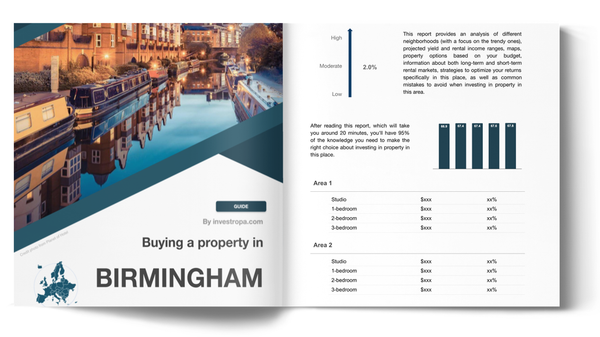
Yes, the analysis of Birmingham's property market is included in our pack
Birmingham in early 2026 is one of the UK's best "value big cities" for expats: you get major-city jobs, a big international population, and better housing value than London, all while being well connected nationally by rail.
We constantly update this blog post to make sure you have the freshest information available, so you can plan your move with confidence.
And if you're planning to buy a property in this place, you may want to download our pack covering the real estate market in Birmingham.
Is Birmingham a good place to live in 2026?
Is quality of life getting better or worse in Birmingham in 2026?
As of early 2026, quality of life in Birmingham is broadly stable to slowly improving for expats who choose the right neighborhood and can afford a decent rental.
The biggest improvement over the past two to three years has been the city's continued reinvention, with major transport upgrades including metro extensions, a revitalized city centre, and a food and cultural scene that now rivals much larger European cities.
The persistent challenge, however, is housing costs, with rents rising around 5% year-on-year in late 2025 and competition for good flats in popular neighborhoods like Harborne and Edgbaston remaining fierce.
Are hospitals good in Birmingham in 2026?
As of early 2026, Birmingham hospitals meet or exceed Western European standards for specialist and emergency care, thanks to the city being a major NHS hub with teaching hospitals and tertiary referral centres.
The hospitals expats most commonly use include Queen Elizabeth Hospital Birmingham (a major trauma and specialist centre), Birmingham Children's Hospital for families, and for private care, The Harborne Hospital (HCA UK) and Spire Parkway Hospital.
A standard private GP appointment in Birmingham in 2026 typically costs around 90 to 120 GBP (roughly 105 to 140 USD or 100 to 130 EUR), while NHS GP visits are free once you are registered and eligible through the Immigration Health Surcharge.
Private health insurance is not strictly necessary for expats paying the Immigration Health Surcharge (1,035 GBP per year for most adult visa routes), but many expats find it worthwhile for faster diagnostics, specialist access, and private rooms.


Ask us about United Kingdom
Buying property there and stuck on something? Tell us, and we'll reply within 12 hours. Free.
Ask us your question →
Are there any good international schools in Birmingham in 2026?
As of early 2026, Birmingham has a strong selection of independent schools rather than traditional "international schools," with several top-tier options offering IB programmes or highly regarded British curricula that serve expat families well.
The most reputable schools among expat families include King Edward's School (Edgbaston), King Edward VI High School for Girls (Edgbaston), and Solihull School, all of which have strong university placement records and welcome international students.
Typical annual tuition fees for these top independent schools in Birmingham range from 15,000 to 22,000 GBP per year for day places (roughly 17,500 to 25,500 USD or 17,000 to 24,000 EUR), with boarding options costing significantly more.
Waitlists at the most sought-after independent schools are competitive and often require applying 6 to 18 months in advance, while state schools remain a viable option for expats willing to rent in the right catchment area.
Is Birmingham a dangerous place in 2026?
As of early 2026, Birmingham has a higher-than-average crime rate for a UK city (around 107 crimes per 1,000 people), but most day-to-day life is perfectly safe, especially in the residential neighborhoods where expats typically settle.
The most common safety concerns for expats are theft from the person in crowded city-centre areas like the Bullring and New Street Station, vehicle crime (which is 179% above the national average), and occasional antisocial behaviour near late-night venues.
The neighborhoods generally considered safest for expats include Harborne, Edgbaston, Moseley, Bournville, Sutton Coldfield, and the Jewellery Quarter, all of which combine good housing stock, walkability, and lower crime rates.
Women can generally live alone safely in Birmingham, especially in the recommended neighborhoods, though standard urban precautions like avoiding poorly lit areas late at night and staying aware in crowded transport hubs are sensible.
Thinking of buying real estate in Birmingham?
Acquiring property in a different country is a complex task. Don't fall into common traps – grab our guide and make better decisions.

How much does everyday life cost in Birmingham in 2026?
What monthly budget do I need to live well in Birmingham in 2026?
As of early 2026, a single person needs around 2,400 to 2,900 GBP per month (roughly 2,800 to 3,400 USD or 2,700 to 3,200 EUR) to live comfortably in Birmingham, including a good one-bedroom flat in a nice area plus regular social activities.
For a modest but decent lifestyle, a single person can manage on around 1,800 to 2,200 GBP per month (roughly 2,100 to 2,550 USD or 2,000 to 2,400 EUR), though this means a smaller flat in a less central location and careful spending on restaurants and entertainment.
For a more comfortable or upscale lifestyle with a higher-end flat, frequent dining out, and regular weekend travel, budget around 3,300 to 4,000 GBP per month (roughly 3,850 to 4,650 USD or 3,650 to 4,400 EUR) for a single person, or 5,000 to 5,500 GBP for a couple.
Housing is by far the largest expense in Birmingham, with average monthly rents reaching around 1,085 GBP in late 2025, followed by transport costs which can run 64 to 100 GBP monthly depending on whether you use bus passes or train combinations.
Got a question about property in United Kingdom?
Buying, owning or renting out: ask us and get a real answer within 12 hours. Free.
Ask us your question →
What is the average income tax rate in Birmingham in 2026?
As of early 2026, a typical middle-income earner in Birmingham making 45,000 GBP gross pays an effective combined tax and National Insurance rate of around 20%, leaving approximately 36,000 GBP net per year (about 3,000 GBP per month).
The UK income tax brackets range from 0% on the first 12,570 GBP (personal allowance), then 20% on income from 12,571 to 50,270 GBP, 40% on income from 50,271 to 125,140 GBP, and 45% on income above that threshold.
Taxes are where people get surprised. Tell us your situation and we'll tell you what to expect.

We did some research and made this infographic to help you quickly compare rental yields of the major cities in the UK versus those in neighboring countries. It provides a clear view of how this country positions itself as a real estate investment destination, which might interest you if you’re planning to invest there.
What kind of foreigners actually live in Birmingham in 2026?
Where do most expats come from in Birmingham in 2026?
As of early 2026, the largest expat communities in Birmingham come from South Asia (particularly India, Pakistan, and Bangladesh), followed by significant populations from Poland, Ireland, Jamaica, and increasingly from Afghanistan and other regions.
Birmingham has approximately 238,000 non-UK born residents, making up around 22 to 24% of the city's total population of roughly 1.14 million people, which is one of the highest proportions outside London.
The main reasons expats from these countries are drawn to Birmingham include established community networks, major universities, NHS employment opportunities, and the city's role as a professional services and manufacturing hub.
The expat population in Birmingham is predominantly a mix of working professionals (especially in healthcare, education, and tech), students at the city's five universities, and family migration, rather than retirees or digital nomads.
Where do most expats live in Birmingham in 2026?
As of early 2026, expats in Birmingham tend to concentrate in Edgbaston (leafy and close to hospitals/university), Harborne (village feel with a great high street), Moseley and Kings Heath (cafes and creative scene), the Jewellery Quarter (stylish city-adjacent apartments), and Sutton Coldfield (suburban and family-friendly).
What makes these neighborhoods attractive is the combination of good housing stock, walkable amenities, reliable public transport links, proximity to international schools or universities, and measurably lower crime rates than inner-city areas.
Emerging neighborhoods gaining popularity among expats include Stirchley (a former industrial area now known for craft breweries and indie food spots) and Digbeth (creative quarter with new apartment developments appealing to younger professionals).
Got a question about the market in United Kingdom?
Prices, areas, rentals: ask us what you'd ask a friend who knows. Free reply within 12 hours.
Ask us your question →Are expats moving in or leaving Birmingham in 2026?
As of early 2026, Birmingham is experiencing a modest net inflow of expats, though the pace has slowed compared to 2022-2023 due to tighter UK visa rules and rising living costs.
The main factor driving expats to Birmingham right now is its value proposition compared to London: similar job opportunities in professional services, healthcare, and tech, but with significantly lower rent (around 40% less than London on average).
The main factor causing some expats to leave Birmingham recently is the increasing cost of the Immigration Health Surcharge (now 1,035 GBP per year), proposed changes extending the path to settlement from 5 to 10 years, and general cost-of-living pressures.
Compared to similar UK cities like Manchester and Leeds, Birmingham remains competitive for expat inflows due to its stronger transport links (especially HS2 progress and central location), though Manchester has a slight edge for younger tech workers.
Not sure what your passport allows in United Kingdom? Tell us and we'll check.
Get fresh and reliable information about the market in Birmingham
Don't base significant investment decisions on outdated data. Get updated and accurate information.
What paperwork do I need to move to Birmingham in 2026?
What visa options are popular in Birmingham in 2026?
As of early 2026, the three most popular visa types for expats moving to Birmingham are the Skilled Worker visa (for sponsored employment), the Graduate visa (for those finishing UK degrees), and family visas (for partners and dependants of UK residents or settled persons).
The Skilled Worker visa requires a job offer from a licensed UK sponsor, a role that meets the skill level (now generally RQF Level 6 or degree-level since July 2025), a minimum salary of 41,700 GBP (or the going rate for the occupation, whichever is higher), and B2 English proficiency from January 2026.
The UK does not currently offer a dedicated digital nomad visa, so remote workers typically need to either secure sponsored employment, qualify under the Global Talent route (for leaders in their field), or use short-term visitor status which does not permit working for UK clients.
Skilled Worker visas are typically issued for up to 5 years at a time, can be extended indefinitely as long as sponsorship continues, and the path to settlement (Indefinite Leave to Remain) is currently 5 years, though proposed changes may extend this to 10 years from April 2026.
Got a question about the paperwork in United Kingdom?
Notary, tax number, bank, residence permit: ask us. We reply within 12 hours, for free.
Ask us your question →How long does it take to get residency in Birmingham in 2026?
As of early 2026, the current standard processing time for an Indefinite Leave to Remain (ILR) application is around 6 months, though most applicants must first complete 5 years of continuous residence on a qualifying visa before applying.
Factors that can delay the residency process include excessive absences from the UK (more than 180 days in any 12-month period), changes in employment or sponsor, incomplete documentation, or failing the Life in the UK test, while factors that speed it up include having all documents ready and using premium processing services.
Under current rules, expats must live in the UK for 5 continuous years on a qualifying route like Skilled Worker before becoming eligible for permanent residency, though proposed changes from April 2026 may extend this to 10 years for most migrants, with potential accelerated pathways for high earners above 125,000 GBP.
Residency rules change often. Ask us about your case.

We created this infographic to give you a simple idea of how much it costs to buy property in different parts of the UK. As you can see, it breaks down price ranges and property types for popular cities in the country. We hope this makes it easier to explore your options and understand the market.
How hard is it to find a job in Birmingham in 2026?
Which industries are hiring the most in Birmingham in 2026?
As of early 2026, the industries hiring most actively in Birmingham are healthcare and social work (anchored by the NHS and university hospitals), professional services (finance, law, and consulting firms), engineering and advanced manufacturing (automotive and aerospace supply chains), and increasingly tech and digital services.
Getting hired in Birmingham without speaking the local language is absolutely realistic since English is the working language, and the main barrier for expats is typically securing visa sponsorship rather than language skills.
The roles most accessible to foreign job seekers in Birmingham include NHS clinical positions (nurses, doctors, allied health professionals), software developers and data analysts, finance and accounting professionals, university research and teaching roles, and engineering specialists in the automotive sector.
What salary ranges are common for expats in Birmingham in 2026?
As of early 2026, typical salaries for expats in Birmingham range from 28,000 to 65,000 GBP (roughly 32,500 to 75,500 USD or 31,000 to 72,000 EUR) depending on industry and experience, with the average salary in Birmingham sitting around 34,300 GBP per year.
Entry-level and mid-level expat positions typically pay between 28,000 and 45,000 GBP per year (roughly 32,500 to 52,000 USD or 31,000 to 50,000 EUR), which translates to around 2,200 to 3,000 GBP per month net after tax.
Senior and specialized roles for expats, such as senior engineers, experienced healthcare consultants, or finance managers, commonly range from 55,000 to 100,000+ GBP per year (roughly 64,000 to 116,000 USD or 61,000 to 110,000 EUR).
Large employers in Birmingham, particularly NHS trusts, universities, major engineering firms, and Big Four consultancies, commonly sponsor Skilled Worker visas, while small and medium businesses rarely do so due to the cost and compliance burden.
Get to know the market before buying a property in Birmingham
Better information leads to better decisions. Get all the data you need before investing a large amount of money.
What's daily life really like for expats in Birmingham right now?
Got a question about your United Kingdom purchase?
Taxes, contracts, banks, permits: tell us where you're stuck. We reply within 12 hours, for free.
Ask us your question →What do expats love most about living in Birmingham right now?
Expats in Birmingham consistently praise three things: the incredible food scene (especially South Asian cuisine that rivals anywhere in Europe), the friendly and diverse community that makes newcomers feel welcome, and the central UK location that makes weekend travel easy.
The lifestyle benefit most frequently praised is the balance between big-city amenities and a slower, more manageable pace of life compared to London, with green spaces like Cannon Hill Park and the canals offering easy escapes within the city.
The practical advantage expats appreciate most is the significantly lower cost of living compared to London, with rents averaging around 40% less and overall monthly budgets stretching further for the same quality of life.
Culturally, expats enjoy Birmingham's genuine diversity where over 100 languages are spoken, the strong arts and music scene (Birmingham has its own symphony orchestra and thriving indie venues), and the warm, unpretentious character of local residents.
What do expats dislike most about life in Birmingham right now?
The top complaints from expats in Birmingham are NHS waiting times for non-urgent care (leading many to pay for private GP visits), the inconsistent quality of neighborhoods (requiring careful research before signing a lease), and the grey weather that can feel relentless from November to March.
The daily inconvenience that frustrates expats most is the patchy public transport outside core routes, with bus reliability varying significantly by area and evening/weekend services sometimes sparse compared to London standards.
The bureaucratic headache that causes the most stress is the UK rental process, which moves fast, requires extensive referencing and upfront costs (often 5 weeks' rent as deposit plus rent in advance), and can be difficult to navigate without a UK guarantor or credit history.
Most expats find these frustrations manageable rather than deal-breaking, especially once they establish a GP registration, learn which neighborhoods suit them, and build the UK credit history that makes future renting easier.
What are the biggest culture shocks in Birmingham right now?
The biggest culture shocks for expats arriving in Birmingham are the speed and competitiveness of the rental market (flats can go within hours of listing), the "queue culture" that applies to everything from GP registration to pub ordering, and the British indirectness in communication that can initially seem unclear.
The social norm that surprises newcomers most is the pub culture, where the local pub serves as a genuine community hub and casual work meetings over a pint are entirely normal, even during lunch hours.
The aspect of daily routines that takes longest to adjust to is the early closing times of shops (many close by 5:30 or 6pm, and Sundays have restricted trading hours), combined with the British tendency to plan social events well in advance rather than spontaneously.

We made this infographic to show you how property prices in the UK compare to other big cities across the region. It breaks down the average price per square meter in city centers, so you can see how cities stack up. It’s an easy way to spot where you might get the best value for your money. We hope you like it.
Can I buy a home as a foreigner in Birmingham in 2026?
Still have a question about United Kingdom?
If this article didn't answer it, ask us. A real person replies within 12 hours, for free.
Ask us your question →Can foreigners legally own property in Birmingham in 2026?
As of early 2026, foreigners can legally buy and own property in Birmingham without restrictions, as the UK has no nationality-based ownership limits on residential or commercial real estate.
The main restriction that applies to foreign buyers is the Stamp Duty Land Tax non-resident surcharge of 2% on top of standard SDLT rates, which increases the purchase cost for anyone who has not been UK resident for at least 183 days in the 12 months before purchase.
Foreigners can buy any type of property in Birmingham, including apartments, houses, and land, with no distinction between property types or any leasehold versus freehold restrictions based on nationality.
Not sure what to check before signing? Ask us first.
What is the average price per m² in Birmingham in 2026?
As of early 2026, the average price per square meter for residential property in Birmingham is around 2,400 to 3,000 GBP (roughly 2,800 to 3,500 USD or 2,650 to 3,300 EUR), with a practical mid-range estimate of about 2,650 GBP per m².
Property prices in Birmingham have remained broadly stable over the past two to three years, with the average house price sitting around 233,000 GBP in late 2025, essentially flat year-on-year, though forecasts suggest 4 to 5% growth in 2026 and potentially 26% cumulative growth over the next five years.
Do banks give mortgages to foreigners in Birmingham in 2026?
As of early 2026, mortgages are available to foreigners in Birmingham but with more limited options than for UK residents, typically requiring larger deposits and coming with higher interest rates due to the added complexity of international income verification.
Banks known to offer mortgages to foreigners and expats in Birmingham include HSBC UK (which has a dedicated foreign nationals programme), Skipton International (a specialist expat lender), and NatWest International through regulated brokers.
Typical mortgage conditions for foreigners include a deposit requirement of 25% or more (compared to 10 to 15% for UK residents), interest rates 0.5 to 1.5% higher than standard products, maximum loan terms of 25 years, and income often "haircut" by 10 to 25% if paid in foreign currency.
Documents typically required include proof of identity (passport and visa), proof of address (UK and overseas), 3 to 6 months of bank statements and payslips, evidence of deposit source for anti-money laundering compliance, and often a UK credit report or international credit history.
Banks say different things to different people. Tell us yours and we'll help.
Buying real estate in Birmingham can be risky
An increasing number of foreign investors are showing interest. However, 90% of them will make mistakes. Avoid the pitfalls with our comprehensive guide.

What sources have we used to write this blog article?
Whether it's in our blog articles or the market analyses included in our property pack about Birmingham, we always rely on the strongest methodology we can … and we don't throw out numbers at random.
We also aim to be fully transparent, so below we've listed the authoritative sources we used, and explained how we used them and the methods behind our estimates.
| Source | Why it's authoritative | How we used it |
|---|---|---|
| GOV.UK Income Tax Rates | It's the official UK government reference for tax bands and personal allowances. | We used it to model net salaries for "comfortable" living calculations in 2026. We also used it to explain how effective tax rates change at key thresholds. |
| GOV.UK Skilled Worker Visa | It's the official rulebook for the UK's main work visa route. | We used it to summarize visa requirements and eligibility criteria for expats. We cross-checked this with settlement guidance to map realistic timelines. |
| Office for National Statistics (ONS) | It's the UK's official statistics agency covering housing, rents, and labour markets. | We used it to anchor rent expectations and house price data with official measurements. We also used it to validate Birmingham salary and employment figures. |
| Birmingham City Council Census 2021 | It's the city's official gateway to population and community demographic data. | We used it to describe Birmingham's international population using verified census evidence. We also used it to support neighborhood recommendations matching real demographics. |
| Police.uk Crime Maps | It's the official public crime statistics platform for England and Wales. | We used it to discuss safety with verifiable data rather than anecdotes. We used it to provide neighborhood-level safety guidance by postcode. |
| Care Quality Commission (CQC) | CQC is England's independent healthcare regulator publishing inspection findings. | We used it to ground hospital quality discussions in official regulator reporting. We combined this with provider websites for a complete picture. |
| GOV.UK Immigration Health Surcharge | This is the official fee schedule for healthcare access on most visa routes. | We used it to quantify what healthcare access costs for most visa holders. We used it to assess when private insurance makes financial sense. |
| National Express West Midlands | It's a major local bus operator publishing current ticket prices. | We used it to put accurate numbers on transport costs for budgeting. We used it to turn "getting around" into a reliable monthly cost line. |
| Nomis Labour Market Portal | It's an ONS service providing official local labour market statistics. | We used it as the backbone for Birmingham job market and salary context. We used it to avoid relying on anecdotal salary claims. |
| House of Commons Library | It provides authoritative parliamentary research briefings on UK policy. | We used it to track immigration policy changes affecting expat settlement pathways. We used it to explain proposed visa rule changes accurately. |

We have made this infographic to give you a quick and clear snapshot of the property market in the UK. It highlights key facts like rental prices, yields, and property costs both in city centers and outside, so you can easily compare opportunities. We’ve done some research and also included useful insights about the country’s economy, like GDP, population, and interest rates, to help you understand the bigger picture.
