
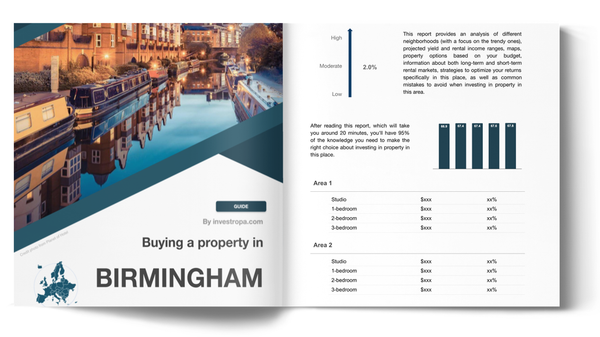
Get all the data you need about the real estate market in Birmingham
We update this article regularly so the data you see here always reflects the latest available figures.
Townhouse prices in Birmingham in 2026 vary enormously depending on which neighborhood you look at, and knowing that difference can save you tens of thousands of pounds.
This guide breaks down exactly what you can expect to pay, neighborhood by neighborhood, so you can make a more informed decision.
And if you're planning to buy a property in this place, you may want to download https://investropa.com/pages/uk-real-estate.
A quick summary table
| Metric | Value |
|---|---|
| Most expensive Birmingham neighborhood for townhouses | Edgbaston |
| Most affordable Birmingham neighborhood for townhouses | Perry Barr |
| Average price per square meter across all Birmingham neighborhoods | Around £3,100 |
| Median townhouse price across Birmingham | Around £263,000 |
| Lowest realistic starting budget for a Birmingham townhouse | Around £150,000 |
| Most expensive Birmingham townhouse type by bedroom count | Four-bedroom |
| Most affordable Birmingham townhouse type by bedroom count | Two-bedroom |
| Average price for a two-bedroom townhouse in Birmingham | Around £250,000 |
| Average price for a three-bedroom townhouse in Birmingham | Around £310,000 |
| Average price for a four-bedroom townhouse in Birmingham | Around £422,000 |
| Price gap between most and least expensive Birmingham townhouse neighborhoods | Around £235,000 at median level |
| Price range across Birmingham townhouse neighborhoods | From around £198,000 to £325,000 at median |
Make a profitable investment in Birmingham
Better information leads to better decisions. Save time and money. Download our data.


Still have a question about United Kingdom?
If this article didn't answer it, ask us. A real person replies within 12 hours, for free.
Ask us your question →
Birmingham neighborhoods in 2026 ranked by townhouse purchase price
This table ranks the top neighborhoods in the Birmingham property market by townhouse purchase price, from the most expensive to the most affordable.
For each neighborhood, the table includes the average price per square meter, the median property price, the starting budget, the average price for a two-bedroom, three-bedroom, and four-bedroom townhouse, the typical buyer profile, the key advantages, the key drawbacks, and the market segment.
Finally, please note you'll find much more detailed data in https://investropa.com/pages/uk-real-estate.
| Rank | Neighborhood | Average Price per Square Meter | Median Property Price | Starting Budget | Average Price for a Two-Bedroom Townhouse | Average Price for a Three-Bedroom Townhouse | Average Price for a Four-Bedroom Townhouse | Typical Buyers | Key Pros | Key Cons | Market Segment |
|---|---|---|---|---|---|---|---|---|---|---|---|
| 1 | Edgbaston | £4,300 | £325,000 | £260,000 | £315,000 | £395,000 | £545,000 | Affluent young families | Close to the city centre, strong schools, prestigious streets, and good long-term resale appeal | Entry prices are high and townhouse supply is limited on the best roads | Luxury |
| 2 | Bournville | £4,000 | £318,000 | £255,000 | £300,000 | £375,000 | £510,000 | School-driven family buyers | Famous village setting, strong family demand, greenery, and consistently desirable townhouse stock | Strict character expectations and limited supply keep competition and asking prices firm | Premium |
| 3 | Harborne | £3,950 | £308,000 | £245,000 | £295,000 | £365,000 | £495,000 | Professional family upgraders | Walkable high street, hospitals nearby, strong schools, and broad owner-occupier demand | Parking can be tight and the best townhouse streets carry a clear premium | Premium |
| 4 | Moseley | £3,800 | £302,000 | £240,000 | £285,000 | £355,000 | £485,000 | Lifestyle-led family buyers | Character streets, cafes, parks, and a strong south Birmingham reputation that supports pricing | Stock is patchy, some roads are noisy, and premiums can feel steep for what you get | Premium |
| 5 | Kings Heath | £3,450 | £280,000 | £225,000 | £265,000 | £330,000 | £450,000 | Space-seeking young families | Popular high street, good amenities, and a cheaper entry point than Harborne or Moseley | The best roads move fast and lower-value pockets can vary sharply street by street | Mid-Market |
| 6 | Selly Park | £3,300 | £270,000 | £215,000 | £255,000 | £320,000 | £435,000 | Upgrade-oriented local households | Leafier feel than Selly Oak, larger period terraces, and good access both southward and into the city centre | Fewer listings mean buyers often wait longer for the right townhouse to come up | Mid-Market |
| 7 | Selly Oak | £3,150 | £258,000 | £205,000 | £245,000 | £305,000 | £415,000 | Mixed owner-occupier buyers | Good value near the university and hospitals, with solid resale liquidity | Student-market influence can affect street feel, parking, and buyer competition | Mid-Market |
| 8 | Stirchley | £3,050 | £248,000 | £195,000 | £235,000 | £295,000 | £400,000 | First-step urban families | Trendier than before, improving amenities, and still cheaper than nearby premium south Birmingham areas | Smaller stock and uneven street quality make careful micro-location selection important | Mid-Market |
| 9 | Yardley | £2,700 | £222,000 | £175,000 | £210,000 | £260,000 | £350,000 | Value-focused suburban buyers | Accessible prices, practical family housing, and useful airport and road connectivity | Less prestige and weaker walkable lifestyle appeal than south Birmingham hotspots | Affordable |
| 10 | Great Barr | £2,650 | £220,000 | £172,000 | £208,000 | £258,000 | £345,000 | Budget-conscious family movers | Solid value, familiar suburban format, and a broader choice of family-oriented townhouse stock | Car dependence is higher and standout premium streets are less common than in south Birmingham | Affordable |
| 11 | Erdington | £2,500 | £208,000 | £160,000 | £195,000 | £242,000 | £325,000 | Entry-level local buyers | Low entry point, straightforward housing stock, and relatively liquid mainstream pricing | More mixed reputation and bigger street-to-street quality differences than premium districts | Budget |
| 12 | Perry Barr | £2,400 | £198,000 | £150,000 | £185,000 | £230,000 | £310,000 | First-time townhouse buyers | Among the easiest Birmingham entry points, with improving transport links and regeneration activity nearby | Busy roads, a patchier residential feel, and weaker prestige than established family-favourite areas | Budget |
Don't buy the wrong property, in the wrong area of Birmingham
Buying real estate is a significant investment. Don't rely solely on your intuition. Gather the right information to make the best decision.
Got a question about the market in United Kingdom?
Prices, areas, rentals: ask us what you'd ask a friend who knows. Free reply within 12 hours.
Ask us your question →
Key insights about townhouse purchase prices in Birmingham
Insights
- A Birmingham townhouse in Edgbaston costs roughly 65% more than one in Perry Barr in early 2026, which means the choice of neighborhood matters far more than the type of property you are buying.
- South Birmingham dominates the premium townhouse market in 2026. Edgbaston, Bournville, Harborne, and Moseley all sit above the £300,000 median mark, while most north and east Birmingham neighborhoods sit well below it.
- Bournville prices are almost as high as Edgbaston despite having a completely different, village-style feel. The school catchment and green setting are doing a lot of the pricing work there.
- The jump from mid-market to premium in Birmingham is steep. Going from Stirchley to Harborne for a three-bedroom townhouse in 2026 means spending around £70,000 more, which is a significant step up for just one neighborhood tier.
- Stirchley is still one of the better-value options for buyers who want to stay in south Birmingham. A three-bedroom Birmingham townhouse there costs around £295,000 in early 2026, compared to £355,000 in Moseley for a broadly similar property.
- Selly Oak works for owner-occupiers but comes with a specific risk: the student-rental market in the area can affect how streets feel and how competitive the buying process gets.
- Yardley and Great Barr are the clearest options for family buyers on tighter budgets in 2026. Both offer three-bedroom townhouses in Birmingham for around £258,000 to £260,000, which is roughly £95,000 to £135,000 less than the premium south Birmingham equivalent.
- Perry Barr is Birmingham's most accessible townhouse entry point in 2026, with a median price of around £198,000 and a starting budget as low as £150,000. That is the most realistic floor for a buyer entering the Birmingham townhouse market from scratch.
- In Birmingham's townhouse market, paying more usually buys school catchment strength, street quality, and better resale depth. Buyers in Edgbaston or Bournville are not just buying a house, they are buying into a set of conditions that tend to hold value well over time.
- A realistic starting budget for a three-bedroom Birmingham townhouse in 2026 ranges from around £230,000 in value areas like Perry Barr and Erdington to around £395,000 in the most sought-after districts like Edgbaston.
- The price difference between a two-bedroom and a four-bedroom townhouse in Birmingham in 2026 is substantial. In Edgbaston, that gap is around £230,000. Even in more affordable areas like Great Barr, it is still around £137,000.
- Kings Heath and Moseley form Birmingham's key middle-premium townhouse step in 2026. Both offer a liveable urban feel at prices that are noticeably lower than Harborne and Edgbaston, but noticeably higher than the more affordable north and east Birmingham neighborhoods.
Thinking of buying real estate in Birmingham?
Acquiring property in a different country is a complex task. Don't fall into common traps – grab our guide and make better decisions.
Got a question nobody's answered?
Buying in United Kingdom and can't find a clear answer anywhere? Ask us. Free reply within 12 hours.
Ask us your question →About our methodology
Official sources in the UK do not publish a clean Birmingham townhouse dataset broken down by neighborhood. To work around this, we combined three types of evidence: official government and ONS data for citywide pricing anchors, Rightmove sold-price data for neighborhood-level terraced market pricing, and Housemetric for size-adjusted price-per-square-meter signals. In the UK, most townhouses sit inside the "terraced" property category in official records, so the figures in this article are townhouse-focused estimates built from that proxy, then adjusted for neighborhood character, typical stock mix, and bedroom size conventions.
We also believe it is important to show our reasoning. It is one of the ways we make our work solid, transparent, and rigorous, just as you will see in https://investropa.com/pages/uk-real-estate.
First, please note that this data is updated regularly, so what you see here reflects the current values as of today.
In order to get reliable data, we applied a strict source filter. We only used authoritative, verifiable sources, not random listings or unsupported figures. More on that point below.
For each Birmingham neighborhood, we aggregated the freshest townhouse purchase price data available. When possible, we cross-checked multiple sources to confirm the same price range.
This allowed us to estimate the average price per square meter and the median property price for each Birmingham neighborhood.
We also calculated the starting budget, which represents the lowest realistic entry point to buy a townhouse in that neighborhood. This is not the cheapest possible listing, but a real, achievable floor for a standard townhouse purchase in Birmingham.
For each bedroom category, we estimated an average purchase price based on local Birmingham market conventions. A two-bedroom townhouse is typically around 70 to 85 square meters, a three-bedroom is around 90 to 110 square meters, and a four-bedroom is around 120 to 145 square meters. These are local working assumptions used for comparability across neighborhoods, not an official classification.
These estimates were not applied as one flat number across the city. They were adjusted by neighborhood and property type to better reflect local ownership conditions and price levels in Birmingham.
This table should therefore be read as a structured market estimate, not as an exact guarantee of transaction prices. Honesty, quality, and rigor are at the core of our work, and they are also what you will find in https://investropa.com/pages/uk-real-estate.
What sources have we used to write this blog article?
Whether it's in our blog articles or the market analyses included in https://investropa.com/pages/uk-real-estate, we rely on verifiable sources and a transparent methodology.
We also aim to be fully transparent, so below we've listed the authoritative sources we used, and explained how we used them and the methods behind our estimates.
| Source | Why it is reliable | How we used it |
|---|---|---|
| HM Land Registry / UK House Price Index | It is the core official house-price dataset for England and Wales, published directly by the government. | We used it to anchor Birmingham-wide pricing and to tie our March 2026 estimates to the latest published official data. We also used its methodology as a reference point for how property types are categorised in the UK. |
| GOV.UK Property Price Trends | It is the official government access point for UK HPI searches by geography and property type. | We used it to verify what the official tool covers at local authority and property-type level. We also used it to confirm that terraced property searches at Birmingham level are supported and consistent with the wider UK HPI methodology. |
| ONS Birmingham Housing Prices | The Office for National Statistics is the UK's national statistics office and publishes independently verified data. | We used it to cross-check Birmingham housing and rental context at city level. We also used it as a sanity check on local market affordability by bedroom count. |
| Rightmove Birmingham Sold Prices | Rightmove is one of the UK's largest property portals and aggregates real sold-price evidence from across the country. | We used it as the main city-level private-sector benchmark for Birmingham terraced pricing. We also used it to compare neighborhood values against the Birmingham city average. |
| Rightmove Edgbaston Sold Prices | It provides neighborhood-level sold-price evidence drawn directly from Land Registry transaction data. | We used it to anchor Edgbaston townhouse pricing and to position Edgbaston at the top end of the Birmingham townhouse market. We cross-referenced it with Housemetric size-adjusted data to sense-check the per-square-meter figures. |
| Rightmove Harborne Sold Prices | It provides neighborhood-level sold-price evidence drawn directly from Land Registry transaction data. | We used it to anchor Harborne townhouse pricing and to compare Harborne against nearby premium family areas. We also used it to assess how much of a premium the Harborne high street and school catchment add to local townhouse values. |
| Rightmove Moseley Sold Prices | It provides neighborhood-level sold-price evidence drawn directly from Land Registry transaction data. | We used it to anchor Moseley townhouse pricing and to measure the character-neighborhood premium in south Birmingham. We also used it to compare Moseley against Kings Heath and assess the pricing gap between the two areas. |
| Rightmove Bournville Sold Prices | It provides neighborhood-level sold-price evidence drawn directly from Land Registry transaction data. | We used it to anchor Bournville townhouse pricing and to capture the school-driven and village-character premium in this part of Birmingham. We also used it to note how closely Bournville tracks Edgbaston despite their very different residential formats. |
| Housemetric Harborne | Housemetric uses transaction data combined with EPC floor area records to produce verified price-per-square-meter estimates. | We used it to inform our townhouse price-per-square-meter estimates for Harborne and to sense-check size-adjusted premiums against Rightmove averages. We also used it to verify that our bedroom-size assumptions were consistent with actual floor area evidence in this part of Birmingham. |
| Housemetric Edgbaston | Housemetric uses transaction data combined with EPC floor area records to produce verified price-per-square-meter estimates. | We used it to inform our townhouse price-per-square-meter estimates for Edgbaston and to compare central premium areas with the wider Birmingham market. We also used it to cross-check that the Edgbaston per-square-meter figure was consistent with actual sold transaction evidence. |
| Savills Residential Market Forecasts | Savills is a major established property consultancy with published, transparent market commentary reviewed by professional analysts. | We used it for early-2026 Birmingham market context, not for neighborhood headline pricing. We also used it to frame the buyer conditions and the softer growth backdrop that shaped the overall market in the period covered by this article. |
Get fresh and reliable information about the market in Birmingham
Don't base significant investment decisions on outdated data. Get updated and accurate information.
