
As of June 2026, houses in Birmingham are still relatively affordable by large UK city standards, but good freehold houses in the best Birmingham neighbourhoods are no longer cheap.
Get all the data you need about the real estate market in Birmingham
We constantly update this blog post so foreign buyers can read fresh Birmingham house price data without having to check dozens of UK property sources.
In June 2026, the main thing to understand is simple: a normal house in Birmingham usually costs far less than in London, but location changes the price very quickly.
This guide focuses only on houses in Birmingham, not flats, because a foreign buyer looking for space, a garden and long-term family use usually needs house-specific numbers.
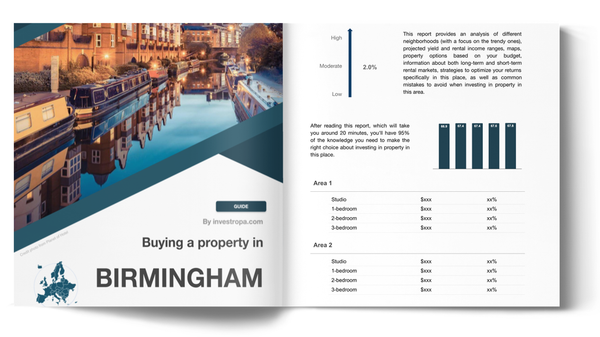
And if you’re planning to buy a property in this place, you may want to download our pack covering the real estate market in Birmingham.
How much do houses cost in Birmingham as of 2026?
What's the median and average house price in Birmingham as of 2026?
As of 2026, the estimated median house price in Birmingham is about £245,000, or about $331,000 and €287,000, while the estimated average house price in Birmingham is about £270,000, or about $365,000 and €316,000.
A realistic price range covering most normal Birmingham house sales in 2026 is about £180,000 to £325,000, or about $243,000 to $439,000 and €211,000 to €380,000.
The average house price in Birmingham is higher than the median because expensive detached houses in Edgbaston, Harborne, Sutton Coldfield and Four Oaks pull the average upward.
At the median price in Birmingham in 2026, a buyer can usually expect a 2-bedroom or smaller 3-bedroom terraced or semi-detached house in an outer or mixed suburban area, often with a small garden and basic parking nearby.
Not sure the price you're looking at is fair? Send it to us.
What's the cheapest livable house budget in Birmingham as of 2026?
As of 2026, the cheapest realistic livable house budget in Birmingham is about £155,000 to £170,000, or about $209,000 to $230,000 and €181,000 to €199,000.
At this entry level, livable usually means a small 2-bedroom terrace or semi-detached house with working heating, a usable kitchen, a basic bathroom and no major structural problem, but often with tired decor or poor insulation.
The cheapest livable houses in Birmingham in 2026 are usually found in Castle Vale, Kingstanding, parts of Erdington, Alum Rock, Bordesley Green, Handsworth, Washwood Heath, Northfield and some streets around Yardley or Stechford.
How much do 2 and 3-bedroom houses cost in Birmingham as of 2026?
As of 2026, a typical 2-bedroom house in Birmingham costs about £190,000, or about $257,000 and €222,000, while a typical 3-bedroom house in Birmingham costs about £260,000, or about $351,000 and €304,000.
A realistic 2-bedroom house range in Birmingham in 2026 is about £170,000 to £220,000, or about $230,000 to $297,000 and €199,000 to €257,000, with better locations often rising above £240,000.
A realistic 3-bedroom house range in Birmingham in 2026 is about £220,000 to £300,000, or about $297,000 to $405,000 and €257,000 to €351,000, with Harborne, Moseley, Bournville and Sutton Coldfield often much higher.
The usual premium for moving from a 2-bedroom house to a 3-bedroom house in Birmingham is about £60,000 to £80,000, or about $81,000 to $108,000 and €70,000 to €94,000.


Got a question about taxes in United Kingdom?
Buying costs, yearly taxes, rental income: ask us and get a clear answer within 12 hours. Free.
Ask us your question →
How much do 4-bedroom houses cost in Birmingham as of 2026?
As of 2026, a typical 4-bedroom house in Birmingham costs about £400,000, or about $540,000 and €468,000, although the mainstream range is closer to £330,000 to £475,000.
A 5-bedroom house in Birmingham in 2026 usually costs about £450,000 to £700,000, or about $608,000 to $945,000 and €527,000 to €819,000, with premium areas often above that.
A 6-bedroom house in Birmingham in 2026 usually costs about £650,000 to £1.1 million, or about $878,000 to $1.49 million and €761,000 to €1.29 million, with large Edgbaston and Four Oaks homes sometimes far higher.
Please note that we give much more detailed data in our pack about the property market in Birmingham.
Not sure how this works in your case? Tell us what you're buying in United Kingdom and we'll help you work it out.
How much do new-build houses cost in Birmingham as of 2026?
As of 2026, a new-build house in Birmingham usually costs about £285,000 to £375,000 for a 2-bedroom or 3-bedroom house, or about $385,000 to $506,000 and €333,000 to €439,000.
New-build houses in Birmingham usually carry a premium of about 10% to 18% over similar older resale houses, because buyers pay more for lower repair risk, modern insulation and builder warranties.
How much do houses with land cost in Birmingham as of 2026?
As of 2026, a Birmingham house with a larger garden usually costs about £280,000 to £450,000, or about $378,000 to $608,000 and €328,000 to €527,000, while a true large-plot house often starts near £700,000.
In Birmingham, a house with land usually means a larger-than-normal garden or a generous detached plot, because proper acreage is rare inside this urban market.
Taxes are where people get surprised. Tell us your situation and we'll tell you what to expect.
Thinking of buying real estate in Birmingham?
Acquiring property in a different country is a complex task. Don't fall into common traps – grab our guide and make better decisions.

Where are houses cheapest and most expensive in Birmingham as of 2026?
Which neighborhoods have the lowest house prices in Birmingham as of 2026?
As of 2026, the lowest house prices in Birmingham are usually in Castle Vale, Kingstanding, Erdington, Alum Rock, Bordesley Green, Handsworth, Washwood Heath, Winson Green, Lozells edge and parts of Northfield.
In these cheaper Birmingham neighbourhoods, a normal house usually costs about £160,000 to £255,000, or about $216,000 to $344,000 and €187,000 to €298,000.
These areas are cheaper because many streets have older terraces or ex-local-authority homes, weaker school catchment demand, lower buyer competition and fewer lifestyle amenities than south-west Birmingham.
Got a question about a property in United Kingdom?
Found a place and not sure about it? Tell us about it and we'll tell you what we'd check. Free, within 12 hours.
Ask us your question →
Which neighborhoods have the highest house prices in Birmingham as of 2026?
As of 2026, the three highest-price house areas in Birmingham are Edgbaston, Sutton Coldfield and Four Oaks, with Harborne, Moseley and Bournville also very expensive for family houses.
In these premium Birmingham neighbourhoods, normal houses often cost about £375,000 to £900,000, or about $506,000 to $1.22 million and €439,000 to €1.05 million, while prime detached homes can pass £1.5 million.
These Birmingham areas command the highest prices because they combine larger houses, greener streets, stronger schools, better professional-buyer demand and a limited supply of prime freehold homes.
The typical buyer in these areas is often a high-income local family, a senior professional, a medical or university worker, a returning expat, or a foreign buyer who wants a safer long-term family base.
Wondering if now's the time to buy in United Kingdom? Tell us your plan.
How much do houses cost near the city center in Birmingham as of 2026?
As of 2026, houses near Birmingham city centre, including Jewellery Quarter edges, Digbeth edges, Ladywood, Lee Bank, Park Central, Hockley and Balsall Heath, usually cost about £250,000 to £430,000, or about $338,000 to $581,000 and €293,000 to €503,000.
Near major rail or tram access in Birmingham, including Erdington, Stechford, Yardley, Northfield, Longbridge, Bournville, Selly Oak and Sutton Coldfield, houses usually cost about £220,000 to £700,000, or about $297,000 to $945,000 and €257,000 to €819,000.
Near top schools such as King Edward VI Camp Hill Boys, King Edward VI Camp Hill Girls, King Edward VI Five Ways, King Edward’s School and King Edward VI High School for Girls, family houses often cost about £325,000 to £1.5 million, or about $439,000 to $2.03 million and €380,000 to €1.76 million.
In expat-popular Birmingham areas such as Edgbaston, Harborne, Moseley, Bournville, Jewellery Quarter, Sutton Coldfield, Selly Oak and Kings Heath, a realistic house budget is about £350,000 to £750,000, or about $473,000 to $1.01 million and €410,000 to €878,000.
How much do houses cost in the suburbs in Birmingham as of 2026?
As of 2026, a normal house in the suburbs of Birmingham usually costs about £220,000 to £325,000, or about $297,000 to $439,000 and €257,000 to €380,000.
Suburban houses in Birmingham are often cheaper than scarce city-centre houses by about 10% to 25%, but prime suburbs such as Harborne, Edgbaston, Moseley, Bournville and Sutton Coldfield are more expensive than the centre.
The most popular Birmingham suburbs for house buyers include Harborne, Moseley, Kings Heath, Bournville, Stirchley, Selly Oak, Kings Norton, Hall Green, Sutton Coldfield, Northfield and Longbridge.
Buying real estate in United Kingdom?
Ask us anything about your purchase: taxes, contracts, banks, permits. A real person replies within 12 hours, for free.
Ask us your question →What areas in Birmingham are improving and still affordable as of 2026?
As of 2026, the Birmingham areas that look improving and still relatively affordable are Stirchley, Kings Norton, Longbridge, Northfield, Erdington, Yardley, Stechford, Balsall Heath and parts of Selly Oak away from the most student-heavy streets.
In these improving Birmingham areas, a typical house usually costs about £200,000 to £320,000, or about $270,000 to $432,000 and €234,000 to €374,000.
The main sign of improvement is not one single project, but the mix of better rail access, stronger independent high streets, lifestyle demand spilling out from expensive south Birmingham areas and more buyers wanting space outside the centre.
Get fresh and reliable information about the market in Birmingham
Don't base significant investment decisions on outdated data. Get updated and accurate information.
What extra costs should I budget for a house in Birmingham right now?
What are typical buyer closing costs for houses in Birmingham right now?
For a foreign buyer purchasing a house in Birmingham in 2026, typical closing costs are often about 4% to 8% of the purchase price if it is a main home, and much higher if the buyer also pays the additional-property surcharge.
The main Birmingham buyer costs are SDLT, solicitor fees of about £1,200 to £2,500, searches of about £250 to £500, surveys of about £400 to £700, valuation or lender fees of about £0 to £700, and setup or removals of about £1,000 to £3,000.
The largest closing cost is usually Stamp Duty Land Tax, especially because a non-UK resident buyer normally adds a 2% surcharge on top of the normal SDLT bands.
We cover all these costs and the strategies to minimize them in our property pack about Birmingham.
How much are property taxes on houses in Birmingham right now?
In Birmingham in 2026, the typical annual council tax for an ordinary house is about £1,600 to £2,900, or about $2,160 to $3,920 and €1,870 to €3,390.
Council tax in Birmingham is calculated by property band, not by today’s purchase price, and many normal houses sit in middle bands while larger prime houses can be in the higher bands.
How much is home insurance for a house in Birmingham right now?
Home insurance for a normal house in Birmingham in 2026 usually costs about £350 to £650 per year, or about $473 to $878 and €410 to €761.
The main factors that change Birmingham home insurance premiums are rebuild cost, house age, roof condition, flood risk, subsidence risk, claims history, security, contents value and whether the property is left empty for long periods.
Got a question about buying in United Kingdom?
Ask our team. A real person replies within 12 hours, for free.
Ask us your question →What are typical utility costs for a house in Birmingham right now?
In Birmingham in 2026, a normal 2-bedroom or 3-bedroom house usually costs about £230 to £330 per month in utilities before council tax, or about $311 to $446 and €269 to €386.
A simple monthly utility breakdown for a Birmingham house is about £135 to £180 for gas and electricity, £35 to £55 for water and sewerage, £25 to £40 for broadband, and £20 to £50 for mobile, TV licence or basic streaming.
What are common hidden costs when buying a house in Birmingham right now?
Common hidden costs for a Birmingham house buyer in 2026 can easily add £3,000 to £12,000, or about $4,100 to $16,200 and €3,500 to €14,000, before any major renovation.
Typical inspection fees are about £400 to £700, or about $540 to $945 and €470 to €820, with older Birmingham houses often justifying a more detailed Level 3 survey.
Beyond inspections, common hidden costs in Birmingham include roof repairs, damp treatment, old wiring, boiler replacement, weak insulation, leasehold or title quirks, restrictive covenants, parking issues and Japanese knotweed checks.
The hidden cost that surprises first-time Birmingham house buyers most is usually damp or roof work, because many older terraces and period houses look acceptable during viewings but need expensive repairs after purchase.
Get to know the market before buying a property in Birmingham
Better information leads to better decisions. Get all the data you need before investing a large amount of money.
What do locals and expats say about the market in Birmingham as of 2026?
Do people think houses are overpriced in Birmingham as of 2026?
As of 2026, many locals and expats think good houses in Birmingham are expensive, but the concern is mostly about desirable family areas rather than the whole city.
Many Birmingham houses take roughly 10 to 14 weeks to find a buyer when priced sensibly, while over-optimistic listings can sit much longer and need price reductions.
The main reason buyers complain is that salaries have not kept up with prices in Harborne, Moseley, Bournville, Edgbaston and Sutton Coldfield, especially for 3-bedroom family houses near schools.
Compared with 2024 and 2025, buyer sentiment in Birmingham in 2026 feels more cautious because mortgage costs, energy costs and higher transaction taxes have made buyers more price-sensitive.
Are prices still rising or cooling in Birmingham as of 2026?
As of 2026, Birmingham house prices look broadly stable rather than strongly rising or sharply falling.
The best estimate for Birmingham house price change in 2026 is about -1% to +2% year over year, with semi-detached family houses holding up better than flats or overpriced premium homes.
Over the next 6 to 12 months, the most realistic expectation is a flat market in Birmingham, with cheaper family houses staying more resilient and expensive houses needing sharper pricing to sell.
Don't lose money on your property in Birmingham
100% of people who have lost money there have spent less than 1 hour researching the market. We have reviewed everything there is to know. Grab our guide now.

What sources have we used to write this blog article?
Whether it’s in our blog articles or the market analyses included in our property pack about Birmingham, we always rely on the strongest methodology we can and we don’t throw out numbers at random.
We also aim to be fully transparent, so below we’ve listed the authoritative sources we used, and explained how we used them and the methods behind our estimates.
| Source | Why this source matters | How we used it |
|---|---|---|
| ONS local housing prices: Birmingham | It is the official local housing dashboard. | We used it as the main anchor for Birmingham sale prices. We also used its detached, semi-detached and terraced price split. |
| GOV.UK UK House Price Index March 2026 | It confirms the official HPI release context. | We used it to check the latest official completed-sale month. We also used it to avoid overstating short-term growth. |
| HM Land Registry open data | It records completed sales in England and Wales. | We used it to check that sold prices were transaction-based. We also used it as the base source behind local sold-price checks. |
| Rightmove Birmingham houses for sale | It shows live supply and asking-market behaviour. | We used it to understand current listing depth. We did not treat asking prices as final sale prices. |
| Rightmove 2-bedroom houses in Birmingham | It shows live 2-bedroom house supply. | We used it to size the starter-house market. We cross-checked it with terraced-house pricing. |
| Rightmove 3-bedroom houses in Birmingham | It tracks the main family-house segment. | We used it to estimate 3-bedroom house supply and pricing. We weighted the estimate toward terraces and semi-detached houses. |
| GetAgent Birmingham market data | It combines listing and sale-performance information. | We used it for market-time and asking-price context. We cross-checked its average against official ONS data. |
| Birmingham City Council tax bands | It is the official local council tax schedule. | We used it for annual recurring local tax costs. We separated ordinary Birmingham charges from Sutton Coldfield precept cases. |
| GOV.UK SDLT residential rates | It is the official stamp duty source. | We used it to estimate buyer tax at common Birmingham budgets. We also included foreign-buyer SDLT risk separately. |
| GOV.UK non-resident SDLT surcharge | It explains the foreign-buyer surcharge. | We used it because the reader is a foreign buyer. We added the 2% surcharge to the buyer-cost discussion. |
| ABI home insurance data | It tracks real paid insurance premiums. | We used it for a practical insurance baseline. We adjusted upward for larger, older or higher-risk Birmingham houses. |
| Ofgem energy price cap | It is the UK energy regulator’s official cap. | We used it to estimate gas and electricity costs. We added water, broadband and everyday household costs separately. |
Buying real estate in Birmingham can be risky
An increasing number of foreign investors are showing interest. However, 90% of them will make mistakes. Avoid the pitfalls with our comprehensive guide.
