
As of June 2026, the median house price in the French Alps is about €380,000, about $440,000, or €380,000, but a family house near Annecy, Geneva, Chamonix, Megève or a top ski resort often costs much more.
Get all the data you need about the real estate market in the French Alps
This blog post is constantly updated, because house prices in the French Alps can move quickly between the ski resorts, lake towns, commuter valleys and lower southern Alpine towns.
We focus only on houses in the French Alps, not apartments, because detached houses, chalets and village houses follow a different price logic.
For June 2026, the French Alps house market is still expensive, but the price gap between a Maurienne village house and a Chamonix chalet is enormous.
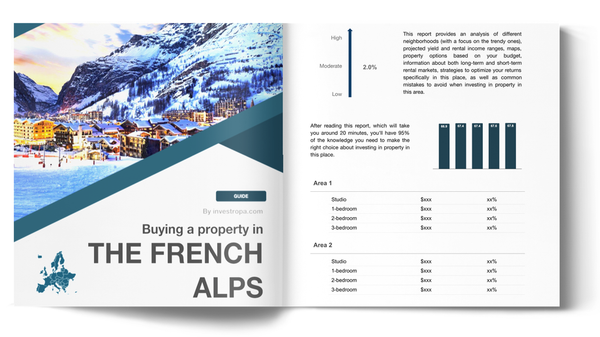
And if you’re planning to buy a property in this place, you may want to download our pack covering the real estate market in the French Alps.
How much do houses cost in the French Alps as of 2026?
What's the median and average house price in the French Alps as of 2026?
As of 2026, the estimated median house price in the French Alps is about €380,000, about $440,000, or €380,000, while the average house price is closer to €520,000, about $600,000, or €520,000.
In practice, the price range that covers many normal house sales in the French Alps in 2026 is roughly €220,000 to €900,000, about $255,000 to $1.04 million, or €220,000 to €900,000.
The average house price in the French Alps is much higher than the median because luxury chalets in Chamonix, Megève, Courchevel, Méribel, Val d’Isère, Annecy and Lake Geneva pull the average upward.
At the median price in the French Alps in 2026, a buyer can usually expect an older 3-bedroom house of about 100 to 115 m², often with a garden, but usually not in a prime lakefront, Geneva-border or ski-lift location.
What's the cheapest livable house budget in the French Alps as of 2026?
As of 2026, the cheapest realistic budget for a livable house in the French Alps is about €220,000 to €260,000, about $255,000 to $300,000, or €220,000 to €260,000.
At this entry-level price in the French Alps, “livable” usually means an older village house with working heating, basic insulation, a usable kitchen and bathroom, and some renovation still needed.
The cheapest livable houses in the French Alps in 2026 are usually found in Vallée de Maurienne, Saint-Jean-de-Maurienne, Modane, Aiguebelle, La Mure, Digne-les-Bains, Sisteron, Castellane, Veynes and villages outside Gap.
This low-budget segment is useful for patient buyers, but it is not the same market as Annecy, Chamonix, Morzine or the Geneva border.
How much do 2 and 3-bedroom houses cost in the French Alps as of 2026?
As of 2026, a 2-bedroom house in the French Alps usually costs €250,000 to €420,000, about $290,000 to $485,000, or €250,000 to €420,000, while a 3-bedroom house usually costs €340,000 to €650,000, about $395,000 to $750,000, or €340,000 to €650,000.
For a 2-bedroom house in the French Alps in 2026, the realistic range is about €200,000 to €300,000 in cheaper valleys and southern towns, and about €450,000 to €800,000 in Annecy, Chamonix, Morzine or near Geneva.
For a 3-bedroom house in the French Alps in 2026, the realistic range is about €280,000 to €420,000 in lower-priced areas, €400,000 to €700,000 in ordinary Alpine towns, and €700,000 to €1.2 million in the most wanted areas.
The move from a 2-bedroom house to a 3-bedroom house in the French Alps usually adds €90,000 to €230,000, because the buyer is often also paying for more land, better family layout and a more practical year-round location.
How much do 4-bedroom houses cost in the French Alps as of 2026?
As of 2026, a 4-bedroom house in the French Alps typically costs €500,000 to €900,000, about $580,000 to $1.04 million, or €500,000 to €900,000.
A 5-bedroom house in the French Alps in 2026 usually costs €700,000 to €1.3 million, about $810,000 to $1.5 million, or €700,000 to €1.3 million, with lower prices mainly in Isère, Maurienne, Hautes-Alpes and Alpes-de-Haute-Provence.
A 6-bedroom house in the French Alps in 2026 usually costs €900,000 to €1.8 million, about $1.04 million to $2.08 million, or €900,000 to €1.8 million, but prime chalets in Chamonix, Megève, Courchevel, Méribel and Val d’Isère can go far above €2 million.
Please note that we give much more detailed data in our pack about the property market in the French Alps.
How much do new-build houses cost in the French Alps as of 2026?
As of 2026, a new-build house in the French Alps usually costs about €430,000 to €520,000, about $500,000 to $600,000, or €430,000 to €520,000 before prime resort exceptions.
New-build houses in the French Alps in 2026 usually cost about 10% to 40% more than older resale houses, with Savoie showing a much larger premium than Haute-Savoie in the June 2026 notary data.
How much do houses with land cost in the French Alps as of 2026?
As of 2026, a normal house with usable land in the French Alps usually costs €350,000 to €700,000, about $405,000 to $810,000, or €350,000 to €700,000.
In the French Alps, a “house with land” usually means a plot of about 600 to 1,000 m², although plots can be smaller in Annecy, lake villages and ski resorts.
The key point in the French Alps is that flat, sunny, buildable and easy-access land is worth much more than steep or isolated land.
Thinking of buying real estate in the French Alps?
Acquiring property in a different country is a complex task. Don't fall into common traps – grab our guide and make better decisions.

Where are houses cheapest and most expensive in the French Alps as of 2026?
Which neighborhoods have the lowest house prices in the French Alps as of 2026?
As of 2026, the lowest house prices in the French Alps are usually in Vallée de Maurienne, Modane, Saint-Jean-de-Maurienne, La Mure, Vizille, Saint-Marcellin, Veynes, Laragne-Montéglin, Digne-les-Bains and Sisteron.
In these cheaper French Alps areas in 2026, a livable house often costs €220,000 to €380,000, about $255,000 to $440,000, or €220,000 to €380,000.
These areas are cheaper because buyers accept longer drives, older housing stock, weaker insulation, fewer international buyers and less direct access to famous ski lifts or lakefront jobs.
Which neighborhoods have the highest house prices in the French Alps as of 2026?
As of 2026, the three most expensive house areas in the French Alps are Chamonix-Mont-Blanc and Les Houches, Megève and Demi-Quartier, and the Annecy lake towns such as Veyrier-du-Lac, Talloires-Montmin and Menthon-Saint-Bernard.
In these premium French Alps areas in 2026, normal houses often cost €900,000 to €2 million, about $1.04 million to $2.3 million, or €900,000 to €2 million, while trophy chalets can cost €3 million to €6 million or more.
These areas command the highest house prices because buyers are paying for international liquidity, mountain or lake views, scarce buildable land, strong rental appeal and a lifestyle that cannot be copied in cheaper valleys.
The typical premium buyer in these French Alps locations is often a high-income French household, a Geneva-linked buyer, a second-home buyer, or an international buyer looking for a chalet with long-term scarcity value.
How much do houses cost near the city center in the French Alps as of 2026?
As of 2026, houses near the main city-center areas of the French Alps, including Annecy centre, Annecy-le-Vieux, Chambéry centre, Bissy, Barberaz, Grenoble inner suburbs, La Tronche, Meylan and Gap centre, usually cost €400,000 to €900,000, about $465,000 to $1.04 million, or €400,000 to €900,000.
Near major transit hubs in the French Alps in 2026, such as Annecy station, Chambéry station, Grenoble station, Annemasse station and the Léman Express corridor, houses usually cost €450,000 to €900,000, about $520,000 to $1.04 million, or €450,000 to €900,000.
Near top schools in the French Alps in 2026, such as Lycée Berthollet in Annecy, Lycée Vaugelas in Chambéry, Lycée Champollion in Grenoble and Cité Scolaire Internationale Europole, houses usually cost €500,000 to €1.1 million, about $580,000 to $1.27 million, or €500,000 to €1.1 million.
In expat-popular French Alps areas such as Chamonix, Les Houches, Megève, Morzine, Les Gets, Annecy, Saint-Julien-en-Genevois, Annemasse, Aix-les-Bains and Divonne-les-Bains edge, a comfortable house usually needs a budget of €700,000 to €1.5 million, about $810,000 to $1.73 million, or €700,000 to €1.5 million.
How much do houses cost in the suburbs in the French Alps as of 2026?
As of 2026, suburban houses in the French Alps usually cost €350,000 to €650,000, about $405,000 to $750,000, or €350,000 to €650,000, with Annecy, Geneva-border and lake suburbs often above that.
Compared with city-center houses in the French Alps in 2026, suburban houses are often 10% to 25% cheaper, unless the suburb has better views, more land, better schools or easier Geneva access.
The most popular French Alps suburbs for house buyers include Annecy-environs, Poisy, Epagny Metz-Tessy, Pringy, Barberaz, Cognin, La Ravoire, Meylan, Corenc, Biviers, Saint-Ismier, Cranves-Sales and Vetraz-Monthoux.
What areas in the French Alps are improving and still affordable as of 2026?
As of 2026, the best improving yet still affordable French Alps areas for house buyers include Saint-Jean-de-Maurienne, Modane, Albertville, Ugine, Rumilly, Cluses, Sallanches, Passy, Gap outskirts, Sisteron and Grenoble west or south suburbs.
In these improving French Alps areas in 2026, typical house prices usually sit around €260,000 to €480,000, about $300,000 to $555,000, or €260,000 to €480,000.
The main sign of improvement is not just tourism, but better commuter logic, infrastructure works, year-round jobs, spillover from expensive towns and buyers accepting practical valleys over postcard locations.
Get fresh and reliable information about the market in the French Alps
Don't base significant investment decisions on outdated data. Get updated and accurate information.
What extra costs should I budget for a house in the French Alps right now?
What are typical buyer closing costs for houses in the French Alps right now?
For an old house in the French Alps, buyers should usually budget 7% to 8% of the purchase price for closing costs, while a new-build house often needs about 2% to 3%.
On a €500,000 house in the French Alps, about $580,000 or €500,000, this usually means roughly €35,000 to €40,000 for an older house, or about €10,000 to €15,000 for a new-build house.
The largest closing cost category for most house buyers in the French Alps is the transfer tax and related public charges, not the notary’s actual personal fee.
We cover all these costs and the strategies to minimize them in our property pack about the French Alps.
How much are property taxes on houses in the French Alps right now?
For a normal house in the French Alps in 2026, a practical annual property-tax budget is about €900 to €2,500, about $1,040 to $2,900, or €900 to €2,500.
Property tax in the French Alps is based on a cadastral rental value, local commune and intercommunal rates, and property features such as size, land, garages, extensions and sometimes pools.
How much is home insurance for a house in the French Alps right now?
For a standard house in the French Alps in 2026, home insurance usually costs about €350 to €800 per year, about $405 to $925, or €350 to €800.
Insurance costs rise in the French Alps when the house is a second home, a large chalet, an older wooden property, a remote property, or a house exposed to snow, freeze, storm, flood, landslide or avalanche risk.
What are typical utility costs for a house in the French Alps right now?
For a full-time household in the French Alps in 2026, total utilities usually cost about €250 to €500 per month, about $290 to $580, or €250 to €500.
A simple monthly budget is €180 to €400 for electricity and heating, €30 to €60 for water, €30 to €50 for internet, plus extra costs for snow clearing or private-road maintenance where needed.
What are common hidden costs when buying a house in the French Alps right now?
House buyers in the French Alps in 2026 should often keep €20,000 to €80,000, about $23,000 to $92,000, or €20,000 to €80,000, for hidden costs after purchase.
Inspection fees for a house in the French Alps usually cost about €400 to €900 for standard diagnostics, €800 to €2,000 for a building expert, and €500 to €1,500 for a roof or chalet specialist.
Beyond inspections, common hidden costs in the French Alps include energy renovation, roof works, septic upgrades, drainage, retaining walls, chimney compliance, asbestos or lead remediation, and snow-access work.
The hidden cost that surprises first-time buyers most in the French Alps is often the cost of making an older mountain house warm, compliant and easy to access in winter.
Get to know the market before buying a property in the French Alps
Better information leads to better decisions. Get all the data you need before investing a large amount of money.
What do locals and expats say about the market in the French Alps as of 2026?
Do people think houses are overpriced in the French Alps as of 2026?
As of 2026, many locals and expats think houses are overpriced in the famous French Alps markets, especially around Annecy, Chamonix, Megève, Morzine, the Geneva border and the Three Valleys.
Normal houses in the French Alps often take about 2 to 4 months to sell, while overpriced chalets or renovation-heavy homes can stay listed for 6 to 12 months.
The main reason people feel prices are high is that local wages compete with second-home buyers, Geneva salaries, foreign buyers and a very limited supply of buildable land.
Compared with one or two years earlier, the French Alps house market feels less frantic in 2026, but good houses in the best locations are still not cheap.
Are prices still rising or cooling in the French Alps as of 2026?
As of 2026, house prices in the French Alps are mixed, with Savoie roughly stable to slightly rising and Haute-Savoie slightly cooling in the notary house index.
The best estimate for year-over-year house price change in the French Alps in 2026 is around 0%, with Savoie old houses near +0.5% and Haute-Savoie old houses near -0.4% in the notary index.
Over the next 6 to 12 months, experts and local agents generally expect a selective market, where well-priced houses in strong locations sell, while expensive renovation projects need discounts.
Don't lose money on your property in the French Alps
100% of people who have lost money there have spent less than 1 hour researching the market. We have reviewed everything there is to know. Grab our guide now.

What sources have we used to write this blog article?
Whether it’s in our blog articles or the market analyses included in our property pack about the French Alps, we always rely on the strongest methodology we can, and we don’t throw out numbers at random.
We also aim to be fully transparent, so below we’ve listed the authoritative sources we used, and explained how we used them and the methods behind our estimates.
| Source | Why we trust it | How we used it |
|---|---|---|
| DVF Etalab | It is France’s public database of recorded property sales. | We used it to anchor estimates in real sale prices. We used it to avoid relying only on asking prices. |
| Cadastre DVF | It is an official French cadastre access point. | We used it to check house and land transaction logic. We used it to confirm that houses are covered. |
| Notaires Savoie June 2026 | Notaries record real property transactions. | We used its Savoie house medians and sector medians. We used it for Maurienne, Tarentaise, Chambéry and Trois Vallées anchors. |
| Notaires Haute-Savoie June 2026 | It gives local notarized data for Haute-Savoie. | We used its house medians for Annecy, Léman, Genevois, Aravis and Mont-Blanc. We used it to separate lake, border and resort prices. |
| Immobilier.notaires.fr | It is the official property-price portal of French notaries. | We used it to cross-check local price levels. We used it where department PDFs did not give enough detail. |
| INSEE Notaires house price index | INSEE is France’s official statistics institute. | We used it to check the national 2026 direction. We used it to avoid overstating local price growth. |
| MeilleursAgents Haute-Savoie | It gives current local price estimates. | We used it for city and town comparisons. We used it to fill gaps between notary sector medians. |
| MeilleursAgents Savoie | It gives monthly market estimates for Savoie. | We used it to compare house prices per m². We used it as a second check beside notary medians. |
| MeilleursAgents Isère | It covers a major Alpine department. | We used it for Grenoble, Grésivaudan, Vercors and Oisans logic. We cross-checked it with public price sources. |
| Service-Public purchase-cost simulator | It is the official French public-service simulator. | We used it to estimate buyer closing costs. We separated old houses from new-build houses. |
| Service-Public taxe foncière | It explains French property tax rules. | We used it to explain who pays property tax. We used it to avoid confusing owner taxes with tenant charges. |
| European Central Bank EUR/USD | It is the euro area’s official exchange-rate source. | We used it to convert euro prices into rounded US dollars. We kept conversions simple for readability. |
Buying real estate in the French Alps can be risky
An increasing number of foreign investors are showing interest. However, 90% of them will make mistakes. Avoid the pitfalls with our comprehensive guide.


