
Authored by the expert who managed and guided the team behind the France Property Pack
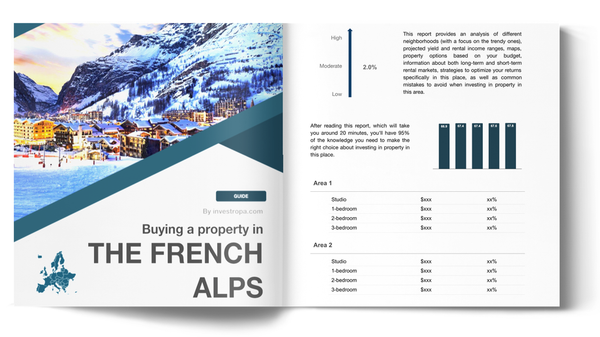
Yes, the analysis of the French Alps' property market is included in our pack
Buying property in the French Alps as a foreigner comes with extra costs beyond the purchase price, and understanding them upfront can save you from expensive surprises.
This guide breaks down every tax, fee, and hidden cost you need to budget for when purchasing a residential property in mountain resort areas like Chamonix, Megève, or Courchevel.
We constantly update this blog post to reflect the latest rates and regulations, so the numbers you see here are current as of early 2026.
And if you're planning to buy a property in this place, you may want to download our pack covering the real estate market in the French Alps.
Overall, how much extra should I budget on top of the purchase price in the French Alps in 2026?
How much are total buyer closing costs in the French Alps in 2026?
As of early 2026, total buyer closing costs in the French Alps typically range from 3% to 12% of the purchase price, which means on a €500,000 property you should budget between €15,000 and €60,000 (roughly $16,000 to $65,000 or £13,000 to £52,000) in additional fees.
The minimum extra budget possible in the French Alps is around 3% of the purchase price (€15,000 on a €500,000 property, or about $16,000/€15,000), but this only applies if you buy a new-build property directly from a developer, pay cash, and skip optional services like independent legal review.
The maximum extra budget buyers should realistically plan for in the French Alps can reach 14% to 16% of the purchase price (€70,000 to €80,000 on a €500,000 property, or roughly $76,000 to $87,000), especially if you buy resale, pay a buyer-side agency fee, use a mortgage, and add translation services.
The main factors that push your closing costs toward the low or high end in the French Alps include whether you buy new-build versus resale (new-build has much lower taxes), whether the agency fee is paid by the buyer or seller, whether you need a mortgage, and how much legal or translation support you require as a foreign buyer.
What's the usual total % of fees and taxes over the purchase price in the French Alps?
The usual total percentage of fees and taxes over the purchase price in the French Alps is around 8% to 12% for resale properties and 3% to 6% for new-build properties.
The realistic low-to-high percentage range that covers most standard property transactions in the French Alps spans from about 3% (best-case new-build with no mortgage) to around 12% (typical resale with agency fee), though complex transactions can exceed this.
Of that total percentage in the French Alps, roughly 5% to 6% goes to government transfer taxes in resale transactions, while the remaining 2% to 3% covers notary remuneration, administrative costs, and optional professional services.
By the way, you will find much more detailed data in our property pack covering the real estate market in the French Alps.
What costs are always mandatory when buying in the French Alps in 2026?
As of early 2026, the mandatory costs when buying property in the French Alps include notary acquisition fees (which bundle transfer taxes, regulated notary remuneration, and land registry formalities), and these cannot be avoided regardless of property type or buyer nationality.
Optional but highly recommended costs for foreign buyers in the French Alps include sworn translation or interpreter services for the purchase contract and final deed, independent legal review by an avocat (especially for complex resort setups or tourist residences), and bank-side property valuations if you are taking out a mortgage.
Don't lose money on your property in the French Alps
100% of people who have lost money there have spent less than 1 hour researching the market. We have reviewed everything there is to know. Grab our guide now.

What taxes do I pay when buying a property in the French Alps in 2026?
What is the property transfer tax rate in the French Alps in 2026?
As of early 2026, the property transfer tax rate in the French Alps for resale properties typically lands between 5.1% and 5.8% of the purchase price, with the exact rate depending on which Alpine department you buy in (Savoie, Haute-Savoie, Isère, Hautes-Alpes, or Alpes-de-Haute-Provence).
There are no extra transfer taxes for foreigners buying property in the French Alps, as France applies the same published departmental rates to all buyers regardless of nationality.
Buyers pay VAT (at 20%) on new-build or off-plan (VEFA) residential property purchases in the French Alps, and in exchange, the registration duties are significantly reduced, which is why total acquisition costs are lower for new construction.
What English speakers call "stamp duty" in the French Alps is effectively the transfer tax collected through the notary at the time of completion, and if you have a mortgage, there may also be additional taxes linked to mortgage registration.
Are there tax exemptions or reduced rates for first-time buyers in the French Alps?
France does not offer a broad nationwide "first-time buyer" stamp duty exemption in the French Alps, but the main way to reduce acquisition taxes is to buy new-build or off-plan property, which qualifies for reduced registration duties regardless of buyer status.
If you buy property through a company (such as an SCI) in the French Alps, purchase taxes are generally similar at acquisition, but the ongoing accounting costs and future income tax or capital gains treatment can differ significantly depending on whether the company is taxed transparently or as a corporation.
Yes, there is a major tax difference between buying new-build versus resale property in the French Alps: new-build purchases fall under the VAT regime with reduced registration duties (leading to around 2% to 3% in notary costs), while resale purchases trigger the full transfer tax package (around 7% to 8% in notary costs).
To qualify for the reduced rates on new-build property in the French Alps, you simply need to purchase from a developer selling under the VEFA or new-build regime, and there is no special first-time buyer documentation required.

We did some research and made this infographic to help you quickly compare rental yields of the major cities in France versus those in neighboring countries. It provides a clear view of how this country positions itself as a real estate investment destination, which might interest you if you’re planning to invest there.
Which professional fees will I pay as a buyer in the French Alps in 2026?
How much does a notary or conveyancing lawyer cost in the French Alps in 2026?
As of early 2026, the notary's total bill in the French Alps runs around 7% to 8% of the purchase price for resale properties (roughly €35,000 to €40,000 on a €500,000 property, or about $38,000 to $43,000) and around 2% to 3% for new-build properties (€10,000 to €15,000, or $11,000 to $16,000).
Notary fees in the French Alps are charged as a combination of regulated percentages (which decrease on price bands) plus fixed disbursements, so they scale with property value but include both percentage-based and flat-rate components.
Translation services for foreign buyers in the French Alps typically cost €40 to €80 per page ($43 to $87) for sworn written translation of documents, and interpreter services for signings or meetings run €300 to €600 ($325 to $650) per half-day.
A tax advisor is not mandatory in the French Alps, but if you have cross-border income, plan to use an SCI structure, or want to do short-term rentals, expect to pay €400 to €1,500 ($435 to $1,630) for a straightforward review or €1,500 to €3,500+ ($1,630 to $3,800+) for structuring advice.
We have a whole part dedicated to these topics in our real estate pack about the French Alps.
What's the typical real estate agent fee in the French Alps in 2026?
As of early 2026, the typical real estate agent fee in the French Alps ranges from 4% to 7% of the purchase price including VAT, which on a €500,000 property means €20,000 to €35,000 (roughly $22,000 to $38,000 or £17,000 to £30,000).
In the French Alps, either the buyer or the seller can pay the agent fee depending on how the listing is structured, and you will often see "fees payable by the buyer" (honoraires à la charge de l'acquéreur) in resort property listings.
The realistic low-to-high range for agent fees in the French Alps spans from about 4% for standard properties to 7% or more for very prime resort stock in places like Courchevel 1850, Megève, or central Chamonix.
How much do legal checks cost (title, liens, permits) in the French Alps?
Legal checks in the French Alps, including title searches, liens verification, and permits review, are mostly embedded in the notary process, but extra copropriété document packages or deep-dive reviews typically cost €100 to €400 ($110 to $435), while independent lawyer review runs €800 to €2,500 ($870 to $2,700) for standard files.
Property valuation fees in the French Alps, which banks often require if you take out a mortgage, typically cost €200 to €500 ($220 to $545).
The most critical legal check you should never skip in the French Alps is the copropriété (co-ownership) documentation review, especially for ski residence apartments, because this reveals any upcoming major works, unpaid charges, or building-level financial problems.
Get the full checklist for your due diligence in the French Alps
Don't repeat the same mistakes others have made before you. Make sure everything is in order before signing your sales contract.
What hidden or surprise costs should I watch for in the French Alps right now?
What are the most common unexpected fees buyers discover in the French Alps?
The most common unexpected fees buyers discover in the French Alps include second-home annual tax surtaxes in resort communes, copropriété special assessments for building works (roofs, façades, boilers, elevators), high running costs for heated ramps, snow clearing, and shared amenities, and energy-renovation pressure on older mountain apartments.
In the French Alps, you typically do not inherit unpaid property taxes (which are tied to the previous owner), but you can inherit unpaid copropriété charges or undisclosed planned building works, which is why careful document review before purchase is essential.
Yes, buyers do get scammed with fake listings or fake "reservation fees" in hot French Alps resort markets, so the rule is that serious payments should only flow through notary or bank channels, never via random transfers to unverified accounts.
Fees that are usually not disclosed upfront by sellers or agents in the French Alps include upcoming copropriété works and special assessments, the true heating and snow-management costs, and second-home surtaxes or local waste taxes that vary by commune.
In our property pack covering the property buying process in the French Alps, we go into details so you can avoid these pitfalls.
Are there extra fees if the property has a tenant in the French Alps?
If the property has a tenant in the French Alps, you will face extra due diligence costs of roughly €200 to €800 ($220 to $870) for reviewing the lease terms, deposits, inventory, and compliance, plus potential legal fees if the tenancy is complex (like a commercial bail in a tourist residence).
When you purchase a tenanted property in the French Alps, you inherit the existing lease and must honor its terms, including the tenant's right to remain until the lease ends and any rent control provisions that may apply.
Terminating an existing lease immediately after purchase in the French Alps is generally not possible for standard residential tenancies, as French law strongly protects tenants and you must wait until the lease renewal period with proper notice (typically at least six months before the lease end).
A sitting tenant in the French Alps typically reduces the property's market value by 10% to 20% or more, which can give you negotiating leverage but also means less immediate flexibility with the property.

We have made this infographic to give you a quick and clear snapshot of the property market in France. It highlights key facts like rental prices, yields, and property costs both in city centers and outside, so you can easily compare opportunities. We’ve done some research and also included useful insights about the country’s economy, like GDP, population, and interest rates, to help you understand the bigger picture.
Which fees are negotiable, and who really pays what in the French Alps?
Which closing costs are negotiable in the French Alps right now?
The closing costs that are negotiable in the French Alps include the real estate agency fee (especially if the buyer is paying it), a small discount on the notary's remuneration for high-value properties, and the "furniture allocation" (mobilier) in furnished ski apartments, which can legitimately reduce the taxable base for transfer taxes.
The closing costs that are fixed by law and cannot be negotiated in the French Alps include transfer taxes, registration duties, and most state-collected fees, as these rates are set by departmental decisions and national law.
Buyers in the French Alps can typically negotiate a 5% to 15% reduction on the agency fee if they have leverage, and properly documented furniture allocations in furnished properties can reduce the transfer tax base by a few thousand euros on eligible items.
Can I ask the seller to cover some closing costs in the French Alps?
Asking the seller to cover some closing costs in the French Alps is possible through price negotiation or fee-splitting arrangements, but sellers agree to this in perhaps 20% to 30% of transactions, usually when the property has been on the market for a while or has issues.
The specific closing costs sellers are most commonly willing to cover in the French Alps include the real estate agency fee (if it was originally buyer-paid), certain pre-sale diagnostic costs, and sometimes contributions toward urgent repairs identified during inspections.
Sellers in the French Alps are more likely to accept covering closing costs when the market is slow, when the property has been listed for several months, when it has energy efficiency problems (poor DPE rating), or when major copropriété works are planned.
Is price bargaining common in the French Alps in 2026?
As of early 2026, price bargaining is common in the French Alps, though the amount varies dramatically depending on location and property condition, with prime resort villages seeing tighter negotiation and less desirable properties allowing more room to negotiate.
In the French Alps, buyers typically negotiate 2% to 5% below asking price in prime areas like Courchevel 1850, Méribel center, central Chamonix, and Megève village, while less prime locations or properties needing work can see discounts of 5% to 10% or more, meaning €10,000 to €50,000 ($11,000 to $54,000) off a €500,000 asking price depending on circumstances.
Don't sign a document you don't understand in the French Alps
Buying a property over there? We have reviewed all the documents you need to know. Stay out of trouble - grab our comprehensive guide.
What monthly, quarterly or annual costs will I pay as an owner in the French Alps?
What's the realistic monthly owner budget in the French Alps right now?
The realistic monthly owner budget in the French Alps (excluding mortgage payments) ranges from about €250 to €650 ($270 to $700) for a typical 50 square meter ski apartment, and €300 to €900 ($325 to $975) or more for a chalet or house with individual maintenance needs.
The main recurring expense categories that make up this monthly budget in the French Alps include copropriété charges (building fees), property insurance, utilities, and a maintenance reserve for unexpected repairs or building works.
The realistic low-to-high range for monthly owner costs in the French Alps spans from about €150 to €200 ($165 to $220) for a small, low-service apartment to €1,000 or more ($1,085+) for large chalets or apartments in high-service buildings with concierge, spa, and heated facilities.
The monthly cost that tends to vary the most in the French Alps is the copropriété charge, because it depends heavily on whether your building has communal heating, a concierge, shared spa facilities, snow clearing services, and how well-maintained the building is overall.
What is the annual property tax amount in the French Alps in 2026?
As of early 2026, the annual property tax (taxe foncière) in the French Alps typically ranges from about €1,300 to €2,100 ($1,400 to $2,280) for a standard residential property, plus a second-home taxe d'habitation that can add several hundred to a few thousand euros depending on the commune.
The realistic low-to-high range for annual property taxes in the French Alps spans from roughly €800 ($870) in lower-tax communes to €4,000+ ($4,350+) in resort towns with high rates and second-home surtaxes, depending on property value and location.
Property tax in the French Alps is calculated based on the cadastral rental value of the property (a theoretical rental value set by the tax authorities), multiplied by rates voted annually by the commune and department, not on the actual market value or purchase price.
There are limited exemptions or reductions available in the French Alps: some apply to new construction (temporary exemption), certain low-income owners, or specific policy categories, but there is no general exemption for foreigners or holiday home owners.

We created this infographic to give you a simple idea of how much it costs to buy property in different parts of France. As you can see, it breaks down price ranges and property types for popular cities in the country. We hope this makes it easier to explore your options and understand the market.
If I rent it out, what extra taxes and fees apply in the French Alps in 2026?
What tax rate applies to rental income in the French Alps in 2026?
As of early 2026, rental income in the French Alps is taxed under French income tax rules, with rates depending on your residency status, the rental regime you choose (furnished versus unfurnished), and your total taxable income, ranging from 0% to 45% plus potential social contributions.
Landlords in the French Alps can deduct expenses from rental income taxes under the "real" (réel) regime, including property management fees, insurance, repairs, mortgage interest, depreciation (for furnished rentals under certain regimes), and copropriété charges.
The realistic effective tax rate after deductions for typical landlords in the French Alps ranges from around 15% to 35%, depending on the regime chosen, the level of deductible expenses, and whether the owner is a French tax resident or non-resident.
Foreign property owners in the French Alps do not necessarily pay a different rental income tax rate, but non-residents are subject to a minimum 20% rate on French-source rental income (or 30% above a certain threshold), and social contributions may also apply depending on their situation and any applicable tax treaty.
Do I pay tax on short-term rentals in the French Alps in 2026?
As of early 2026, short-term rental income in the French Alps is taxable and may also trigger additional obligations including tourist tax collection (taxe de séjour), local registration requirements in some communes, and potentially VAT if you offer hotel-like services (para-hôtellerie).
Short-term rental income in the French Alps is taxed similarly to long-term furnished rental income, but the simplified "micro-BIC" regime offers a 50% automatic deduction (or 71% for classified tourist accommodation), which can result in a lower effective tax burden for casual landlords.
Get to know the market before buying a property in the French Alps
Better information leads to better decisions. Get all the data you need before investing a large amount of money.

If I sell later, what taxes and fees will I pay in the French Alps in 2026?
What's the total cost of selling as a % of price in the French Alps in 2026?
As of early 2026, the total cost of selling a property in the French Alps (excluding any capital gains tax) typically ranges from 5% to 8% of the sale price, primarily driven by the real estate agent commission.
The realistic low-to-high percentage range for total selling costs in the French Alps spans from about 4% (if you sell privately without an agent) to around 10% or more (if you use a premium agent and have extensive diagnostic requirements or mortgage early repayment penalties).
The specific cost categories that typically make up selling expenses in the French Alps include the real estate agent commission (4% to 7%), mandatory property diagnostics package (€500 to €1,500), and potentially early mortgage repayment fees (varies by contract) and minor administrative costs.
The single largest contributor to selling expenses in the French Alps is almost always the real estate agent commission, which typically accounts for 80% or more of the total selling costs.
What capital gains tax applies when selling in the French Alps in 2026?
As of early 2026, the capital gains tax rate when selling property in the French Alps is 19% on the gain for non-residents, plus social contributions that can reach 17.2%, for a combined rate of up to 36.2% before any relief.
The main exemption to capital gains tax in the French Alps is holding-period relief: the gain becomes fully exempt from income tax after 22 years of ownership and fully exempt from social contributions after 30 years, with graduated reductions applying from year 6 onward.
Foreigners do not pay extra capital gains taxes when selling property in the French Alps beyond the standard rates, though social contribution specifics and treaty positions can affect the final amount owed.
The capital gain in the French Alps is calculated as the sale price minus the purchase price (including original acquisition costs), adjusted for documented improvement works, with the holding-period relief then applied to reduce the taxable amount.

We made this infographic to show you how property prices in France compare to other big cities across the region. It breaks down the average price per square meter in city centers, so you can see how cities stack up. It’s an easy way to spot where you might get the best value for your money. We hope you like it.
What sources have we used to write this blog article?
Whether it's in our blog articles or the market analyses included in our property pack about the French Alps, we always rely on the strongest methodology we can … and we don't throw out numbers at random.
We also aim to be fully transparent, so below we've listed the authoritative sources we used, and explained how we used them and the methods behind our estimates.
| Source | Why it's authoritative | How we used it |
|---|---|---|
| French Tax Authority (DGFiP) - Notary Fees FAQ | It's the official tax administration explaining what is legally collected on a purchase. | We used it to confirm what "frais de notaire" legally include. We also used it to structure the mandatory versus optional costs breakdown. |
| French Ministry of Economy - Notary Fees Explainer | It's a government explainer consolidating acquisition costs for consumers. | We used it to anchor typical fee ranges and discount rules. We cross-checked how costs differ between new-build and resale. |
| French Tax Authority (DGFiP) - Buy New-Build | It's the official rulebook for VAT and reduced duties in new-build purchases. | We used it to explain VAT on new residential property. We set the minimum closing-cost scenario based on this guidance. |
| French Tax Authority (DGFiP) - Transfer Tax Rates 2026 | It's the official, dated table of transfer-tax rates by department. | We used it to explain why the French Alps vary by department. We supported the 2026 transfer tax rate section with this data. |
| Legifrance - CGI Transfer Tax Framework | It's the official publication of French law (Code général des impôts). | We used it to ground what's legally possible on departmental rates. We cross-checked that tax authority tables sit on this legal base. |
| Notaires de France - Reduced Notary Fees | It's the national notaries' network explaining new-build fee reductions. | We used it to quantify new-build notary fee ranges. We explained when reduced fees apply (neuf/VEFA situations). |
| Notaires de France - VAT and Property Sales | Notaires are a primary practitioner source for VAT in property transactions. | We used it to explain when VAT applies and why some cases are tricky. We supported the VAT new versus resale section. |
| French Tax Authority (DGFiP) - Non-Resident Capital Gains | It's the official non-resident guidance for French real-estate capital gains. | We used it for the headline CGT rate (19%) and social contributions reference. We built the "sell later" section on this guidance. |
| Ministry of Economy - Local Taxes Viewer | It's a government tool pointing to calculated local tax rates by commune. | We used it to explain how to verify exact Alpine commune rates. We supported the owner budget methodology with this tool. |
| Savoie/Haute-Savoie Notaries Chamber - Market Notes | It's the local notaries' statistical publication for the Alps. | We used it to keep the guide Alps-specific rather than Paris-centric. We justified that resort markets behave differently. |
| Le Monde - Second-Home Surtax Trend | It's a major national newspaper citing official rules and municipal decisions. | We used it to highlight the Alpine-relevant cost risk of second-home surtaxes. We explained why annual tax bills can jump in resort communes. |
Get fresh and reliable information about the market in the French Alps
Don't base significant investment decisions on outdated data. Get updated and accurate information.


