
Authored by the expert who managed and guided the team behind the France Property Pack
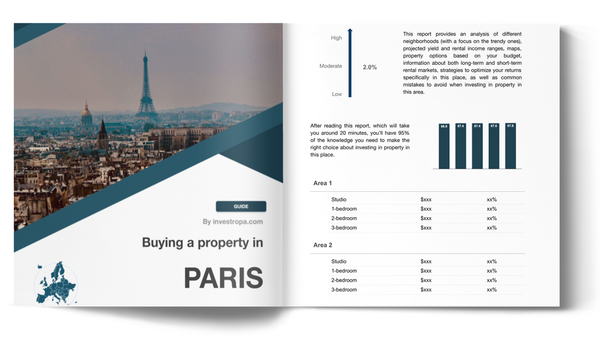
Yes, the analysis of Paris' property market is included in our pack
If you're thinking about buying property in Paris, the first question you probably have is: what can I actually afford?
Paris real estate prices vary wildly depending on the arrondissement, the size of the apartment, and the condition of the building, so it helps to know what each budget level really gets you in early 2026.
This blog post breaks down what you can realistically buy in Paris at $100k, $200k, $300k, and $500k, and we update these figures regularly to reflect the latest market data.
And if you're planning to buy a property in this place, you may want to download our pack covering the real estate market in Paris.
What can I realistically buy with $100k in Paris right now?
Are there any decent properties for $100k in Paris, or is it all scams?
With $100k (around €85,000 all-in, or roughly €79,000 after closing costs), you can realistically buy a micro-studio or a small "chambre de service" in Paris, typically ranging from 7 to 12 square meters in the more affordable arrondissements.
The neighborhoods in Paris that offer the best value and most legitimate options for a $100k budget are the 19th arrondissement (areas like La Villette, Ourcq, and Danube) and the 20th arrondissement (areas like Porte de Bagnolet, Saint-Blaise, and Belleville), where prices sit around €7,850 to €8,290 per square meter.
Buying in popular or upscale areas of Paris like the 6th or 7th arrondissement for $100k is technically possible, but you would be limited to very small top-floor service rooms of around 5 to 6 square meters, which often come with strict building rules and awkward layouts.
What property types can I afford for $100k in Paris (studio, land, old house)?
For $100k (€85,000) in Paris, the only realistic property type you can afford is a micro-studio apartment, and land or houses are simply not available at this price point inside the city.
At this budget level in Paris, buyers should typically expect older buildings with dated electrics, tired bathrooms, and possible insulation issues, so renovation costs should be factored into your planning.
Among property types at the $100k level in Paris, a well-located micro-studio near a metro station in the 19th or 20th arrondissement tends to offer the best long-term value because it appeals to the largest pool of renters and future buyers.
What's a realistic budget to get a comfortable property in Paris as of 2026?
As of early 2026, a realistic minimum budget to get a comfortable property in Paris is around €250,000 to €300,000 (approximately $295,000 to $350,000 USD), which allows you to buy a proper studio or small one-bedroom of 25 to 35 square meters in the more affordable arrondissements.
Most buyers looking for a comfortable standard in Paris typically need a budget range of €350,000 to €500,000 ($410,000 to $590,000 USD) to access a well-maintained one-bedroom or small two-bedroom apartment in decent locations.
In Paris, "comfortable" generally means an apartment of at least 25 to 40 square meters with a functional layout, a proper bathroom, a separate kitchen area, good natural light, and a building with an elevator if above the second floor.
The required budget in Paris can vary significantly depending on the neighborhood: you might find a comfortable 35 square meter apartment for €280,000 in the 19th arrondissement (Jourdain area), while the same size in the Marais (4th arrondissement) would cost €400,000 or more.
Get fresh and reliable information about the market in Paris
Don't base significant investment decisions on outdated data. Get updated and accurate information.

What can I get with a $200k budget in Paris as of 2026?
What "normal" homes become available at $200k in Paris as of 2026?
As of early 2026, a $200k budget (around €170,000 all-in, or €158,000 after closing costs) in Paris gets you a real studio apartment rather than a micro-unit, though it will still be compact and likely in the outer arrondissements.
For this budget in Paris, you can expect a typical size of around 16 to 20 square meters depending on the neighborhood: roughly 19 to 20 square meters in the 19th or 20th arrondissement, or closer to 16 to 17 square meters in the more central 10th or 11th arrondissement.
By the way, we have much more granular data about housing prices in our property pack about Paris.
What places are the smartest $200k buys in Paris as of 2026?
As of early 2026, the smartest neighborhoods to buy at $200k in Paris are the 19th arrondissement (especially Ourcq and La Villette), the 20th arrondissement (Jourdain, Télégraphe, and Père Lachaise edges), and parts of the 12th arrondissement near Porte de Vincennes.
What makes these areas smarter buys compared to other $200k options in Paris is their combination of lower price per square meter, excellent metro connectivity, and established neighborhood character that attracts both renters and owner-occupiers.
The main growth and appreciation factor driving value in these smart-buy areas of Paris is the ongoing urban renewal around canal and park areas in the 19th, plus the spillover effect from more expensive neighboring arrondissements pushing demand into these zones.

We have made this infographic to give you a quick and clear snapshot of the property market in France. It highlights key facts like rental prices, yields, and property costs both in city centers and outside, so you can easily compare opportunities. We’ve done some research and also included useful insights about the country’s economy, like GDP, population, and interest rates, to help you understand the bigger picture.
What can I buy with $300k in Paris in 2026?
What quality upgrade do I get at $300k in Paris in 2026?
As of early 2026, the main quality upgrade when moving from $200k to $300k (€255,000 all-in, or €238,000 after costs) in Paris is not luxury finishes but livability: you can move from a compact studio to a proper studio or small one-bedroom with a functional layout.
A $300k budget can sometimes buy a property in a newer building in Paris, but usually only if the apartment is still relatively small (mid-20s square meters) or located in a less in-demand micro-pocket of an outer arrondissement.
At this budget level in Paris, specific features that typically become available include a separate kitchen corner, a properly sized bathroom, better natural light, and buildings with fewer "compromises" like difficult stair access or noisy street exposure.
Can $300k buy a 2-bedroom in Paris in 2026 in good areas?
As of early 2026, finding a 2-bedroom property for $300k (€238,000 after costs) in good areas of Paris is very unlikely, because a typical 2-bedroom apartment of 45 to 60 square meters requires €360,000 to €540,000 even in the cheaper arrondissements.
The only specific areas in Paris where 2-bedroom options might approach this budget are the far edges of the 19th and 20th arrondissements (such as Porte de Pantin or Porte de Bagnolet), but these properties often need significant renovation or have compromised layouts.
If you did find a $300k 2-bedroom in Paris, the typical size would be around 40 to 45 square meters, which is on the smaller end for a 2-bedroom and often involves a second bedroom that is quite compact.
Which places become "accessible" at $300k in Paris as of 2026?
At the $300k price point in Paris, neighborhoods that become accessible for a functional small apartment include the 13th arrondissement (Maison-Blanche, Butte-aux-Cailles edges, Tolbiac), the 12th arrondissement (Bel-Air, Porte Dorée, Daumesnil), and more of the 20th arrondissement (Jourdain, Gambetta, Saint-Fargeau).
What makes these newly accessible areas in Paris desirable compared to lower-budget zones is their better building stock, proximity to parks like Bois de Vincennes and Butte-aux-Cailles, and established dining and shopping streets that create genuine neighborhood life.
For $300k in these newly accessible Paris areas, buyers can typically expect a proper studio or small one-bedroom of around 28 to 32 square meters with a reasonable layout, rather than the micro-units available at lower budgets.
Get to know the market before buying a property in Paris
Better information leads to better decisions. Get all the data you need before investing a large amount of money.
What does a $500k budget unlock in Paris in 2026?
What's the typical size and location for $500k in Paris in 2026?
As of early 2026, a $500k budget (€426,000 all-in, or €396,000 after closing costs) in Paris typically buys around 50 square meters in the 19th arrondissement, 41 square meters in the 11th arrondissement, or 28 square meters in the premium 6th arrondissement, giving you a real choice between space and location.
A $500k budget can occasionally buy a Paris apartment with a small terrace or balcony, but a true family home with a garden is very uncommon inside Paris proper and would typically be priced much higher.
At $500k in Paris, the typical configuration is a comfortable one-bedroom or small two-bedroom apartment with one bathroom, though in outer arrondissements you might find a proper two-bedroom of around 50 square meters with slightly more flexible layouts.
Which "premium" neighborhoods open up at $500k in Paris in 2026?
At $500k in Paris, premium neighborhoods that open up to buyers include edges of the Marais (3rd and 4th arrondissements), parts of the 5th arrondissement (Jardin des Plantes, Place Monge), and select streets in the 9th arrondissement (Saint-Georges, good parts of Pigalle).
What makes these Paris neighborhoods considered premium is their combination of historic Haussmannian architecture, walkability to major cultural landmarks, excellent restaurant and cafe scenes, and strong international desirability that supports long-term value.
For $500k in these premium Paris neighborhoods, buyers can realistically expect a small one-bedroom apartment of around 28 to 38 square meters, often in a classic building with character features like parquet floors and high ceilings, but with limited outdoor space.

We did some research and made this infographic to help you quickly compare rental yields of the major cities in France versus those in neighboring countries. It provides a clear view of how this country positions itself as a real estate investment destination, which might interest you if you’re planning to invest there.
What counts as "luxury" in Paris in 2026?
At what amount does "luxury" start in Paris right now?
In Paris, properties start being considered luxury at around €1,000,000 ($1.18 million USD), which is the threshold where buyers can access both a prime address and genuine high-end building quality or finishes.
The entry point to luxury real estate in Paris is defined by properties in the top arrondissements (6th, 7th, 8th, 16th) priced at €12,000 to €14,000 or more per square meter, featuring Haussmannian details, premium building maintenance, and often views or balconies.
Compared to other major global cities like London or New York, the Paris luxury threshold is relatively accessible in terms of price per square meter, though prime Paris apartments tend to be smaller than their counterparts in those markets.
The typical price range for mid-tier luxury in Paris is €1.5 to €3 million ($1.75 to $3.5 million USD), while top-tier luxury properties in locations like Place Vendôme, Île Saint-Louis, or Avenue Montaigne start at €5 million and can exceed €20 million.
Which areas are truly high-end in Paris right now?
The truly high-end neighborhoods in Paris right now are Saint-Germain-des-Prés and Luxembourg in the 6th, Invalides and Champ de Mars in the 7th, Triangle d'Or and Faubourg Saint-Honoré in the 8th, Passy and La Muette in the 16th, and Île Saint-Louis in the 4th.
What makes these Paris areas considered truly high-end is their concentration of historic private mansions (hôtels particuliers), proximity to iconic landmarks like the Eiffel Tower and Palais Royal, prestigious school catchments, and the presence of luxury boutiques and Michelin-starred restaurants.
The typical buyer profile for these high-end Paris areas includes international executives, successful entrepreneurs, established families seeking generational properties, and wealthy individuals from the Middle East, United States, and other European countries looking for a pied-à-terre or primary residence.
Don't buy the wrong property, in the wrong area of Paris
Buying real estate is a significant investment. Don't rely solely on your intuition. Gather the right information to make the best decision.
How much does it really cost to buy, beyond the price, in Paris in 2026?
What are the total closing costs in Paris in 2026 as a percentage?
As of early 2026, total closing costs in Paris for an existing (older) property typically run around 7% to 8% of the purchase price, while new-build properties have lower costs of around 2% to 3%.
The realistic low-to-high percentage range that covers most standard Paris transactions is 7% to 8.5% for resale apartments, with variations depending on the exact property price and any recent policy adjustments to transfer taxes.
The specific fee categories that make up this total percentage in Paris include transfer taxes (the largest portion at around 5.8%), notary fees (regulated and relatively small), land registry fees, and various administrative disbursements.
To avoid hidden costs and bad surprises, you can check our our pack covering the property buying process in Paris.
How much are notary, registration, and legal fees in Paris in 2026?
As of early 2026, notary, registration, and legal fees in Paris for a €300,000 property total approximately €21,000 to €24,000 ($25,000 to $28,000 USD), representing the bulk of your closing costs.
These fees typically represent around 7% to 8% of the property price in Paris, with the exact percentage slightly lower for more expensive properties due to the regressive structure of some fee components.
Among these three fee types in Paris, registration taxes (droits de mutation) are by far the most expensive, accounting for roughly 5.8% of the purchase price, while the notary's actual remuneration is a much smaller regulated amount.
What annual property taxes should I expect in Paris in 2026?
As of early 2026, annual property tax (taxe foncière) in Paris for a typical apartment ranges from roughly €400 to €800 per year ($470 to $940 USD) for a 20 square meter studio, up to €1,000 to €1,600 ($1,175 to $1,880 USD) for a 60 square meter family apartment.
Paris property taxes are calculated based on the cadastral rental value of the property rather than market value, so they typically represent a relatively small percentage (often under 1%) of the property's actual worth.
Property taxes in Paris can vary based on the specific property's cadastral classification and any improvements, though location within Paris does not dramatically change the rate since the city applies a uniform municipal rate.
There are limited exemptions available in Paris, primarily for certain new constructions (temporary exemption for the first two years) and for property owners over 75 with modest incomes, so most buyers should budget for the full tax amount.
Is mortgage a viable option for foreigners in Paris right now?
Obtaining a mortgage as a foreigner in Paris is viable but more challenging than for French residents, as banks apply stricter documentation requirements and often expect higher down payments of 20% to 30% or more.
Typical loan-to-value ratios available to foreign buyers in Paris range from 70% to 80% (meaning you need 20% to 30% down), with interest rates in early 2026 generally between 3% and 4% depending on your profile and the lender.
Foreign buyers seeking a Paris mortgage typically need to provide proof of income (tax returns, employment contracts), bank statements showing stable finances, identification documents, and often proof of existing assets, with the process taking longer than for residents.

We made this infographic to show you how property prices in France compare to other big cities across the region. It breaks down the average price per square meter in city centers, so you can see how cities stack up. It’s an easy way to spot where you might get the best value for your money. We hope you like it.
What should I predict for resale and growth in Paris in 2026?
What property types resell fastest in Paris in 2026?
As of early 2026, the property types that resell fastest in Paris are well-priced studios and one-bedroom apartments near metro stations, because they attract the largest pool of both first-time buyers and investors.
The typical time on market to sell a correctly priced property in Paris is around 2 to 3 months from listing to accepted offer, though high-demand units in popular neighborhoods can sell faster.
What makes certain Paris properties sell faster is a combination of being on the right metro line (lines 1, 9, and 11 are particularly desirable), having a good energy performance rating (DPE), and being in a well-maintained co-ownership with reasonable charges.
The property types that tend to be slowest to resell in Paris are large family apartments above €1 million (smaller buyer pool), properties with poor DPE ratings (F or G, which face rental restrictions), and top-floor units without elevators in buildings above four stories.
If you're interested, we cover all the best exit strategies in our real estate pack about Paris.
Make a profitable investment in Paris
Better information leads to better decisions. Save time and money. Download our data.
What sources have we used to write this blog article?
Whether it's in our blog articles or the market analyses included in our property pack about Paris, we always rely on the strongest methodology we can... and we don't throw out numbers at random.
We also aim to be fully transparent, so below we've listed the authoritative sources we used, and explained how we used them and the methods behind our estimates.
| Source | Why it's authoritative | How we used it |
|---|---|---|
| Chambre des Notaires de Paris price database | It's the official Paris notaries' transaction-based dataset, the closest to ground truth pricing. | We used it as our core price per square meter reference for each Paris arrondissement (Q3 2025 data). We then converted USD budgets into realistic Paris surface areas. |
| Chambre des Notaires de Paris price methodology | It explains the official notary methodology for standardized prices aligned with Notaires-INSEE. | We used it to validate how arrondissement prices are computed. We also used it to frame January 2026 as the most recent publication window. |
| Notaires de France Q3 2025 market note | It's the national notaries' official market commentary based on signed deals and pre-contracts. | We used it to describe Paris market conditions in early 2026. We used it to support resale and negotiation timing comments. |
| INSEE Notaires-INSEE housing price indices | INSEE is France's official statistics agency co-producing the housing price indices. | We used it to cross-check broader Île-de-France price direction. We used it to avoid relying on listings-only sources. |
| Notaires de France acquisition costs guide | It's the notaries' official explanation of closing costs, taxes, and fee components. | We used it to estimate realistic closing cost ranges. We used it to translate costs into all-in budget calculations. |
| French government HCSF credit rules | It's the government's official page for binding mortgage rules applied by banks. | We used it to explain why mortgages are harder for foreigners. We used it to ground mortgage viability in actual regulation. |
| DGFiP taxe foncière statistics | It's an official statistical publication from the French tax administration on property tax. | We used it to support that taxe foncière is material and rising. We used it to avoid blog estimates as the only basis for tax discussion. |
| European Central Bank EUR/USD rate | The ECB reference rate is a clean, auditable benchmark for currency conversion. | We used it to convert USD budgets into EUR. We used it so the surface area calculations are numerically consistent. |
| PAP time-to-sell analysis | PAP is a major French property marketplace that publishes market-practice metrics. | We used it as a practical cross-check for typical selling times in Paris. We used it to complement notaries' qualitative framing. |
| Ville de Paris tax information | It's the City of Paris explaining the local tax system and what taxes exist. | We used it to confirm what local taxes apply at the city level. We used it to frame what buyers should ask sellers for. |

We created this infographic to give you a simple idea of how much it costs to buy property in different parts of France. As you can see, it breaks down price ranges and property types for popular cities in the country. We hope this makes it easier to explore your options and understand the market.
