
Authored by the expert who managed and guided the team behind the France Property Pack
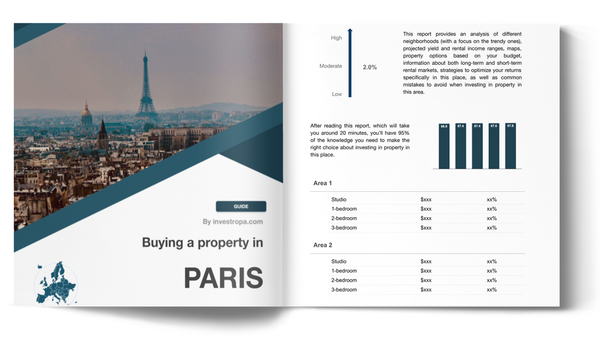
Get all the data you need about the real estate market in Paris
We constantly update this blog post so Paris property buyers can read fresh data instead of old market opinions.
As of June 2026, Paris residential property is no longer in the same frozen market seen in 2023 and 2024.
The Paris property market is stabilizing, but buyers still need to be selective because prices remain high compared with local incomes.
And if you’re planning to buy a property in this place, you may want to download our pack covering the real estate market in Paris.
So, is now a good time?
As of June 2026, buying a property in Paris is generally a reasonable choice, but only if you buy carefully and avoid overpriced listings.
The strongest signal is that Paris apartment prices have stopped falling clearly, while closed-sale data now points more to stabilization than panic.
Another strong signal is that mortgage credit in France has reopened compared with 2024, even if borrowing is still not cheap.
Other strong signals are tight usable housing supply, low practical rental vacancy, strict building constraints, and still-deep buyer demand for good Paris apartments.
The best strategy is to buy a liquid apartment, or a rare house-like property, in a strong Paris neighborhood and hold it for several years rather than expect a quick flip.
This is not financial or investment advice, we do not know your personal situation, and you should always do your own research before buying property in Paris.
Is it smart to buy now in Paris, or should I wait as of 2026?
Do real estate prices look too high in Paris as of 2026?
As of 2026, Paris property prices still look about 10% to 20% above what local incomes alone would justify, but they look much less stretched than during the 2020 to 2022 peak.
The clearest listings signal is that many ordinary Paris apartments still need price cuts or negotiation, especially when the unit has a weak DPE rating, no lift, little light, high charges, or renovation work.
At the same time, good renovated apartments in places like Saint-Germain-des-Prés, the Marais, Auteuil, Batignolles, Commerce, and Canal Saint-Martin still move much faster, which means the Paris market is expensive but not uniformly weak.
Found a place and not sure about the price? Ask us.
Does a property price drop look likely in Paris as of 2026?
As of 2026, the risk of a meaningful Paris property price decline over the next 12 months looks medium rather than high.
A reasonable 12-month range for Paris residential prices is roughly 3% down to 4% up, with better apartments doing better than flawed or overpriced stock.
The single macro factor that would most increase the risk of a Paris price drop is a renewed rise in mortgage rates, because Paris buyers already face high prices and strict borrowing rules.
That risk is real but not our base case, because Banque de France data shows housing credit has stabilized after the rebound, even though rates remain sensitive.
Finally, please note that we cover the price trends for next year in our pack about the property market in Paris.
Could property prices jump again in Paris as of 2026?
As of 2026, the likelihood of a renewed Paris property price surge in the next 12 months looks low to medium.
The plausible upside range is about 1% to 4% for good Paris apartments, while exceptional turnkey homes or rare townhouse-style properties may do better in very specific streets.
The biggest demand-side trigger would be cheaper credit, because many buyers who waited in 2023 and 2024 could return if monthly payments become easier.


Got a question about the market in France?
Prices, areas, rentals: ask us what you'd ask a friend who knows. Free reply within 12 hours.
Ask us your question →
Are we in a buyer or a seller market in Paris as of 2026?
As of 2026, Paris is a neutral to slightly buyer-leaning market overall, but it is still seller-leaning for the best renovated apartments in the best streets.
The closest practical estimate is that ordinary Paris apartments often sit in a 3 to 5 month selling window, which gives buyers room to negotiate when the listing is not special.
Price reductions are common enough on weak stock to show that sellers no longer control the whole market, but the best homes in the 5th, 6th, 7th, 8th, 16th, and strong parts of the 11th and 15th remain protected by scarcity.
Not sure the price you're looking at is fair? Send it to us.
Get fresh and reliable information about the market in Paris
Don't base significant investment decisions on outdated data. Get updated and accurate information.

Are homes overpriced, or fairly priced in Paris as of 2026?
Are homes overpriced versus rents or versus incomes in Paris as of 2026?
As of 2026, Paris homes look clearly expensive versus local incomes and only moderately expensive versus rents, because sale prices corrected while rents stayed firm.
A typical Paris apartment around €9,700 per square meter and a controlled long-term rent around €30 to €38 per square meter per month gives a simple price-to-rent ratio near 22 to 27 years, which is above a balanced market but not extreme for central Paris.
Compared with income, the pressure is stronger, because the median living standard in Paris is far below what would make a typical family apartment easy to buy without high savings.
Finally please note that you will have all the indicators you need in our property pack covering the real estate market in Paris.
Are home prices above the long-term average in Paris as of 2026?
As of 2026, Paris home prices are still above their long-term affordability average, but they are no longer at the overheated level seen around the last cycle peak.
The recent 12-month price picture is close to flat to mildly positive for good apartments, which is much slower than the strong Paris growth years before and around the pandemic period.
In inflation-adjusted terms, Paris prices are clearly below their prior peak, which makes the market less risky than 2021 but still not cheap for a normal household buyer.
Don't buy the wrong property, in the wrong area of Paris
Buying real estate is a significant investment. Don't rely solely on your intuition. Gather the right information to make the best decision.
What local changes could move prices in Paris as of 2026?
Got a question about property in France?
Buying, owning or renting out: ask us and get a real answer within 12 hours. Free.
Ask us your question →
Are big infrastructure projects coming to Paris as of 2026?
As of 2026, the biggest infrastructure project affecting Paris property is the Grand Paris Express, but its strongest price impact is likely around connected suburbs rather than inside central Paris.
The Grand Paris Express is being delivered in stages between 2024 and 2030, with 200 kilometers of metro lines and 68 stations planned around the Paris region.
For Paris buyers, the practical effect is that areas near city gateways such as Porte de Clichy, Porte de Saint-Ouen, Porte de Pantin, Porte d’Orléans, Bercy, and Charenton may benefit from better regional access, while suburbs like Saint-Ouen, Clichy, Montreuil, Villejuif, Issy-les-Moulineaux, and Pantin become stronger competitors.
Are zoning or building rules changing in Paris as of 2026?
The most important planning change in Paris is the PLU bioclimatique, which pushes more housing, more greening, office conversion, climate adaptation, and stronger rules around land use.
As of 2026, the likely net effect on Paris property prices is supportive rather than bearish, because the plan may add some housing over time but does not create enough private free-market supply to flood the city.
The most affected areas are office-heavy or redevelopment areas such as parts of the 8th, 12th, 13th, 15th, 17th, and eastern Paris edges, while protected areas like the Marais and parts of the 7th remain much harder to transform.
Worried about what you can't see? Tell us about the place and we'll tell you what to check.
Are foreign-buyer or mortgage rules changing in Paris as of 2026?
As of 2026, there is no broad foreign-buyer ban in Paris, so rule changes are more likely to affect taxes, rental use, and mortgage access than the right to buy.
The most likely foreign-buyer issue is tighter enforcement around furnished rental, tourist use, vacant homes, and tax treatment, rather than a simple ban on non-resident buyers.
The most important mortgage rule remains the HCSF framework, especially the 35% debt-service rule and maturity limits, which keep Paris price growth tied to household borrowing capacity.
Make a profitable investment in Paris
Better information leads to better decisions. Save time and money. Download our data.
Will it be easy to find tenants in Paris as of 2026?
Got a question about the paperwork in France?
Notary, tax number, bank, residence permit: ask us. We reply within 12 hours, for free.
Ask us your question →Is the renter pool growing faster than new supply in Paris as of 2026?
As of 2026, Paris renter demand is not growing fast by population count, but it is still stronger than usable private rental supply.
The best demand signal is not population growth, because Paris has been losing residents, but the persistent need from students, young professionals, separated households, international workers, and people priced out of ownership.
The best supply signal is that regional construction is recovering, but Paris intra-muros has very little spare land and many homes are inactive, vacant, used occasionally, or not available to normal long-term renters.
Not sure it'll pay off as a rental? Send us the numbers.
Are days-on-market for rentals falling in Paris as of 2026?
As of 2026, good Paris rentals are already letting quickly, so days-on-market look more like they are staying very short than falling sharply.
A well-priced studio or one-bedroom near a metro hub, university, hospital, or office district can often attract serious candidates in less than 10 to 20 days, while weaker units can take much longer.
The main reason time-to-let stays short in Paris is that controlled rents cap the upside, but they do not remove the shortage of clean, practical, well-located rental homes.
Are vacancies dropping in the best areas of Paris as of 2026?
As of 2026, practical rental vacancy is very low in strong Paris rental areas like the 5th, 10th, 11th, 12th, 14th, 15th, 17th, Jules Joffrin, Abbesses, Buttes-Chaumont, Jourdain, and Gambetta.
Investor-relevant vacancy for correctly priced long-term rentals is probably below 3% in strong neighborhoods and below 5% across most of Paris, even though structural inactivity is much higher.
A practical sign that the best areas are tightening first is that landlords can be selective on tenant files without raising rents beyond the legal ceiling.
Get to know the market before buying a property in Paris
Better information leads to better decisions. Get all the data you need before investing a large amount of money.
Am I buying into a tightening market in Paris as of 2026?
Got a question about your France purchase?
Taxes, contracts, banks, permits: tell us where you're stuck. We reply within 12 hours, for free.
Ask us your question →Is for-sale inventory shrinking in Paris as of 2026?
As of 2026, we estimate that total Paris for-sale inventory is roughly stable to slightly down versus last year, while quality inventory is down more clearly.
The closest practical months-of-supply proxy is around 3 to 5 months for ordinary apartments, which is near balanced but still gives good buyers some negotiating power.
The main reason quality inventory is shrinking is that many owners with good homes do not need to sell, while buyers now compete more for renovated, bright, efficient apartments.
Are homes selling faster in Paris as of 2026?
As of 2026, good Paris homes are selling faster than in the frozen 2023 market, with a realistic median selling time around 60 to 80 days for mainstream apartments.
That looks modestly better than last year for well-priced homes, but overpriced or renovation-heavy listings can still sit for 90 to 120 days or more.
Are new listings slowing down in Paris as of 2026?
As of 2026, we estimate that new Paris for-sale listings are flat to down about 5% in quality segments, although we are less confident for the whole market.
Paris usually sees more new listings in spring and early summer, so a weak flow in June matters because it means buyers are not getting a large seasonal reset.
The most plausible reason is seller caution, because many Paris owners do not want to sell below the old peak unless they have a life event or a better purchase opportunity.
Still have a question about France?
If this article didn't answer it, ask us. A real person replies within 12 hours, for free.
Ask us your question →Is new construction failing to keep up in Paris as of 2026?
As of 2026, new construction is failing to keep up inside Paris, even though the wider Île-de-France region is seeing a recovery in authorizations.
DRIEAT data shows more than 70,000 homes authorized over 12 months in Île-de-France by March 2026, but that regional recovery does not remove the shortage of private housing inside Paris.
The biggest bottleneck in Paris is land scarcity, followed by heritage constraints, co-ownership complexity, planning rules, and the slow conversion of offices into homes.
Buying real estate in Paris can be risky
An increasing number of foreign investors are showing interest. However, 90% of them will make mistakes. Avoid the pitfalls with our comprehensive guide.

Will it be easy to sell later in Paris as of 2026?
Is resale liquidity strong enough in Paris as of 2026?
As of 2026, Paris resale liquidity is strong enough for realistic sellers, especially for apartments that are easy to understand, easy to rent, and easy to finance.
The median resale time is roughly 60 to 80 days for well-priced mainstream Paris apartments, which is close to a healthy market benchmark for a large European city.
The characteristic that most improves resale liquidity in Paris is a clean, bright, efficient apartment near reliable metro access, especially in the 10th, 11th, 12th, 15th, 17th, 18th, 19th, and 20th.
Is selling time getting longer in Paris as of 2026?
As of 2026, selling time in Paris is longer than during the frenzy years, but it is not getting worse compared with the weakest 2023 to 2024 period.
The current realistic range is about 45 to 75 days for strong listings, 60 to 90 days for normal listings, and more than 90 days for flawed or ambitious listings.
The clearest reason selling time can lengthen in Paris is affordability pressure, because buyers can love the city and still refuse an apartment priced 8% to 12% above its real level.
Is it realistic to exit with profit in Paris as of 2026?
As of 2026, the likelihood of selling a Paris property with a profit is medium over a normal holding period, but low if the buyer expects a quick resale.
The minimum holding period that most often makes a profitable Paris exit realistic is about 5 to 7 years, because transaction costs are high.
A typical round-trip cost drag in Paris can reach about 9% to 12% of the property price, so on a €600,000 apartment that is roughly €54,000 to €72,000, about $58,000 to $77,000, or €54,000 to €72,000.
The factor that most improves profit odds is buying below market value in a liquid area, especially if the apartment can be improved through light renovation without major co-ownership risk.
Don't lose money on your property in Paris
100% of people who have lost money there have spent less than 1 hour researching the market. We have reviewed everything there is to know. Grab our guide now.
What sources have we used to write this blog article?
Whether it’s in our blog articles or the market analyses included in our property pack about Paris, we always rely on the strongest methodology we can … and we don’t throw out numbers at random.
We also aim to be fully transparent, so below we’ve listed the authoritative sources we used, and explained how we used them and the methods behind our estimates.
| Source | Why we trust it | How we used it |
|---|---|---|
| Notaires du Grand Paris | It is the official notarial source for completed Greater Paris housing sales. | We used it to anchor closed-sale trends in Paris. We treated it as stronger than asking-price data. |
| Chambre des Notaires de Paris price map | It publishes standardized notarial price data by area. | We used it for Paris price benchmarks. We compared those levels with live private platforms. |
| Banque de France housing loans | It is France’s central bank and the best source for mortgage-credit data. | We used it to judge whether financing supports demand. We also used it to assess crash risk. |
| HCSF mortgage rules | It sets the main macroprudential mortgage rules in France. | We used it to understand buyer borrowing limits. We treated the 35% rule as a cap on fast price growth. |
| INSEE Paris local data | INSEE is France’s official statistics agency. | We used it for population, income, household, and housing context. We compared Paris prices with local affordability. |
| APUR inactive housing in Paris | APUR is Paris’s official urban-planning research agency. | We used it to understand unused housing in Paris. We separated inactive homes from true rental vacancy. |
| DRIEAT Sitadel construction data | It publishes official construction-permit and housing-start data for Île-de-France. | We used it to assess new housing supply. We separated regional construction from Paris intra-muros scarcity. |
| OLAP rent data | OLAP is the reference rent observatory for Paris and nearby areas. | We used it to estimate realistic Paris rents. We combined it with price data to estimate yields. |
| Paris City Hall rent control | It is the official Paris page for rent-control rules. | We used it to avoid overstating rental upside. We treated rent ceilings as a real investor constraint. |
| Service-public.fr rent rules | It is France’s official legal-information portal. | We used it to verify residential rent-control rules. We included it when estimating realistic gross and net yields. |
| Société des grands projets | It is the public project owner for the Grand Paris Express. | We used it to track transport projects around Paris. We treated the impact as strongest in connected suburbs. |
| Paris PLU bioclimatique | It is the official planning framework for Paris urban rules. | We used it to assess future supply and conversion rules. We focused on long-term effects, not short-term hype. |
| Notaires de France non-resident purchase guide | It is the national notarial source for foreign buyers in France. | We used it for foreign-buyer rules. We included taxes, resale treatment, and practical process issues. |
| Meilleurs Agents Paris prices | It is a major French platform with transparent live-market methodology. | We used it only as a live-market cross-check. We did not treat it as stronger than notarial data. |
| SeLoger Paris listings | It is a major French property portal with broad listing coverage. | We used it to read asking-price and supply signals. We treated it as market temperature, not completed-sale evidence. |
Thinking of buying real estate in Paris?
Acquiring property in a different country is a complex task. Don't fall into common traps – grab our guide and make better decisions.
