
Authored by the expert who managed and guided the team behind the France Property Pack
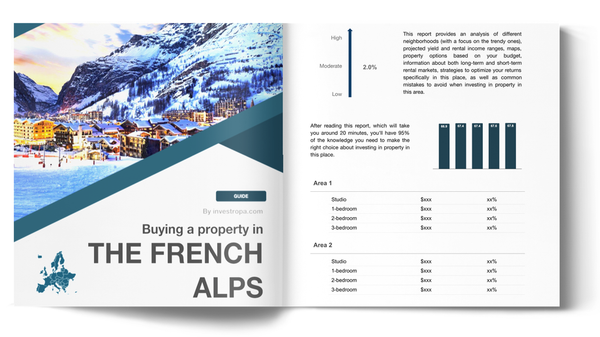
Get all the data you need about the real estate market in the French Alps
Foreigners can buy residential property in the French Alps in 2026, but the safe purchase is the one where ownership, planning, rental rules, taxes and financing all work together.
We constantly update this blog post because French Alps property rules, mortgage conditions and short-term rental controls can change quickly from one commune to another.
This guide focuses on ordinary residential property in the French Alps, including ski apartments, chalets, houses, village homes, new-build homes and residential land.
And if you’re planning to buy a property in this place, you may want to download our pack covering the real estate market in the French Alps.

Fact-checked and reviewed by our local expert
Laurence Rapp 🇬🇧
Sales representative at Skiing Property


What can I legally buy and truly own as a foreigner in the French Alps?
What property types can foreigners legally buy in the French Alps right now?
Foreigners can legally buy ordinary residential property in the French Alps in 2026, including apartments, ski-station flats, copropriété units, chalets, detached houses, village houses, townhouses, VEFA new-build homes and residential building plots.
The main legal condition is not nationality, because the buyer must instead pass the same notarial, anti-money-laundering, planning, tax and financing checks as a French individual buyer.
That means a non-resident buyer can usually own a chalet in Chamonix, an apartment in Megève, a house in Annecy or a ski flat in Morzine, as long as the property itself is legally saleable and the buyer can prove clean funds.
The more difficult part in the French Alps is often not buying the home, but confirming that the home can be rented, renovated, extended, insured and used in the exact way the foreign buyer expects.
Finally, please note that our pack about the property market in the French Alps is specifically tailored to foreigners.
Can I own land in my own name in the French Alps right now?
Yes, a foreign individual can own French Alps land in their own name in 2026, including the land under a chalet, a detached house plot or a residential building plot.
This right does not mean that every type of land is usable, because agricultural land, protected mountain land, forest land, non-buildable land and risk-zone land may be legally ownable but very limited in practice.
For French Alps land, the key question is usually whether the commune, the PLU, the certificat d’urbanisme and the risk documents allow the buyer’s intended project.
By the way, we cover everything there is to know about the land buying process in the French Alps here.
As of 2026, what other key foreign-ownership rules or limits should I know in the French Alps?
As of 2026, the key extra rules in the French Alps are local-use rules, short-term rental controls, copropriété restrictions, energy-performance pressure and mountain planning rules, not a special foreign-buyer law.
There is no general foreign-ownership quota for apartments or copropriété buildings in the French Alps, so a foreign buyer can usually buy the same unit that a French buyer can buy.
The most common registration issue is short-term rental compliance, because many French Alps communes can require a meublé de tourisme declaration, a registration number or a change-of-use authorization before tourist rental.
The notable 2026 change is that France has tightened the tools available to communes for furnished tourist rentals, including stronger local monitoring and more attention to copropriété rules.
What’s the biggest ownership mistake foreigners make in the French Alps right now?
The biggest mistake is buying a French Alps property because it is legally available, then discovering that rental, renovation, extension, parking or energy-upgrade plans are blocked or expensive.
The real-world consequence can be painful, because a buyer may own a ski apartment in Chamonix, Megève or Courchevel but be unable to rent it legally for the income assumed in the budget.
Other classic French Alps pitfalls include weak copropriété checks, underestimated works funds, unclear cellar or attic rights, poor winter access, avalanche or flood exposure, and old buildings with expensive energy upgrades ahead.
Get fresh and reliable information about the market in the French Alps
Don't base significant investment decisions on outdated data. Get updated and accurate information.

Which visa or residency status changes what I can do in the French Alps?
Do I need a specific visa to buy property in the French Alps right now?
You do not need a specific French visa to buy property in the French Alps in June 2026, and a non-resident can buy while visiting France as a tourist if the stay itself is legal.
The most common non-property issue that blocks foreign buyers is banking compliance, because the notaire and the bank must understand the buyer’s identity, tax residence, marital status and source of funds.
You usually do not need a French tax number before signing, but a French tax account becomes important after completion for property notices, rental income, annual declarations and a future sale.
A foreign buyer should expect to provide a passport, proof of address, marital-status documents, proof of funds, bank references, tax-residence information and translated or certified documents when the notaire asks for them.
Does buying property help me get residency and citizenship in the French Alps in 2026?
As of 2026, buying property in the French Alps does not give automatic French residency, permanent residence or citizenship, even if the buyer purchases an expensive chalet.
France does not offer a simple residential-property golden visa, so a chalet in Megève or an apartment in Chamonix can support accommodation evidence but does not replace visa eligibility.
The usual long-stay or residence routes are visitor, work, family, study, entrepreneur or talent status, while long-term residence and citizenship depend on legal stay, integration, income, language and personal circumstances.
Can I legally rent out property on my visa in the French Alps right now?
Your visa status usually does not stop you from owning a French Alps property and receiving rental income, but the property, commune, tax regime and rental format must allow the rental.
You do not need to live in France to rent out a French Alps home, but a non-resident owner normally needs a reliable local manager, cleaner, emergency contact and tax process.
The key rental details are declaration, registration, possible change-of-use authorization, copropriété permission, tourist-tax handling, income-tax filing, guest insurance and winter maintenance.
We cover everything there is to know about buying and renting out in the French Alps here.
Get to know the market before buying a property in the French Alps
Better information leads to better decisions. Get all the data you need before investing a large amount of money.
How does the buying process actually work step-by-step in the French Alps?
What are the exact steps to buy property in the French Alps right now?
The standard French Alps purchase sequence is to define the property type, visit or inspect remotely, make an offer, choose a notaire, sign the promesse or compromis, pay the deposit, complete due diligence, secure financing, sign the acte authentique, pay through the notaire and receive the keys.
You do not always need to be physically present in France, because a valid power of attorney and some electronic signatures can work, although identity checks, bank compliance and property visits often still justify a trip.
The step that typically makes the deal legally serious is the signed compromis de vente or promesse de vente, especially after the buyer’s residential cooling-off period has expired and the conditions are satisfied.
A straightforward French Alps resale usually takes about 8 to 12 weeks from accepted offer to final signing, while foreign financing, complex title, copropriété issues or VEFA purchases can push the timeline to 3 to 6 months or more.
We have a document entirely dedicated to the whole buying process our pack about properties in the French Alps.
Is it mandatory to get a lawyer or a notary to buy a property in the French Alps right now?
A notaire is mandatory to complete and register a French Alps property purchase, while a separate lawyer is optional for most simple residential purchases.
The notaire secures the legal transfer and registration, while a lawyer or tax adviser can protect the buyer’s personal position on inheritance, company ownership, rental structure, disputes and cross-border tax.
For a French Alps purchase, the engagement scope should explicitly cover title, mortgage or lien status, copropriété documents, planning limits, short-term rental permission and any unregistered spaces such as attics, cellars, garages or annexes.
Make a profitable investment in the French Alps
Better information leads to better decisions. Save time and money. Download our data.
What checks should I run so I don’t buy a problem property in the French Alps?
How do I verify title and ownership history in the French Alps right now?
The official route is the service de publicité foncière, usually handled by the notaire, because this service holds the legal property information used to verify ownership history in France.
The key document is the official property information extract from the land-registration records, often requested through the French property-information forms rather than taken from the cadastre map alone.
A realistic look-back period is at least the current owner’s acquisition and prior registered transfers, with deeper review when the chalet, plot, annexes or rights of way have a complicated history.
A red flag is any mismatch between the advertised property and the registered property, such as an attic bedroom, mazot, garage, terrace, ski locker or plot area that the title records do not clearly support.
You will find here the list of classic mistakes people make when buying a property in the French Alps.
How do I confirm there are no liens in the French Alps right now?
The standard way to confirm no liens in the French Alps is for the notaire to request official land-registration information from the service de publicité foncière before completion.
Foreign buyers should specifically ask about registered mortgages, unpaid copropriété charges, servitudes, shared-road obligations and rights of way, because Alpine access and maintenance burdens can be expensive.
The best written proof is the official response from the service de publicité foncière showing the legal situation of the property, including registered mortgages, charges and relevant rights.
How do I check zoning and permitted use in the French Alps right now?
The safest route is to check the commune’s planning rules through the Géoportail de l’Urbanisme, the local PLU, the mairie and, for land or extension plans, a certificat d’urbanisme.
The key zoning reference is the PLU zoning map and written rules for the parcel, supported by the certificat d’urbanisme when the buyer needs confirmation for a project.
A common French Alps pitfall is assuming a chalet can be enlarged or rebuilt because nearby homes are larger, even though avalanche zones, heritage rules, slope risks, parking rules or mountain-law limits may block the project.
Don't buy the wrong property, in the wrong area of the French Alps
Buying real estate is a significant investment. Don't rely solely on your intuition. Gather the right information to make the best decision.
Can I get a mortgage as a foreigner in the French Alps, and on what terms?
Do banks lend to foreigners for homes in the French Alps in 2026?
As of 2026, French banks do lend to some foreign buyers in the French Alps, but the file must be strong, documented and acceptable under the lender’s country, income and risk rules.
Most foreign borrowers should expect roughly 50% to 80% loan-to-value, with stronger EU or Swiss profiles often closer to the top of the range and harder non-resident files closer to the lower range.
The single biggest eligibility factor is stable, verifiable income that the French bank can understand, especially when the borrower earns outside France or outside the eurozone.
You can also read our latest update about mortgage and interest rates in France.
Which banks are most foreigner-friendly in the French Alps in 2026?
As of 2026, the most realistic foreigner-friendly mortgage routes in the French Alps are Crédit Agricole des Savoie or Sud Rhône Alpes, Banque Populaire Auvergne Rhône Alpes and BNP Paribas, often through a broker or private-banking contact.
The feature that makes these lenders more practical is not a public foreigner discount, but local knowledge of Alpine collateral and the ability to process well-documented non-resident or cross-border files.
These banks may lend to non-residents, but a buyer without French residency should expect stricter deposit, insurance, income, age, currency and source-of-funds checks.
We actually have a specific document about how to get a mortgage as a foreigner in our pack covering real estate in the French Alps.
What mortgage rates are foreigners offered in the French Alps in 2026?
As of 2026, strong foreign buyers in the French Alps should plan around 3.5% to 4.2% fixed mortgage rates, while harder non-resident files should stress-test closer to 4.2% to 5.0% plus borrower insurance.
Fixed-rate mortgages remain the normal French planning reference, while variable-rate offers can be cheaper at the start but are less common for cautious foreign buyers who want predictable long-term payments.
Get fresh and reliable information about the market in the French Alps
Don't base significant investment decisions on outdated data. Get updated and accurate information.
What will taxes, fees, and ongoing costs look like in the French Alps?
What are the total closing costs as a percent in the French Alps in 2026?
In 2026, a foreign buyer should usually budget about 7% to 8% closing costs for an existing French Alps home and about 2% to 3% for a new-build VEFA purchase.
A realistic range for most standard French Alps transactions is about 2.5% for new-build homes to about 8% for resale apartments, chalets and houses, excluding any agency fee shown separately.
The usual closing-cost categories are transfer taxes, notaire remuneration, land-registration costs, disbursements, mortgage guarantee or registration costs, bank fees, translations and sometimes legal or tax advice.
The biggest contributor is usually transfer tax on existing property, not the notaire’s personal fee, which is why resale chalets and older ski apartments carry higher acquisition costs.
If you want to go into more details, we also have a blog article detailing all the property taxes and fees in the French Alps.
What annual property tax should I budget in the French Alps in 2026?
As of 2026, a typical French Alps owner should budget about €600 to €1,800, roughly $650 to $1,950, for a small apartment and about €2,000 to €8,000, roughly $2,150 to $8,650, for a larger chalet.
French local property tax is based on cadastral rental value and commune-level tax rates, not simply on the purchase price paid by the foreign buyer.
How is rental income taxed for foreigners in the French Alps in 2026?
As of 2026, foreign owners should often reserve about 20% to 35% of net French Alps rental profit for French income-tax and social-charge exposure until a tax adviser models the exact case.
A non-resident owner usually must declare French-source rental income in France, and furnished and unfurnished rentals use different forms, deductions and tax categories.
What insurance is common and how much in the French Alps in 2026?
As of 2026, a standard French Alps home policy often costs about €200 to €600 per year, roughly $215 to $650, for a small apartment and about €800 to €2,500, roughly $865 to $2,700, for a chalet.
The most common coverage is multi-risk home insurance, often combined with non-occupant owner cover for apartments and extra landlord cover when the property is rented.
The biggest pricing factor in the French Alps is exposure to winter and mountain risk, including vacant periods, frozen pipes, snow load, water damage, fire risk, guest damage and the value of contents.
Get to know the market before buying a property in the French Alps
Better information leads to better decisions. Get all the data you need before investing a large amount of money.
What sources have we used to write this blog article?
Whether it’s in our blog articles or the market analyses included in our property pack about the French Alps, we always rely on the strongest methodology we can … and we don’t throw out numbers at random.
We also aim to be fully transparent, so below we’ve listed the authoritative sources we used, and explained how we used them and the methods behind our estimates.
| Source | Why we trust it | How we used it |
|---|---|---|
| Notaires de France | French notaries complete and register property transfers. | We used it to confirm the non-resident purchase framework. We also used it for tax and notarial-process context. |
| Service-Public.fr buying and selling housing | It is France’s official public-service portal for individuals. | We used it to map the basic purchase process. We also used it to keep the article aligned with current official wording. |
| Service-Public.fr promesse de vente | It explains French preliminary sale contracts in plain terms. | We used it to explain the promesse and compromis stage. We also used it to identify when the buyer becomes seriously committed. |
| Service-Public.fr acte de vente | It covers the final authentic deed for home sales. | We used it to explain why the notaire is mandatory. We also used it to describe the final signing step. |
| Service-Public.fr and ANIL notary-fee simulator | It is the official public simulator for acquisition-cost estimates. | We used it to estimate resale and new-build closing costs. We rounded the figures into simple buyer-friendly percentages. |
| impots.gouv.fr property for non-residents | It is the French tax authority’s own guidance. | We used it for local taxes and non-resident property obligations. We also used it to separate ownership from tax residence. |
| impots.gouv.fr rental income for non-residents | It directly addresses non-resident property income. | We used it to explain French-source rental-income filing. We also used it to avoid relying on expat summaries for tax basics. |
| France-Visas long-stay visa | It is France’s official visa portal. | We used it to confirm the rule for stays over 90 days. We also used it to explain why ownership does not create residence rights. |
| Service-Public.fr talent residence permit | It is the official page for France’s talent permit. | We used it to check whether residential property purchase qualifies as investment. We found that the route focuses on economic activity. |
| Banque de France housing-loan panorama, April 2026 | France’s central bank is the strongest source for mortgage conditions. | We used it as the baseline for 2026 mortgage-rate conditions. We then adjusted for common non-resident lending risk. |
| Service-Public.fr property information | It explains the official property-information request process. | We used it for title and ownership-history checks. We also used it to describe the role of the service de publicité foncière. |
| cadastre.gouv.fr | It is the official French cadastral map portal. | We used it for parcel identification and cadastral-map context. We did not treat it as proof of ownership or exact boundaries. |
| Géoportail de l’Urbanisme | It publishes French zoning documents and public easements. | We used it for PLU, zoning and servitude checks. We also used it because mountain properties face unusual planning risks. |
| Service-Public.fr short-term rental update | It summarizes recent official rental-rule changes. | We used it to update the short-term rental section for 2026. We also used it to explain the stronger role of communes and copropriétés. |
| Légifrance short-term rental law | Légifrance is the official source for French legislation. | We used it to confirm the legal basis for tighter tourist-rental controls. We also used it to avoid relying on press summaries. |
| FNAIM ski-resort study 2025 | FNAIM is a major French real-estate federation. | We used it for French Alps market and energy-risk context. We treated it as market evidence, not as legal authority. |
Make a profitable investment in the French Alps
Better information leads to better decisions. Save time and money. Download our data.
Related blog posts
- Is now a good time to invest in property in the French Alps?