Authored by the expert who managed and guided the team behind the Bulgaria Property Pack

Yes, the analysis of Sofia's property market is included in our pack
Sofia in early 2026 offers one of the best "quality of life per euro" ratios among European capitals, combining fast-growing salaries, a strong tech and services job market, and easy access to Vitosha Mountain.
Bulgaria officially adopted the euro on January 1, 2026, and joined the Schengen Area in 2025, making Sofia even more accessible and appealing for foreigners looking to relocate.
We constantly update this blog post to reflect the latest changes in Sofia's cost of living, job market, visa rules, and property prices.
And if you're planning to buy a property in this place, you may want to download our pack covering the real estate market in Sofia.
Is Sofia a good place to live in 2026?
Is quality of life getting better or worse in Sofia in 2026?
As of early 2026, quality of life in Sofia is generally improving, driven by rising wages, expanding international services, and better metro connectivity, though housing affordability remains a growing concern.
The factor that has improved the most in Sofia over the past two to three years is the job market breadth, especially in IT, shared services, and multilingual customer support roles, which now offer salaries competitive with some Western European cities.
However, the persistent challenge in Sofia remains the housing market, where rents and property prices have increased by 15 to 18 percent annually, outpacing many locals' ability to buy or rent comfortably in central neighborhoods like Lozenets or Oborishte.
Are hospitals good in Sofia in 2026?
As of early 2026, hospitals in Sofia offer generally good care, especially in the private sector, though public facilities can feel bureaucratic and involve longer wait times compared to Western European or North American standards.
The hospitals expats most commonly recommend in Sofia include Acibadem City Clinic Tokuda Hospital, SofiaMed, and Alexandrovska University Hospital (UMHAT Alexandrovska), all of which have English-speaking staff and modern equipment.
A standard private doctor consultation in Sofia in 2026 typically costs between 40 and 120 Bulgarian leva (20 to 60 euros, or 22 to 65 dollars), depending on the specialty, while public system copays are much lower at just a few leva.
Private health insurance is strongly recommended for expats living in Sofia, as it shortens wait times, expands English-speaking options, and simplifies billing at private hospitals, even though employed residents are covered by the public National Health Insurance Fund.


Got a question about property in Bulgaria?
Buying, owning or renting out: ask us and get a real answer within 12 hours. Free.
Ask us your question →
Are there any good international schools in Sofia in 2026?
As of early 2026, Sofia is unusually well-served for international schools given its size, with around five to six major options offering British, American, French, and international baccalaureate curricula.
The most reputable international schools among expat families in Sofia include the Anglo-American School of Sofia (AAS), the British School of Sofia, and the Lycée Français Victor Hugo, all of which have strong academic reputations and active parent communities.
Annual tuition fees at international schools in Sofia in 2026 typically range from 15,000 to 40,000 Bulgarian leva (8,000 to 20,000 euros, or 8,500 to 22,000 dollars), depending on the school and grade level, plus one-time enrollment and capital fees at some institutions.
Waitlists at popular international schools in Sofia can be long, especially at sought-after entry grades, so applying six to twelve months in advance is sensible, while public schools are generally only viable for expat children if the family is committed to Bulgarian-language integration.
Is Sofia a dangerous place in 2026?
As of early 2026, Sofia is generally considered safe for residents and expats by European capital standards, with violent crime being rare and most safety concerns limited to petty theft, scams, and occasional taxi overcharging.
The most common safety concerns expats should be aware of in Sofia include pickpocketing in crowded areas like Vitosha Boulevard and metro stations, ATM skimming fraud, and unlicensed taxis at Sofia Airport overcharging passengers.
The neighborhoods generally considered safest for expats to live in Sofia include Lozenets, Ivan Vazov, Oborishte (near Doctor's Garden), Iztok, and the southern mountain-adjacent areas like Boyana and Dragalevtsi, all of which are well-lit and have active street life.
Women can generally live alone safely in Sofia, though standard big-city precautions apply, such as sticking to well-lit routes at night, avoiding isolated parks late in the evening, and staying alert in crowded nightlife areas.
Thinking of buying real estate in Sofia?
Acquiring property in a different country is a complex task. Don't fall into common traps – grab our guide and make better decisions.

How much does everyday life cost in Sofia in 2026?
What monthly budget do I need to live well in Sofia in 2026?
As of early 2026, a single person in Sofia needs roughly 2,900 to 4,500 Bulgarian leva (1,500 to 2,300 euros, or 1,600 to 2,500 dollars) per month to live comfortably with a good apartment, social life, and occasional dining out.
For a more modest but decent lifestyle in Sofia in 2026, including a smaller apartment outside the city center and cooking at home most days, a single person can manage on about 2,000 to 2,900 leva (1,000 to 1,500 euros, or 1,100 to 1,600 dollars) per month.
For a more comfortable or upscale lifestyle in Sofia in 2026, including a central apartment, regular dining out, gym membership, and short trips, budgeting 4,500 to 6,500 leva (2,300 to 3,300 euros, or 2,500 to 3,600 dollars) per month is realistic for a single person.
The expense category that typically takes up the largest share of a monthly budget in Sofia is rent, which has increased sharply in recent years, with a one-bedroom apartment in the city center now costing 1,200 to 1,800 euros per month in prime areas like Lozenets or Oborishte.
Got a question about your Bulgaria purchase?
Taxes, contracts, banks, permits: tell us where you're stuck. We reply within 12 hours, for free.
Ask us your question →
What is the average income tax rate in Sofia in 2026?
As of early 2026, the estimated effective income tax burden for a typical middle-income employee in Sofia is around 24 percent of gross salary, combining Bulgaria's 10 percent flat personal income tax with approximately 13.78 percent in employee social and health contributions.
Bulgaria uses a flat 10 percent personal income tax rate that applies to all income levels, which is one of the lowest in Europe, while social and health contributions add about 13.78 percent on the employee side (with additional employer contributions on top).
Want us to check the numbers for your case? Write to us, it's free.
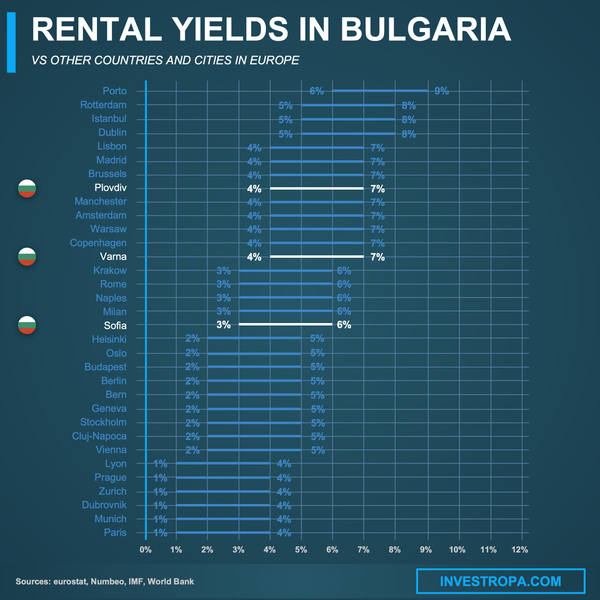
We did some research and made this infographic to help you quickly compare rental yields of the major cities in Bulgaria versus those in neighboring countries. It provides a clear view of how this country positions itself as a real estate investment destination, which might interest you if you’re planning to invest there.
What kind of foreigners actually live in Sofia in 2026?
Where do most expats come from in Sofia in 2026?
As of early 2026, the top countries of origin for expats living in Sofia include EU and UK nationals (especially from Germany, Italy, and the UK), Turkey, Russia, Ukraine, and a smaller but growing number from the United States and Middle Eastern countries.
Foreign residents make up a relatively small share of Sofia's population of roughly 1.4 million, but the number of registered foreigners has increased significantly over the past decade, with estimates suggesting several tens of thousands of non-Bulgarian residents now live in the capital.
The main reason expats from these top origin countries are drawn to Sofia is the combination of lower cost of living, competitive salaries in tech and services sectors, Bulgaria's EU membership with straightforward residency options, and the city's improving international infrastructure.
The expat population in Sofia is predominantly working professionals in their 20s to 40s, especially in IT, shared services, and multilingual support roles, though there is also a smaller but notable segment of retirees, entrepreneurs, and digital nomads attracted by low taxes and affordable living.
Where do most expats live in Sofia in 2026?
As of early 2026, the top neighborhoods where expats concentrate in Sofia include Lozenets, Ivan Vazov, Oborishte (Doctor's Garden area), Iztok, and the mountain-adjacent areas like Boyana and Dragalevtsi for families seeking green space.
What makes these neighborhoods attractive to expats in Sofia is the combination of walkability, proximity to international schools and embassies, modern apartment buildings, good restaurant and cafe scenes, and easy access to Vitosha Mountain for weekend hikes.
Emerging neighborhoods in Sofia that are starting to attract more expats include Krastova Vada and Manastirski Livadi, which offer newer construction, better prices than central districts, and improving metro connectivity, while still being close to South Park and Vitosha.
Got a question about the market in Bulgaria?
Prices, areas, rentals: ask us what you'd ask a friend who knows. Free reply within 12 hours.
Ask us your question →Are expats moving in or leaving Sofia in 2026?
As of early 2026, Sofia continues to experience a net inflow of expats, as the city's concentration of international jobs, EU membership benefits, Schengen access, and euro adoption make it increasingly attractive for foreigners seeking a European base.
The main factor driving expats to move to Sofia right now is the strong job market in IT, shared services, and multilingual customer support, combined with salaries that have been rising 10 to 15 percent annually while still offering lower living costs than Western Europe.
The main factor causing some expats to leave Sofia recently is the housing market pressure, where rents and property prices have increased 15 to 18 percent annually, eroding the "Sofia deal" of high quality of life at low cost that originally attracted many foreigners.
Compared to similar destinations in the region like Bucharest, Belgrade, or Budapest, Sofia's expat population trend is competitive, benefiting from EU and Schengen membership, lower taxes, and a more established international services sector, though housing affordability is becoming a shared regional challenge.
Not sure what your passport allows in Bulgaria? Tell us and we'll check.
Get fresh and reliable information about the market in Sofia
Don't base significant investment decisions on outdated data. Get updated and accurate information.
What paperwork do I need to move to Sofia in 2026?
What visa options are popular in Sofia in 2026?
As of early 2026, the three most popular visa types for expats moving to Sofia are the EU/EEA registration certificate (for European citizens), the employer-sponsored work and residence permit (for non-EU workers), and the newly launched digital nomad visa (for remote workers).
For the most commonly used expat visa in Sofia, the work and residence permit, the main eligibility requirements include a job offer from a Bulgarian employer, proof that the position could not be filled locally, a valid passport, health insurance, and proof of accommodation in Bulgaria.
Bulgaria launched a digital nomad visa in late 2025, which allows remote workers employed by companies outside the EU to live in Sofia legally, with basic conditions including proof of at least one year of remote work experience, a minimum annual income of around 27,500 euros, and valid health insurance.
The typical validity period for popular expat visas in Sofia is one year for the digital nomad visa (renewable once for a total of two years) and one year for temporary residence permits (renewable annually), with permanent residency available after five years of continuous legal residence.
Got a question about the paperwork in Bulgaria?
Notary, tax number, bank, residence permit: ask us. We reply within 12 hours, for free.
Ask us your question →How long does it take to get residency in Sofia in 2026?
As of early 2026, the estimated typical processing time to obtain temporary residency in Sofia is a few weeks for EU/EEA citizens (once documents are ready) and one to three months for non-EU nationals applying through the work permit route, depending on employer readiness and appointment availability.
Common factors that can delay the residency application process in Sofia include incomplete documentation, missing apostilles or Bulgarian translations, backlogs at migration offices, and employer delays in obtaining work permit approvals from the Bulgarian Employment Agency.
An expat must live in Sofia legally for five continuous years before becoming eligible for permanent residency, after which Bulgarian citizenship by naturalization becomes possible with an additional five years of residence and passing a Bulgarian language exam (or obtaining an exemption).
Residency rules change often. Ask us about your case.

We created this infographic to give you a simple idea of how much it costs to buy property in different parts of Bulgaria. As you can see, it breaks down price ranges and property types for popular cities in the country. We hope this makes it easier to explore your options and understand the market.
How hard is it to find a job in Sofia in 2026?
Which industries are hiring the most in Sofia in 2026?
As of early 2026, the top three industries currently hiring the most in Sofia are ICT and software development, business process outsourcing (BPO) and shared services centers, and finance and accounting operations, all of which actively seek multilingual candidates and international professionals.
It is realistic for expats to get hired in Sofia without speaking Bulgarian, especially in tech, multinational services, and customer support roles where English is the working language, though outside this "international bubble," Bulgarian becomes a significant advantage for career advancement.
The types of roles most accessible to foreign job seekers in Sofia include software developers, data analysts, cybersecurity specialists, multilingual customer support agents (especially for German, French, Italian, and Spanish speakers), and finance operations professionals in shared services centers.
What salary ranges are common for expats in Sofia in 2026?
As of early 2026, the estimated typical gross salary range for expats working in Sofia is 2,400 to 6,000 Bulgarian leva per month (1,200 to 3,000 euros, or 1,300 to 3,300 dollars), depending on industry, role seniority, and language skills.
For entry-level or mid-level expat positions in Sofia in 2026, such as multilingual support or junior corporate roles, gross salaries typically range from 2,400 to 4,000 leva per month (1,200 to 2,000 euros, or 1,300 to 2,200 dollars).
For senior or specialized expat roles in Sofia in 2026, such as senior software developers, team leads, or finance managers, gross salaries can range from 6,000 to 12,000 leva per month (3,000 to 6,000 euros, or 3,300 to 6,600 dollars) or higher for top tech talent.
Employers in Sofia do commonly sponsor work visas for foreign hires, especially multinationals in tech, shared services, and finance, though many prefer candidates who already have EU citizenship or the right to work, unless the candidate brings specialized skills that are hard to find locally.
Get to know the market before buying a property in Sofia
Better information leads to better decisions. Get all the data you need before investing a large amount of money.
What's daily life really like for expats in Sofia right now?
Still have a question about Bulgaria?
If this article didn't answer it, ask us. A real person replies within 12 hours, for free.
Ask us your question →What do expats love most about living in Sofia right now?
The top two or three things expats love most about living in Sofia are the city-mountain combo (Vitosha Mountain is practically the city's backyard), the strong value for money on services like gyms, cafes, and restaurants, and the vibrant cafe and dining culture without the overwhelming pace of a megacity.
The lifestyle benefit most frequently praised by expats in Sofia is the ability to work a normal capital-city day and then be hiking or skiing on Vitosha Mountain within 30 minutes, which offers a rare work-life balance for a European capital.
The practical advantage expats appreciate most in Sofia is the low tax burden, with a flat 10 percent income tax and affordable services, which allows people to save more or enjoy a higher quality of life than their salary would buy in Western Europe.
The social and cultural aspect that makes Sofia particularly enjoyable for expats is the strong restaurant, bar, and cafe scene concentrated in walkable neighborhoods like Vitosha Boulevard and Oborishte, combined with a friendly international community that is small enough to feel connected.
What do expats dislike most about life in Sofia right now?
The top two or three complaints expats have about living in Sofia are the heavy bureaucracy with its "come back tomorrow" culture, the traffic congestion and parking difficulties, and the rapidly rising housing costs that are eroding the city's former affordability advantage.
The daily inconvenience that frustrates expats the most in Sofia is dealing with the city's traffic and the patchwork quality of infrastructure, where some streets are modern and well-maintained while others a block away feel decades behind, creating an inconsistent urban experience.
The bureaucratic issue that causes the most headaches for expats in Sofia is the paper-heavy administrative processes at migration offices, banks, and government agencies, where even simple tasks often require multiple visits, notarized documents, and Bulgarian translations.
These common frustrations are generally considered manageable rather than deal-breakers for most expats in Sofia, as the trade-offs in terms of cost of living, lifestyle, and career opportunities still make the city worthwhile, though housing stress is becoming a more serious retention concern.
What are the biggest culture shocks in Sofia right now?
The top two or three biggest culture shocks expats experience when moving to Sofia are the directness in service settings (which can feel blunt rather than rude), the very paper-forward administrative culture where stamps and signatures still dominate, and the stark contrast between hyper-modern and old-school neighborhoods just blocks apart.
The social norm in Sofia that surprises newcomers the most is the Bulgarian head shake and nod, where shaking your head means "yes" and nodding means "no," which is the opposite of most Western cultures and takes real effort to unlearn.
The aspect of daily routines in Sofia that takes the longest for expats to adjust to is the slower pace of official business and customer service, where tasks that would take minutes online in Western Europe may require in-person visits, queues, and multiple appointments in Bulgaria.

We made this infographic to show you how property prices in Bulgaria compare to other big cities across the region. It breaks down the average price per square meter in city centers, so you can see how cities stack up. It’s an easy way to spot where you might get the best value for your money. We hope you like it.
Can I buy a home as a foreigner in Sofia in 2026?
Got a question nobody's answered?
Buying in Bulgaria and can't find a clear answer anywhere? Ask us. Free reply within 12 hours.
Ask us your question →Can foreigners legally own property in Sofia in 2026?
As of early 2026, foreign property ownership in Sofia is generally allowed for apartments and buildings, but there are restrictions on land ownership for non-EU citizens that require legal structuring or local company formation to navigate.
The specific restriction that applies to foreigners buying property in Sofia is that non-EU/EEA citizens cannot directly own land in Bulgaria, though they can own buildings and apartments, and EU citizens gained full land ownership rights after Bulgaria's EU accession transition periods ended.
In practical terms, foreigners in Sofia can freely buy apartments and condominium units, but buying a house with land as a non-EU citizen typically requires setting up a Bulgarian company to hold the land, which adds legal complexity and costs that most expats manage with local legal advice.
Something in the paperwork worrying you? Write to us.
What is the average price per m² in Sofia in 2026?
As of early 2026, the estimated average price per square meter for residential property in Sofia is around 4,400 Bulgarian leva (2,250 euros, or 2,650 dollars), though prices range dramatically from about 1,250 euros per square meter in outer districts like Obelya to over 4,000 euros per square meter in prime central areas like Iztok and Oborishte.
Property prices in Sofia have trended sharply upward over the past two to three years, with annual increases of 12 to 18 percent, driven by euro adoption psychology, limited supply of quality new builds, strong domestic demand from IT professionals, and increasing foreign investor interest.
Do banks give mortgages to foreigners in Sofia in 2026?
As of early 2026, mortgages for foreigners in Sofia are available but more conditional than for Bulgarian residents, with stricter documentation requirements, higher down payments, and slightly higher interest rates for international buyers.
The banks in Sofia known to offer mortgages to foreigners include DSK Bank, UniCredit Bulbank, and United Bulgarian Bank (UBB), all of which have experience handling non-standard documentation and can provide English-language support.
Typical mortgage conditions for foreigners in Sofia in 2026 include a down payment of 30 to 50 percent (compared to 15 to 20 percent for locals), interest rates of 3.5 to 5 percent for euro-denominated loans, and maximum loan terms of 20 to 25 years.
Documents and eligibility requirements foreigners typically need to qualify for a mortgage in Sofia include a valid passport, proof of stable income (ideally documented EU income), a residence permit or proof of legal stay, a Bulgarian bank account, property valuation, and health and property insurance.
Not sure a bank will lend to you? Ask us.
Buying real estate in Sofia can be risky
An increasing number of foreign investors are showing interest. However, 90% of them will make mistakes. Avoid the pitfalls with our comprehensive guide.

What sources have we used to write this blog article?
Whether it's in our blog articles or the market analyses included in our property pack about Sofia, we always rely on the strongest methodology we can… and we don't throw out numbers at random.
We also aim to be fully transparent, so below we've listed the authoritative sources we used, and explained how we used them and the methods behind our estimates.
| Source | Why It's Authoritative | How We Used It |
|---|---|---|
| National Statistical Institute (NSI) Bulgaria | Bulgaria's official statistics agency for wages and employment data. | We used it to ground salary estimates in Sofia and nationally. We then translated official figures into net pay and comfortable income ranges for 2026. |
| Bulgarian National Bank (BNB) Economic Review | The central bank's official publication on lending and housing conditions. | We used it to understand mortgage tightening and credit standards. We then connected that to what foreigners can realistically finance in Sofia in 2026. |
| Bulgarian Ministry of Finance | The government body responsible for tax policy and official explanations. | We used it to anchor the income tax discussion accurately. We then combined it with social contribution rules to estimate net pay. |
| Migration Directorate (MVR) | Bulgaria's official immigration authority for residence rules. | We used it to frame visa and residency pathways for 2026. We then cross-checked timelines against the Foreigners Act text. |
| Sofia Investment Agency | The city's official investment promotion agency with policy intent. | We used it to identify industries that hire internationals in Sofia. We then paired it with EU labor market data to avoid hype. |
| EURES (EU) Labour Market Information | The EU's official portal for cross-border workers with standardized data. | We used it to identify shortage areas and job expectations for foreigners. We then translated that into job search strategy and salary bands. |
| Global Property Guide Bulgaria | A respected international property research platform with verified data. | We used it to benchmark property price trends and square meter costs. We then cross-referenced with local market reports for accuracy. |
| Anglo-American School of Sofia | The school's own published fee schedule and admissions information. | We used it to provide real, checkable international school costs. We then compared it against other schools' published fees for range estimates. |
| BTA (Bulgarian News Agency) | Bulgaria's national news agency citing official Interior Ministry data. | We used it to summarize year-over-year crime direction. We then used it to assess whether Sofia is getting safer or not in early 2026. |
| National Health Insurance Fund (NHIF) | The public healthcare payer with official coverage information. | We used it to explain what public healthcare covers for residents. We then used it to advise when expats should buy private insurance. |
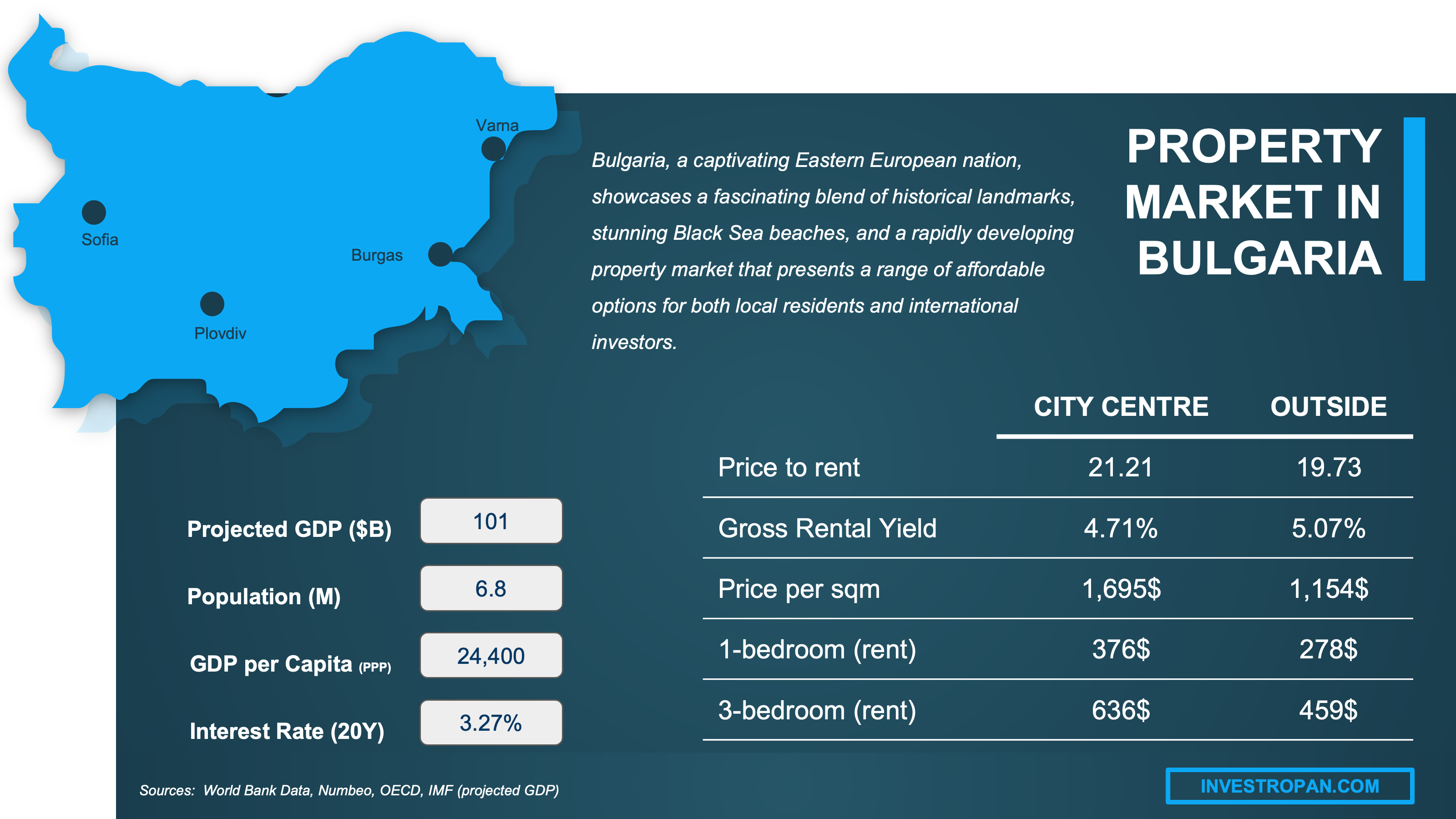
We have made this infographic to give you a quick and clear snapshot of the property market in Bulgaria. It highlights key facts like rental prices, yields, and property costs both in city centers and outside, so you can easily compare opportunities. We’ve done some research and also included useful insights about the country’s economy, like GDP, population, and interest rates, to help you understand the bigger picture.
