
As of June 2026, apartments in the French Alps are still expensive in the best ski resorts and lake towns, but the real market is much wider than Chamonix, Annecy or Megève, with cheaper entry points in Grenoble, Chambéry, Albertville, Cluses and Briançon.
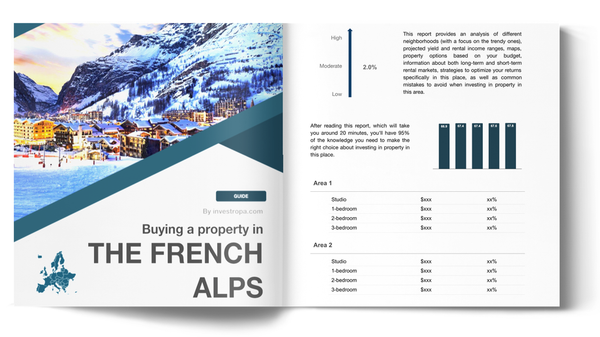
Get all the data you need about the real estate market in the French Alps
We constantly update this blog post so foreign buyers can follow real apartment prices in the French Alps in 2026 without reading dozens of technical reports.
The French Alps apartment market is not one single market, because a flat in Grenoble, Annecy, Chamonix or Morzine can have a completely different price and rental logic.
In this guide, we focus only on residential apartments in the French Alps, with simple price ranges, buying costs and ongoing ownership costs.
And if you’re planning to buy a property in this place, you may want to download our pack covering the real estate market in the French Alps.
Insights
- The French Alps apartment market in 2026 has a huge price gap, from about €2,500/m² in some valley cities to more than €10,000/m² in prime ski resorts.
- A realistic apartment budget in the French Alps in June 2026 is about €330,000 for a normal two-bedroom, before buyer costs and furniture.
- Annecy is expensive because it has lake demand, local jobs and Geneva-linked buyers, while Grenoble remains much cheaper because supply is deeper and less tourist-driven.
- For foreign buyers, the real cash need is often much higher than the headline price, because banks may ask for 30% equity plus closing costs.
- In the French Alps in 2026, resale apartments usually make more sense for yield, while new-build apartments usually make more sense for lower maintenance.
- High-altitude ski resorts are holding prices better than low-altitude resorts, because snow reliability has become a real property-market factor.
- A cheap 1970s ski apartment can become expensive after purchase if the building has poor insulation, high heating costs or future renovation votes.
- The best value for many first-time buyers is often not inside a famous resort, but in places such as Chambéry, Cluses, Sallanches, Albertville or Briançon.
- In a strong French Alps resort, a studio that can work for tourist rental is often closer to €200,000 to €280,000 than to the headline regional median.
How much do apartments really cost in the French Alps in 2026?
What's the average and median apartment price in the French Alps in 2026?
As of June 2026, the estimated median apartment price in the French Alps is about €220,000, or about $238,000, while the estimated average apartment price in the French Alps is about €270,000, or about $292,000.
That means the median apartment price in the French Alps in 2026 is about €3,700/m², or about $4,000/m², which is around €344/ft², or about $372/ft², while the average is closer to €4,100/m², or about $4,430/m², which is around €381/ft², or about $412/ft².
For most standard apartments in the French Alps in June 2026, a realistic purchase range is about €155,000 to €650,000, or about $167,000 to $702,000, with the lower end in valley cities and the upper end in strong ski resorts.
Sources and methodology: we used Notaires de France, DVF and MeilleursAgents.
We used official transactions first, then June 2026 local indices where official data was less detailed.
We also checked our own French Alps apartment model against resort, lake and valley-city price bands.
How much is a studio apartment in the French Alps in 2026?
As of June 2026, a typical studio apartment in the French Alps costs about €125,000, or about $135,000, but a useful studio in a strong ski-rental location is usually closer to €200,000 to €280,000, or about $216,000 to $302,000.
More concretely, entry-level to mid-range studios in the French Alps usually cost about €70,000 to €260,000, or about $76,000 to $281,000, while high-end or luxury studios in Chamonix, Megève, Courchevel or Val d’Isère can reach about €230,000 to €420,000, or about $248,000 to $454,000.
Most studio apartments in the French Alps are small, usually around 22 m² to 30 m², so the location and building quality often matter more than the extra few square meters.
Sources and methodology: we used Savoie and Haute-Savoie notaries, DVF and MeilleursAgents Chamonix.
We applied local price per square meter data to normal Alpine studio sizes.
We then adjusted the result for ski access, tourist demand and our own listing checks.
How much is a one-bedroom apartment in the French Alps in 2026?
As of June 2026, a typical one-bedroom apartment in the French Alps costs about €210,000, or about $227,000, while a one-bedroom in a serious ski-rental location often starts closer to €300,000, or about $324,000.
Entry-level to mid-range one-bedroom apartments in the French Alps usually cost about €105,000 to €390,000, or about $113,000 to $421,000, while high-end or luxury one-bedroom apartments in Chamonix, Megève, Courchevel or Val d’Isère can cost about €350,000 to €700,000, or about $378,000 to $756,000.
Most one-bedroom apartments in the French Alps are around 35 m² to 45 m², which is why a small difference in price per square meter can quickly change the total budget.
Sources and methodology: we used Immobilier.notaires.fr, DVF and FNAIM’s ski-station study.
We used 35 m² to 45 m² as the normal one-bedroom size range.
We separated local-resident markets from tourist-resort markets before estimating the final ranges.
How much is a two-bedroom apartment in the French Alps in 2026?
As of June 2026, a typical two-bedroom apartment in the French Alps costs about €330,000, or about $356,000, but a good two-bedroom in a strong ski resort often needs about €450,000, or about $486,000.
Entry-level to mid-range two-bedroom apartments in the French Alps usually cost about €150,000 to €600,000, or about $162,000 to $648,000, while high-end or luxury two-bedroom apartments in Chamonix, Megève, Courchevel or Val d’Isère can cost about €550,000 to €1.1 million, or about $594,000 to $1.19 million.
By the way, you will find much more detailed price ranges for apartments in our property pack covering the property market in the French Alps.
Sources and methodology: we used local notary medians, DVF and MeilleursAgents June 2026 data.
We used 55 m² to 70 m² as the normal two-bedroom size range.
We then checked the result against our own French Alps apartment price grid.
How much is a three-bedroom apartment in the French Alps in 2026?
As of June 2026, a typical three-bedroom apartment in the French Alps costs about €500,000, or about $540,000, but a family-sized ski apartment in a good resort is usually above €700,000, or about $756,000.
Entry-level to mid-range three-bedroom apartments in the French Alps usually cost about €230,000 to €950,000, or about $248,000 to $1.03 million, while high-end or luxury three-bedroom apartments in prime resorts can cost about €900,000 to €1.8 million or more, or about $972,000 to $1.94 million or more.
Most three-bedroom apartments in the French Alps are around 75 m² to 95 m², so buyer budgets rise quickly in places where prices are already above €7,000/m².
Sources and methodology: we used Notaires de France, FNAIM and DVF transaction data.
We applied Alpine apartment prices to the normal 75 m² to 95 m² family-apartment range.
We treated prime resorts separately because luxury sales pull the average upward.
What's the price gap between new and resale apartments in the French Alps in 2026?
As of June 2026, new-build apartments in the French Alps usually cost about 20% to 50% more than resale apartments, with the biggest premium in Annecy, Chamonix, Megève, Courchevel, Val d’Isère and Geneva-border towns.
For new-build apartments in the French Alps in 2026, a realistic average price is about €5,300/m² to €13,000/m², or about $5,720/m² to $14,040/m², which is about €492/ft² to €1,208/ft², or about $531/ft² to $1,304/ft².
For resale apartments in the French Alps in 2026, a realistic average price is about €2,700/m² to €9,000/m², or about $2,916/m² to $9,720/m², which is about €251/ft² to €836/ft², or about $271/ft² to $903/ft².
Sources and methodology: we used notary resale data, FPI France and June 2026 local price indices.
We separated old apartments from new-build apartments before comparing price per square meter.
We also used our own checks to avoid giving luxury-resort prices as normal Alpine prices.
Get to know the market before buying a property in the French Alps
Better information leads to better decisions. Get all the data you need before investing a large amount of money.

Can I afford to buy in the French Alps in 2026?
What's the typical total budget (all-in) to buy an apartment in the French Alps in 2026?
As of June 2026, the typical all-in budget to buy a standard apartment in the French Alps is about €357,000 to €366,000, or about $386,000 to $395,000, if the apartment itself costs around €330,000.
This all-in French Alps apartment budget usually includes the purchase price, notary and registration costs, possible agency fees, bank costs, mortgage guarantee costs and a small reserve for furniture or immediate repairs.
We go deeper and try to understand what costs can be avoided or minimized (and how) in our French Alps property pack.
Sources and methodology: we used Service-Public’s notary-fee simulator, Notaires de France and Banque de France credit data.
We used resale costs of about 8% to 11% and new-build costs of about 3% to 5%.
We then added Alpine-specific transaction assumptions from our own buyer-cost model.
What down payment is typical to buy in the French Alps in 2026?
As of June 2026, a foreign buyer should often expect a typical down payment of about 30% plus costs, so a €400,000 French Alps apartment may require about €155,000 in cash, or about $167,000.
For a strong borrower, the minimum down payment for a French Alps apartment may be around 10% to 20% plus closing costs, but many non-resident buyers are asked for 30% to 40% plus fees.
To secure better mortgage terms in the French Alps in 2026, a safer target is 30% to 35% equity plus all buyer costs, especially for resort apartments or short-term rental plans.
Sources and methodology: we used Banque de France, Fédération bancaire française and Service-Public.
We used the 2026 French mortgage market as the base case.
We then adjusted cash needs for foreign-buyer risk, resort liquidity and bank conservatism.
Buying real estate in the French Alps can be risky
An increasing number of foreign investors are showing interest. However, 90% of them will make mistakes. Avoid the pitfalls with our comprehensive guide.

Which neighborhoods are cheapest or priciest in the French Alps in 2026?
How much does the price per m² for apartments vary by neighborhood in the French Alps in 2026?
As of June 2026, apartment prices in the French Alps can vary from about €1,700/m² to €18,000/m², or about $1,836/m² to $19,440/m², which is about €158/ft² to €1,672/ft², or about $171/ft² to $1,806/ft².
In the more affordable French Alps neighborhoods, examples include Grenoble’s Villeneuve, Teisseire and Eaux-Claires at about €1,700/m² to €2,600/m², Chambéry’s Biollay and Hauts-de-Chambéry at about €2,100/m² to €2,800/m², and Briançon’s Sainte-Catherine at about €2,500/m² to €3,400/m².
In the most expensive French Alps neighborhoods, examples include Annecy’s Albigny and Vieille Ville at about €6,000/m² to €7,300/m², Chamonix Centre and Les Praz at about €9,000/m² to €13,000/m², and Megève’s Mont d’Arbois at about €12,000/m² to €18,000/m².
Sources and methodology: we used Notaires de France, DVF and MeilleursAgents.
We used neighborhoods only where local price patterns were clear enough to explain simply.
We also checked resort names separately because ski access changes prices street by street.
What neighborhoods are best for first-time buyers on a budget in the French Alps in 2026?
As of June 2026, the best French Alps areas for first-time buyers on a budget are Grenoble’s Eaux-Claires and Saint-Bruno, Chambéry’s Bissy and Cognin edge, and the Cluses, Sallanches and Passy corridor near Mont-Blanc.
In these budget-friendly French Alps areas, standard apartments often cost about €100,000 to €290,000, or about $108,000 to $313,000, depending on size, DPE rating, building age and transport access.
These areas can work well because they have local tenants, train or road links, schools, shops and easier access to jobs than a small ski-only village.
The main trade-off is that these budget-friendly French Alps areas usually have less prestige, less tourist demand and lower resale excitement than Annecy, Chamonix or Megève.
Sources and methodology: we used DVF, Observatoires locaux des loyers and MeilleursAgents.
We looked for areas with lower prices, real rental depth and decent daily-life infrastructure.
We avoided weak micro-markets where a low price could hide poor resale demand.
Which neighborhoods have the fastest-rising apartment prices in the French Alps in 2026?
As of June 2026, the fastest-rising or most resilient French Alps apartment areas are high-altitude resorts such as Val d’Isère and Tignes, Mont-Blanc quality areas such as Chamonix Centre and Les Praz, and Annecy spillover areas such as Cran-Gevrier and Seynod.
In these stronger French Alps areas, the estimated recent price increase is often around 2% to 6% year over year, while the best high-altitude ski markets have also benefited from a wider rebound in ski-station prices.
The main driver is simple: scarce land, strong lifestyle demand, better snow reliability in high resorts, and buyers moving from the most expensive addresses to nearby cheaper streets.
Sources and methodology: we used FNAIM’s ski-station study, Savoie and Haute-Savoie notaries and DVF.
We focused on areas where higher prices are backed by demand, not just asking-price optimism.
We also adjusted for altitude, year-round tourism and local supply limits.
Don't lose money on your property in the French Alps
100% of people who have lost money there have spent less than 1 hour researching the market. We have reviewed everything there is to know. Grab our guide now.
What extra costs will I pay on top of the apartment price in the French Alps in 2026?
What are all the buyer closing costs when you buy an apartment in the French Alps?
For a typical €330,000 resale apartment in the French Alps, buyer closing costs are usually about €27,000 to €36,000, or about $29,000 to $39,000, before furniture and renovation.
The main closing-cost categories in the French Alps are transfer duties, notary fees, land-registration costs, possible agency fees, mortgage guarantee costs, bank file fees and small administrative costs.
The largest closing cost for most French Alps resale apartments is the transfer duty paid through the notary, because this is linked directly to the purchase price.
Some closing costs are fixed by law, but agency fees, mortgage setup costs, currency costs and legal support can vary a lot between transactions.
Sources and methodology: we used Service-Public, Notaires de France and Economie.gouv.fr.
We calculated costs for old resale and new-build apartments separately.
We added a foreign-buyer margin for banking, legal review and currency costs.
On average, how much are buyer closing costs as a percentage of the purchase price for an apartment in the French Alps?
For a resale apartment in the French Alps, buyers should usually budget about 8% to 11% of the purchase price for closing costs, or closer to 10% to 13% if the buyer pays agency fees.
For most standard French Alps transactions, a realistic low-to-high range is about 7.5% to 13% for resale apartments and about 2.5% to 4% for new-build apartments.
We actually cover all these costs and strategies to minimize them in our pack about the real estate market in the French Alps.
Sources and methodology: we used Service-Public’s simulator, Notaires de France and Economie.gouv.fr.
We used official fee logic first and then tested real Alpine price examples.
We kept the final ranges rounded so buyers can use them quickly.
Thinking of buying real estate in the French Alps?
Acquiring property in a different country is a complex task. Don't fall into common traps – grab our guide and make better decisions.
What are the ongoing monthly and yearly costs of an apartment in the French Alps in 2026?
What are typical HOA fees in the French Alps right now?
HOA fees, usually called copropriété charges in France, are common for apartments in the French Alps, and a normal 50 m² to 60 m² apartment often costs about €100 to €180 per month, or about $108 to $194 per month.
For basic buildings in the French Alps, HOA fees can be around €50 to €90 per month, or about $54 to $97, while resort buildings with lifts, snow clearing, heated common areas, pools or concierge services can reach €300 to €800 or more per month, or about $324 to $864 or more.
Sources and methodology: we used Service-Public copropriété guidance, ANIL and our French Alps building-cost checks.
We separated simple valley buildings from ski-resort residences with heavier shared services.
We also treated old 1960s to 1980s mountain buildings as a higher-risk cost category.
What utilities should I budget monthly in the French Alps right now?
For a typical 50 m² to 60 m² apartment in the French Alps in June 2026, a sensible monthly utility budget is about €120 to €180, or about $130 to $194, if the apartment is reasonably efficient.
The realistic utility range in the French Alps is about €70 to €120 per month for efficient occasional use, or about €180 to €500 or more per month for older electric-heated mountain apartments in winter.
This monthly utility budget usually includes electricity, heating, hot water, internet, water charges not included in the building fees, and sometimes waste or small local service charges.
Heating is usually the most expensive utility for French Alps apartment owners, especially in older ski apartments with weak insulation and electric radiators.
Sources and methodology: we used CRE electricity tariff data, Service-Public energy guidance and our Alpine heating assumptions.
We adjusted normal French utility budgets for colder winters and mountain-building exposure.
We used wider ranges for older resort apartments because heating use can vary sharply.
How much is property tax on apartments in the French Alps?
For a normal apartment in the French Alps in 2026, a typical annual property tax is about €1,200, or about $1,296, for a standard two-bedroom apartment.
French property tax, called taxe foncière, is paid by the owner and is calculated from the cadastral rental value, then multiplied by local rates set by the commune and other local authorities.
In practice, annual property tax for apartments in the French Alps often ranges from about €500 to €800 for a small Grenoble or Chambéry studio, or about $540 to $864, to more than €1,500 to €3,000 for a large prime-resort apartment, or about $1,620 to $3,240.
Sources and methodology: we used Service-Public, Impots.gouv.fr and Economie.gouv.fr.
We used the official tax logic, then estimated amounts from apartment size and commune type.
We kept wide ranges because local French Alps tax levels differ by municipality.
What's the yearly building maintenance cost in the French Alps?
For a normal older apartment in the French Alps, a sensible yearly building maintenance reserve is about €1,800 to €3,000 on a €300,000 apartment, or about $1,944 to $3,240.
The realistic range is about 0.3% to 0.5% of the property value per year for a recent building, about 0.6% to 1.0% for a normal older copropriété, and about 1.0% to 1.5% for many 1960s to 1980s ski residences.
These building maintenance costs can include façade work, roof repairs, lift repairs, boiler systems, snow-related wear, insulation upgrades, balconies, shared hallways and safety compliance.
In the French Alps, normal maintenance may be included in HOA fees, but major works are often voted separately by the copropriété and can create large one-off bills.
Sources and methodology: we used Service-Public copropriété rules, ANIL and FNAIM’s ski-residence analysis.
We separated regular HOA charges from major works voted by owners.
We gave higher ranges for old mountain buildings because roofs, façades and insulation are more exposed.
How much does home insurance cost in the French Alps?
For a typical apartment in the French Alps in 2026, annual home insurance is often about €250 to €500, or about $270 to $540, depending on size, use and coverage.
A realistic range is about €130 to €300 per year for a small owner-occupied apartment, or about $140 to $324, and about €450 to €900 per year for a rented resort apartment with wider cover, or about $486 to $972.
Home insurance is not always mandatory for an owner-occupier in the same way as for a tenant, but it is strongly expected in copropriété buildings and usually required by lenders and good property practice.
Sources and methodology: we used Service-Public housing insurance guidance, French insurance market benchmarks and our Alpine risk assumptions.
We separated owner-occupier insurance from non-occupant owner and rental-use cover.
We increased the upper range for resort rentals, luxury contents and weather exposure.
Get the full checklist for your due diligence in the French Alps
Don't repeat the same mistakes others have made before you. Make sure everything is in order before signing your sales contract.
What sources have we used to write this blog article?
Whether it’s in our blog articles or the market analyses included in our property pack about the French Alps, we always rely on the strongest methodology we can, and we don’t throw out numbers at random.
We also aim to be fully transparent, so below we’ve listed the authoritative sources we used, and explained how we used them and the methods behind our estimates.
| Source | Why we trust it | How we used it |
|---|---|---|
| Notaires de France / Immobilier.notaires.fr | It is based on real signed property sales. | We used it as the anchor for resale apartment prices. We prioritized notary data over listing portals when both were available. |
| Chambre interdépartementale des notaires de Savoie et Haute-Savoie | It gives local notary medians for key Alpine sectors. | We used it for Haute-Savoie sector prices. We used sector medians to avoid over-weighting luxury listings. |
| DVF / data.gouv.fr explorer | It is the French government database of real property transactions. | We used it to cross-check actual sale prices by commune. We treated it as the best source for real paid prices. |
| Service-Public DVF explanation | It explains the DVF dataset in official public-service language. | We used it to verify what DVF includes. We relied on it to explain the link with notarial acts and cadastral records. |
| INSEE / Notaires old-housing index | INSEE is France’s official statistics agency. | We used it to frame national resale-market momentum. We did not use it as a local French Alps pricing source. |
| Banque de France credit statistics | It is the official source for French household credit data. | We used it for mortgage-rate assumptions. We then adjusted the borrowing view for foreign buyers and resort purchases. |
| Fédération bancaire française | It summarizes French banking-sector credit conditions. | We used it as a liquidity and affordability check. We compared it with Banque de France credit data. |
| Service-Public notary-fee simulator | It is the official public simulator for purchase fees. | We used it for closing-cost ranges. We separated old resale apartments from new-build apartments. |
| Notaires de France fee calculator | It comes from the official notary real-estate platform. | We used it to verify buyer acquisition costs. We compared the result with Service-Public and rounded the final ranges. |
| Service-Public property tax page | It explains taxe foncière rules for property owners. | We used it to explain who pays property tax. We estimated likely amounts using commune type and apartment size. |
| Impots.gouv.fr property-tax statistics | It is the French tax authority’s own information source. | We used it to check the national tax context. We kept local estimates broad because commune rates vary. |
| Observatoires locaux des loyers | It is the public rent-observatory network. | We used it to understand rental depth in Alpine towns. We relied on it especially for Annecy and Grenoble-type markets. |
| ADIL 74 local rent observatory | It tracks rents across Haute-Savoie using a rigorous method. | We used it to understand rental demand in Haute-Savoie. We compared rent data with apartment price levels. |
| Data.gouv.fr rent map | It provides commune-level rental indicators. | We used it as a rent check outside full OLL coverage. We did not use rent data as a direct price source. |
| FNAIM ski-station study 2025 | It is Alpine-specific and focused on ski-resort property. | We used it for resort pricing and altitude effects. We also used it to separate stronger high-altitude resorts from weaker low-altitude markets. |
| MeilleursAgents June 2026 regional prices | It is a recognized French price-index platform. | We used it for June 2026 commune and neighborhood estimates. We cross-checked it against notary and DVF data. |
| MeilleursAgents Chamonix local prices | It gives current local price estimates for a prime resort. | We used it to test Chamonix apartment levels. We avoided treating Chamonix as representative of the whole French Alps. |
| CRE electricity tariff data | CRE is France’s energy-market regulator. | We used it for utility-cost assumptions. We adjusted the result for colder Alpine winters and older electric-heated apartments. |
| FPI France | It represents the French new-build property sector. | We used it to frame the new-build market. We compared new-build scarcity with resale apartment values in Alpine areas. |
Get fresh and reliable information about the market in the French Alps
Don't base significant investment decisions on outdated data. Get updated and accurate information.


