
Reviewed by the researcher who helped assess buyer mistakes and real-world purchase problems in Bulgaria.

Bulgaria has officially adopted the euro as of January 1, 2026, making it even easier for foreign retirees to manage their finances in this affordable European country.
In this guide, we break down exactly how much money you need to retire in Bulgaria in 2026, from minimum survival budgets to luxury lifestyles, along with current housing prices that we constantly update.
And if you’re planning to buy here, read what went wrong for other property buyers in Bulgaria before you commit.
How much money do I need to retire in Bulgaria right now?
What's the absolute minimum monthly budget to survive in Bulgaria?
The absolute minimum monthly budget to survive in Bulgaria as a foreign retiree is around 900 euros (roughly $980 USD) in smaller cities like Plovdiv or Veliko Tarnovo, and about 1,200 euros ($1,300 USD) in Sofia, the capital and most expensive city.
This minimum budget in Bulgaria covers basic rent for a simple one-bedroom apartment, utilities including winter heating, groceries for cooking at home, local public transportation, and essential healthcare costs.
Living on this minimum in Bulgaria means accepting trade-offs like renting in less central neighborhoods, cooking most meals at home, limiting social outings, and relying heavily on the public healthcare system rather than private clinics.
What lifestyle do I get with $2,000/month in Bulgaria in 2026?
As of early 2026, a budget of $2,000 per month (about 1,850 euros) in Bulgaria provides a comfortable local lifestyle, especially outside Sofia, where you can enjoy regular dining out, occasional taxis, and private dental care without constant budgeting.
On $2,000 per month in Bulgaria, you can afford a nice one-bedroom apartment in sought-after Sofia neighborhoods like Geo Milev or Mladost for around 550 to 700 euros (600 to 760 USD), or a spacious two-bedroom in Plovdiv's trendy Kapana district or Varna's Briz area for 400 to 500 euros.
This budget in Bulgaria allows you to join a gym, attend cultural events at Sofia's National Palace of Culture, take weekend trips to Rila Monastery or the Black Sea coast, and enjoy Bulgaria's excellent cafe culture in historic city centers.
The main limitation at $2,000 per month in Bulgaria is that you will still need to watch your winter utility bills carefully, since district heating costs can spike significantly during the cold months, and you may need to choose between a prime central location and a larger living space.


Got a question about property in Bulgaria?
Buying, owning or renting out: ask us and get a real answer within 12 hours. Free.
Ask us your question →
What lifestyle do I get with $3,000/month in Bulgaria in 2026?
As of early 2026, a budget of $3,000 per month (about 2,750 euros) in Bulgaria delivers a very comfortable lifestyle almost anywhere in the country, and upper-comfort living in Sofia with room for quality housing, regular entertainment, and healthcare peace of mind.
On $3,000 per month in Bulgaria, you can afford a quality two-bedroom apartment in prestigious Sofia neighborhoods like Lozenets, Ivan Vazov, or Oborishte for 700 to 1,000 euros (760 to 1,090 USD), or a premium apartment near Varna's Sea Garden for 500 to 700 euros.
At this budget level in Bulgaria, you can dine at Sofia's top restaurants like Sushi Bar and Made in Home several times per week, book spontaneous weekend flights to European capitals using Sofia's well-connected airport, and maintain memberships at high-end fitness centers like Pulse Fitness or Next Level.
The key upgrade from $2,000 to $3,000 per month in Bulgaria is the ability to afford private specialists and diagnostics without hesitation, hire occasional cleaning help, and maintain a comfortable emergency fund that shields you from utility price swings or unexpected costs.
What lifestyle do I get with $5,000/month in Bulgaria in 2026?
As of early 2026, a budget of $5,000 per month (about 4,600 euros) provides luxury living in Bulgaria for a single person, while $10,000 per month (9,200 euros) offers a global luxury lifestyle with premium real estate, constant travel, and Western European-level private healthcare.
At $5,000 per month in Bulgaria, you can rent premium apartments in Sofia's most exclusive areas like Doctor's Garden or top parts of Lozenets for 1,200 to 1,800 euros (1,300 to 1,960 USD), while $10,000 per month unlocks penthouse apartments or luxury homes with parking and terraces for 2,500 to 4,000 euros.
At the $5,000 to $10,000 per month range in Bulgaria, you gain access to private driver services, membership at exclusive clubs like the Sofia Golf Club, shopping at the high-end Paradise Center mall, personal trainers, private chefs for events, and the ability to use Bulgaria's best private hospitals like Tokuda and Acibadem for all medical needs.
How much for a "comfortable" retirement in Bulgaria in 2026?
As of early 2026, a comfortable retirement in Bulgaria requires about 1,800 euros per month ($1,960 USD) outside Sofia, and approximately 2,300 euros per month ($2,500 USD) in Sofia, to cover quality housing, regular leisure activities, and adequate healthcare.
A safe buffer to add to your comfortable retirement budget in Bulgaria is 15%, which means an extra 270 to 345 euros (295 to 375 USD) per month, to account for winter utility spikes from district heating, inflation adjustments, and the "newcomer premium" that foreigners often pay during their first year.
A comfortable retirement budget in Bulgaria covers expenses that a basic budget does not, including a well-located apartment rather than just affordable housing, private health insurance instead of relying solely on public healthcare, regular restaurant meals, gym memberships, domestic travel, and funds for translation and administrative services.
Got a question about your Bulgaria purchase?
Taxes, contracts, banks, permits: tell us where you're stuck. We reply within 12 hours, for free.
Ask us your question →
How much for a "luxury" retirement in Bulgaria in 2026?
As of early 2026, a luxury retirement in Bulgaria requires about 4,000 euros per month ($4,350 USD) outside Sofia, and approximately 5,000 euros per month ($5,450 USD) in Sofia, to enjoy premium housing, frequent international travel, and comprehensive private healthcare.
A luxury retirement in Bulgaria includes premium apartments or renovated houses in top neighborhoods starting at 1,500 euros per month, full private health coverage costing 300 to 500 euros monthly, a personal vehicle with parking, regular international travel, domestic cleaning services, and access to high-end restaurants and wellness facilities.
The most popular neighborhoods in Bulgaria for retirees seeking a luxury lifestyle include Sofia's Doctor's Garden area, Lozenets, and Iztok, as well as Varna's Greek Quarter near the Sea Garden, and Burgas's upscale Lazur district along the Black Sea coast.
The main advantage of a luxury budget beyond comfort in Bulgaria is complete freedom from financial stress during healthcare decisions, the ability to handle any bureaucratic or translation challenge by hiring professional help, and the flexibility to travel internationally whenever you want without worrying about your monthly budget.
Found a place and not sure about the price? Ask us.
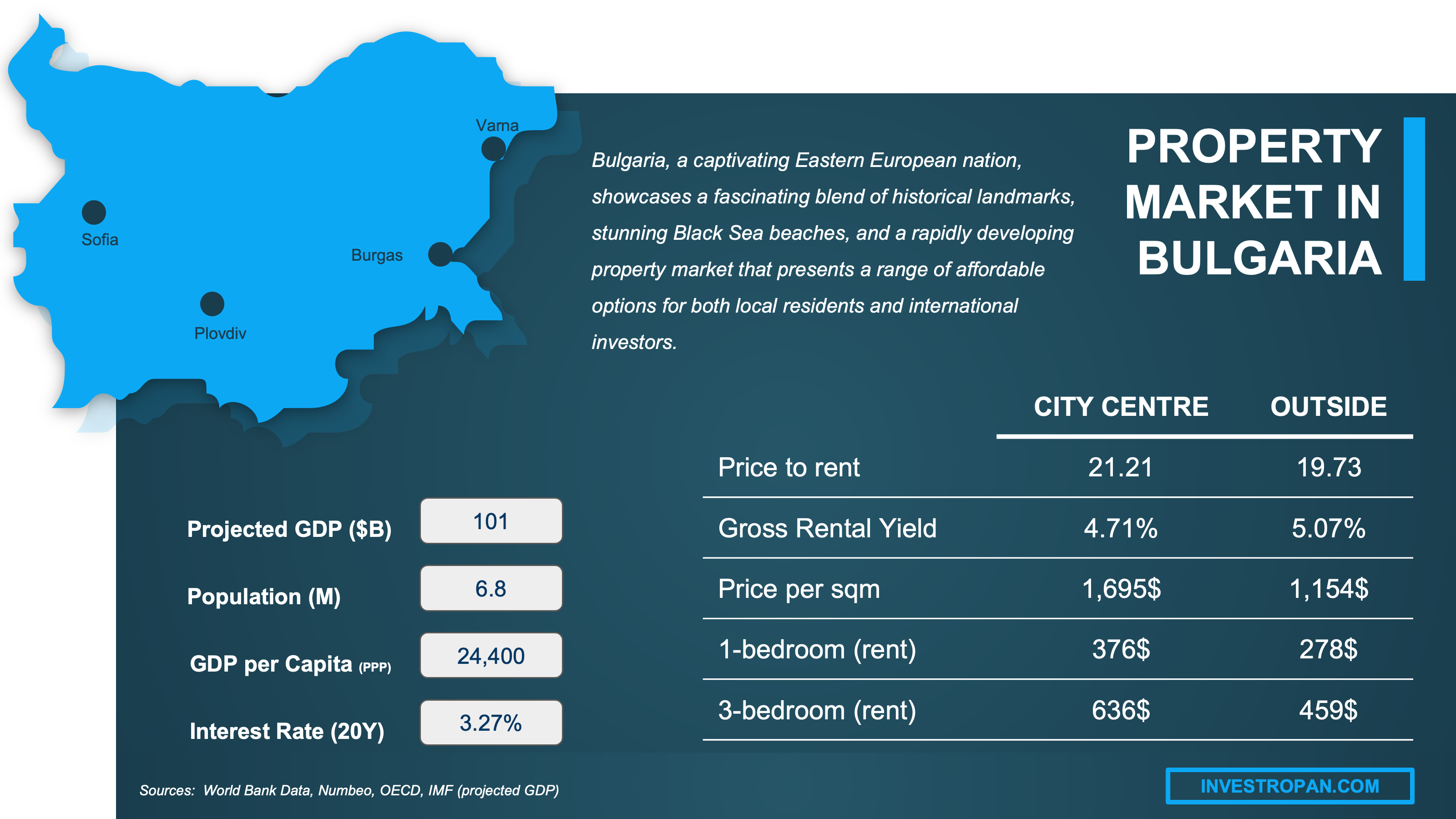
We have made this infographic to give you a quick and clear snapshot of the property market in Bulgaria. It highlights key facts like rental prices, yields, and property costs both in city centers and outside, so you can easily compare opportunities. We’ve done some research and also included useful insights about the country’s economy, like GDP, population, and interest rates, to help you understand the bigger picture.
What are the real monthly expenses for retirees in Bulgaria in 2026?
What is a realistic monthly budget breakdown by category in Bulgaria?
A realistic monthly budget breakdown for a comfortable retiree in Sofia in Bulgaria at around 2,300 euros (2,500 USD) includes rent at 700 to 1,000 euros, utilities at 180 to 300 euros, food at 350 to 500 euros, transport at 60 to 150 euros, healthcare at 120 to 300 euros, lifestyle at 200 to 500 euros, and miscellaneous at 150 to 250 euros.
Housing costs in Bulgaria typically consume 30% to 45% of a retiree's monthly budget, translating to roughly 700 to 1,000 euros (760 to 1,090 USD) for a comfortable one-bedroom in a good Sofia neighborhood, though this percentage drops significantly in smaller cities like Plovdiv or Burgas.
Food and groceries in Bulgaria typically account for 15% to 22% of a retiree's monthly budget, meaning around 350 to 500 euros (380 to 545 USD) per month for a mix of home cooking with quality ingredients from supermarkets like Billa and Kaufland plus regular restaurant meals.
The budget category that varies most in Bulgaria depending on personal lifestyle choices is healthcare, which can range from 80 euros per month for someone using mainly public services to over 600 euros for retirees with chronic conditions who prefer private specialists and imported medications.
Still have a question about Bulgaria?
If this article didn't answer it, ask us. A real person replies within 12 hours, for free.
Ask us your question →What fees surprise foreigners most after moving to Bulgaria?
The top three fees that surprise foreigners most in Bulgaria are winter district heating bills that can triple your utility costs from November to March, immigration paperwork costs including visa fees, residence card renewals, and document translations, and housing setup costs like security deposits, agency fees, and furnishing upgrades common in expat-targeted rentals.
Foreigners arriving in Bulgaria should budget 500 to 1,500 euros (545 to 1,630 USD) for one-time setup and administrative fees including the Type D visa at 100 euros, residence permit processing, notarized document translations, rental agency fees often equal to one month's rent, and utility connection deposits.
Not sure what your passport allows in Bulgaria? Tell us and we'll check.
What's the average rent for a 1-bedroom or a 2-bedroom in Bulgaria in 2026?
As of early 2026, the average monthly rent for a one-bedroom apartment in Sofia is about 550 euros (600 USD), while a two-bedroom averages around 700 euros (760 USD), with prices in other major cities like Plovdiv and Varna running 20% to 35% lower than Sofia.
The realistic rent range for a one-bedroom in Bulgaria goes from about 350 euros (380 USD) in budget neighborhoods or smaller cities up to 900 euros (980 USD) in premium Sofia locations like Lozenets or Ivan Vazov with modern finishes and central locations.
The realistic rent range for a two-bedroom in Bulgaria spans from approximately 450 euros (490 USD) in affordable areas or regional cities up to 1,200 euros (1,300 USD) in upscale Sofia neighborhoods with new construction, parking, and amenities.
The neighborhoods offering the best value for retirees seeking affordable rent in Bulgaria include Sofia's Studentski Grad and Mladost areas near the metro, Plovdiv's Kamenitsa and Karshiyaka districts, and Varna's Chayka neighborhood, all offering modern apartments at 15% to 25% below prime area prices.
What do utilities cost monthly in Bulgaria in 2026?
As of early 2026, total monthly utilities for a typical one-bedroom retiree apartment in Bulgaria cost between 120 and 170 euros (130 to 185 USD) in summer, but rise to 200 to 320 euros (220 to 350 USD) in winter due to district heating costs in cities like Sofia.
The typical monthly utility breakdown in Bulgaria for a single retiree includes electricity at 40 to 80 euros (45 to 90 USD), water and sewage at 10 to 20 euros (11 to 22 USD) based on Sofia Water tariffs, and heating or gas at 50 to 180 euros (55 to 200 USD) depending on season and heating type.
Internet and mobile phone service in Bulgaria typically costs 25 to 50 euros (27 to 55 USD) per month combined, with high-speed fiber internet from providers like A1 or Vivacom running 15 to 25 euros and mobile plans with generous data costing 10 to 25 euros.
Got a question about taxes in Bulgaria?
Buying costs, yearly taxes, rental income: ask us and get a clear answer within 12 hours. Free.
Ask us your question →What's the monthly food and transportation budget for one person in Bulgaria in 2026?
As of early 2026, the monthly food and transportation budget for one person in Bulgaria ranges from about 280 euros (305 USD) for a frugal lifestyle with home cooking and public transit up to 730 euros (795 USD) for frequent dining out and regular taxi use.
A realistic monthly grocery budget in Bulgaria for a single retiree cooking at home ranges from 200 euros (220 USD) for basic Bulgarian staples and market produce up to 400 euros (435 USD) for imported products, specialty items, and premium ingredients from stores like Fantastico or Metro.
Dining out regularly in Bulgaria versus cooking at home creates a significant cost difference, with restaurant meals adding 150 to 300 euros (165 to 330 USD) per month if you eat out three to four times per week at mid-range restaurants where main courses average 10 to 18 euros.
Monthly transportation costs in Bulgaria range from 30 to 50 euros (33 to 55 USD) using Sofia's metro and bus system with a monthly pass, up to 150 to 250 euros (165 to 275 USD) for retirees who rely on taxis, ride-sharing apps, or own a car with fuel and insurance costs.
Can I retire in Bulgaria if I want to buy property in 2026?
What's the average home price in Bulgaria in 2026?
As of early 2026, the average home price in Sofia, Bulgaria's most expensive market, is approximately 2,310 euros per square meter (2,515 USD per square meter), which translates to about 139,000 euros (151,000 USD) for a typical 60 square meter one-bedroom or 208,000 euros (226,000 USD) for a 90 square meter two-bedroom.
The realistic price range in Bulgaria spans from about 1,200 euros per square meter (1,300 USD) in more affordable Sofia neighborhoods and regional cities like Plovdiv up to 3,500 euros per square meter (3,800 USD) in premium Sofia areas like Lozenets, Doctor's Garden, and parts of the city center.
For retirees in Bulgaria, apartments in well-maintained residential complexes from the 2000s to 2010s typically offer the best value, providing modern layouts, elevator access, and central heating at 15% to 25% below new construction prices while avoiding the maintenance challenges of older Communist-era panel buildings.
Got a question about the market in Bulgaria?
Prices, areas, rentals: ask us what you'd ask a friend who knows. Free reply within 12 hours.
Ask us your question →What down payment do foreigners usually need in Bulgaria in 2026?
As of early 2026, foreigners buying property in Bulgaria typically need a down payment of 30%, meaning about 42,000 to 62,000 euros (46,000 to 67,000 USD) for a standard Sofia apartment, because Bulgarian banks like UniCredit Bulbank offer non-residents financing of up to 70% of property value.
Foreigners in Bulgaria do face higher down payment requirements than Bulgarian residents or EU citizens with permanent residence, who can often access mortgages with only 10% to 20% down, making the additional 10% to 20% down payment a real cost of being a non-resident buyer.
Residency rules change often. Ask us about your case.
What's the all-in monthly cost to own in Bulgaria in 2026?
As of early 2026, the all-in monthly cost to own a typical 200,000 euro property in Sofia with 30% down is approximately 950 to 1,200 euros (1,035 to 1,305 USD), covering mortgage payments, building fees, property taxes, and utilities.
The all-in monthly ownership cost in Bulgaria includes mortgage payment of 700 to 850 euros (760 to 925 USD) depending on interest rate and term, building maintenance and HOA fees of 60 to 150 euros (65 to 165 USD), property tax and waste fee of 10 to 40 euros (11 to 45 USD), and utilities of 180 to 300 euros (195 to 330 USD) with seasonal variation.
Monthly property tax and HOA fees in Bulgaria typically total 70 to 190 euros (75 to 210 USD), with property tax rates varying by municipality within legally defined ranges, and HOA fees depending heavily on building age, amenities like elevators and security, and the quality of common area maintenance.
The hidden ownership cost that catches new buyers off guard in Bulgaria is the building renovation fund contribution, which can add 50 to 150 euros per month when major repairs like roof replacement, facade work, or elevator modernization are needed, especially in older buildings where these costs were previously deferred.
Is buying cheaper than renting in Bulgaria in 2026?
As of early 2026, the monthly cost comparison in Sofia shows renting a one-bedroom at 550 euros (600 USD) versus owning a similar property with mortgage at 700 to 850 euros (760 to 925 USD) plus 70 to 190 euros in taxes and fees, making renting often cheaper in the short term but ownership potentially advantageous over 7 to 10 years.
The typical break-even point where buying becomes cheaper than renting in Bulgaria is approximately 7 to 10 years, though this varies significantly based on your down payment size, mortgage interest rate, property appreciation in your neighborhood, and how long you plan to stay in Bulgaria.
The key factors that make buying more attractive than renting for retirees in Bulgaria include the security of not facing rent increases or lease non-renewals, the ability to customize your space for aging-in-place needs, Bulgaria's relatively low property taxes compared to Western Europe, and the inheritance simplicity of owning property in an EU country after Bulgaria's 2026 euro adoption.
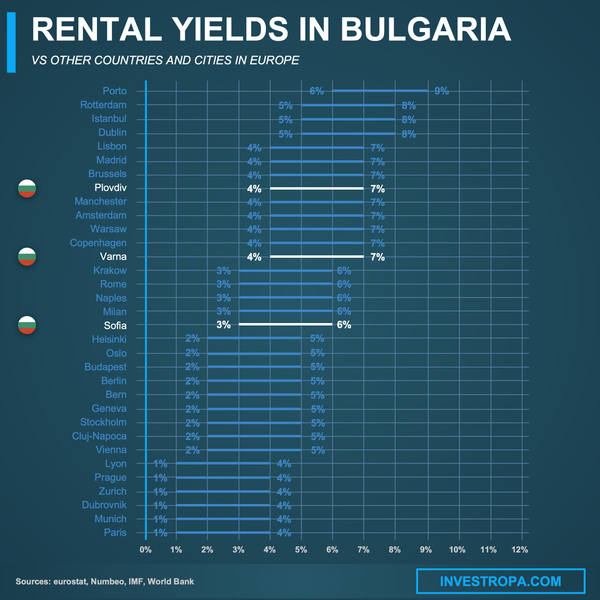
We did some research and made this infographic to help you quickly compare rental yields of the major cities in Bulgaria versus those in neighboring countries. It provides a clear view of how this country positions itself as a real estate investment destination, which might interest you if you’re planning to invest there.
What visas, taxes, and healthcare costs should I plan for in Bulgaria in 2026?
Got a question about renting out in Bulgaria?
Rules, yields, managers: tell us your plan and we'll reply within 12 hours, for free.
Ask us your question →What retirement visa options exist in Bulgaria in 2026?
As of early 2026, Bulgaria does not offer a dedicated "retirement visa" but retirees typically use the long-stay Type D visa costing 100 euros (110 USD) as the entry step, followed by a residence permit application through the Migration Directorate based on proof of pension income or savings.
The key financial requirements to qualify for residence in Bulgaria as a retiree include demonstrating a pension income at least equal to Bulgaria's minimum wage of 620 euros per month, or showing savings of approximately 3,200 euros (3,500 USD) in a Bulgarian bank account under the "well-off pensioner" program pathway.
The typical annual visa renewal cost in Bulgaria ranges from 300 to 700 euros (325 to 760 USD) per person, covering residence card renewal fees, required document translations and notarizations, and potential legal assistance fees, with the process involving a visit to your local Migration Directorate office.
The most common visa mistake foreign retirees make in Bulgaria is failing to gather apostilled and translated documents before arriving, which forces expensive rush translations and notarizations in-country, and underestimating the bureaucratic time required for appointments at the Migration Directorate offices in Sofia or other cities.
Do I pay tax on foreign income in Bulgaria in 2026?
As of early 2026, if you become a Bulgarian tax resident by staying 183 or more days per year in Bulgaria, you are generally expected to declare your worldwide income under Bulgaria's tax rules, with most personal income taxed at a flat rate of 10%.
Foreign pensions are typically taxable in Bulgaria at the 10% flat rate if you are a tax resident, while investment income like dividends and capital gains may have different treatments, and Social Security payments from countries like the United States may be partially or fully exempt depending on the applicable tax treaty.
Bulgaria maintains double taxation treaties with over 70 countries including the United States, United Kingdom, Germany, and most EU members, which can prevent you from paying tax twice on the same income and may override domestic Bulgarian tax rules for certain income types.
The single most important tax rule foreign retirees should understand before moving to Bulgaria is that tax residency triggers at 183 days of presence, meaning your tax situation can change dramatically even if your income sources remain "from abroad," so planning your days carefully or consulting a Bulgarian tax advisor before your first year is essential.
Want us to check the numbers for your case? Write to us, it's free.
What health insurance do retirees need in Bulgaria in 2026?
As of early 2026, retirees in Bulgaria typically need either private health insurance costing 80 to 200 euros (87 to 220 USD) per month or must enroll in the Bulgarian public health system through the National Health Insurance Fund (NHIF) once they establish legal residence and make health contributions.
Foreigners can access Bulgaria's public healthcare system if they obtain legal residence status and are properly insured, either through employment contributions, voluntary enrollment in the NHIF at 8% of declared income, or through an S1 form if coming from another EU country with transferable healthcare rights.
A realistic total annual healthcare budget for a retiree in Bulgaria including insurance premiums, out-of-pocket costs, and medications ranges from 1,000 euros (1,090 USD) for someone in good health using mostly public services up to 7,200 euros (7,850 USD) for retirees with chronic conditions who prefer private specialists and imported medications.
What sources have we used to write this blog article?
Whether it’s in our blog articles or our buyer-mistake research for Bulgaria, we rely on the strongest methodology we can and don’t throw out numbers at random.
We also aim to be fully transparent, so below we've listed the authoritative sources we used, and explained how we used them and the methods behind our estimates.
| Source | Why it's authoritative | How we used it |
|---|---|---|
| Bulgaria National Statistical Institute (NSI) | Bulgaria's official statistics agency publishing baseline household spending data. | We used this as the foundation for what people actually spend in Bulgaria on food, transport, and utilities. We then adjusted figures for foreign retirees who rent rather than own homes. |
| Global Property Guide | Long-running property data publisher with stated rent methodology. | We used their Sofia rent data to estimate what foreign retirees actually pay when renting. We cross-checked affordability against NSI spending totals for realistic budget planning. |
| European Central Bank | The primary authority on euro-area decisions and official conversion rates. | We used it to treat lev and euro values consistently at the fixed rate of 1 EUR = 1.95583 BGN. We presented all budgets in euros since Bulgaria adopted the euro in January 2026. |
| PwC Worldwide Tax Summaries | Widely used professional tax reference with regular updates. | We used it to explain Bulgaria's tax residency rules including the 183-day test. We also referenced their income tax and contribution rate data for budget planning. |
| Bulgaria Migration Directorate (MoI) | Official government body handling residence permits for foreigners. | We used it to map the real residence permit process and fee references. We framed what renewals typically involve for accurate budgeting. |
| Bulgaria Ministry of Foreign Affairs | Official schedule of consular fees charged by Bulgaria. | We used it to provide accurate Type D visa costs at 100 euros. We estimated recurring immigration paperwork budget lines from their fee schedules. |
| Toplofikatsiya Sofia | Main district heating provider publishing regulated prices with regulator references. | We used it to estimate winter heating and hot water costs for Sofia apartments. We justified including a bigger winter utility buffer than warm-country retirement guides suggest. |
| Sofia Water | Utility provider showing tariffs tied to regulator decisions effective January 2026. | We used it to estimate realistic water and sewage costs in Sofia for early 2026. We avoided vague utility estimates by grounding numbers in official tariffs. |
| UniCredit Bulbank | Major Bulgarian bank publishing concrete lending terms for non-residents. | We used it to estimate realistic foreigner down payment requirements at 30%. We modeled ownership costs using Bulgarian mortgage rate reality rather than assumptions. |
| National Health Insurance Fund (NHIF) | Bulgaria's public health insurance institution. | We used it to confirm the structure of public healthcare coverage in Bulgaria. We explained what public healthcare access means in practice for foreign retirees. |
| Bulgaria Ministry of Finance | Finance ministry describing property acquisition tax and local fee rules. | We used it to include buyer closing costs that many foreigners underestimate. We explained why transfer tax varies by municipality within legal bounds. |
| Numbeo | Crowd-sourced cost of living database with thousands of recent entries. | We used it as a cross-reference to validate our NSI-based estimates. We checked that our budget ranges aligned with real user-reported costs in Bulgarian cities. |

We made this infographic to show you how property prices in Bulgaria compare to other big cities across the region. It breaks down the average price per square meter in city centers, so you can see how cities stack up. It’s an easy way to spot where you might get the best value for your money. We hope you like it.


