
Authored by the expert who managed and guided the team behind the United Kingdom Property Pack
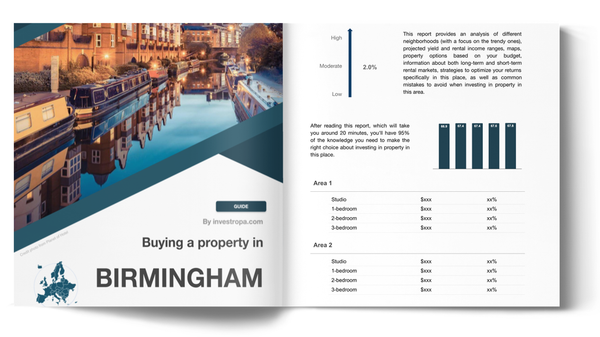
Get all the data you need about the real estate market in Birmingham
We constantly update this blog post so buyers can follow the Birmingham property market with fresh data, not old guesses.
In June 2026, the question is not whether Birmingham property is cheap everywhere, but whether the price, area and property type make sense.
For most buyers, Birmingham looks more like a selective buying opportunity than a market to chase blindly.
And if you’re planning to buy a property in this place, you may want to download our pack covering the real estate market in Birmingham.
So, is now a good time?
Rather yes, June 2026 is a sensible time to buy property in Birmingham if you negotiate hard and avoid overpriced flats.
The strongest signal is that the average house price in Birmingham in 2026 is about £233,000, while prices are flat and rents are still rising.
Another strong signal is that buyers have more choice, so sellers in Birmingham are under more pressure than they were during the hot market years.
Other strong signals are Birmingham’s large renter pool, major universities, long-term housing need and regeneration around Digbeth, Eastside, Smithfield and the City Centre.
The best strategy is to target well-priced terraced houses or semi-detached houses in proven areas, or only buy flats in locations with strong resale demand and sensible service charges.
This is not financial or investment advice, we do not know your personal situation, and you should always do your own research before buying property in Birmingham.

Is it smart to buy now in Birmingham (England), or should I wait as of 2026?
Do real estate prices look too high in Birmingham (England) as of 2026?
As of 2026, Birmingham property prices look broadly fair to slightly cheap versus rents, because the average house price in Birmingham was about £233,000 in March 2026 and average rent was about £1,086 per month in April 2026.
This matters because the Birmingham housing market is not showing the classic signs of a local bubble, with official prices flat from a year earlier while rents still rose by about 3.3%.
The weaker part of the market is flats, because Birmingham flats were around £145,000 and down from a year earlier, which means apartment buyers should negotiate harder than house buyers.
You can also read our latest update regarding the housing prices in Birmingham.
Does a property price drop look likely in Birmingham (England) as of 2026?
As of 2026, the risk of a meaningful property price drop in Birmingham looks medium for flats but low to medium for good family houses.
A sensible 12-month range for Birmingham property prices is roughly -3% to +3%, with weaker new-build flats closer to the lower end and strong houses closer to flat or mildly positive.
The biggest macro factor that could push Birmingham prices down is mortgage affordability, because many Birmingham buyers still depend on monthly payments rather than cash wealth.
This factor is already present in June 2026, but a severe shock looks less likely than a slow, selective market where sellers with unrealistic prices have to cut.
Finally, please note that we cover the price trends for next year in our pack about the property market in Birmingham.
Could property prices jump again in Birmingham (England) as of 2026?
As of 2026, the chance of a renewed property price surge in Birmingham within the next 12 months looks low.
A realistic upside range is about +2% to +5% for the best Birmingham houses over 12 to 24 months, while most flats look more likely to rise by 0% to +3%.
The biggest demand-side trigger would be lower mortgage rates, because a cheaper monthly payment would quickly bring more first-time buyers and movers back into the Birmingham property market.
Please also note that we regularly publish and update real estate price forecasts for Birmingham here.
That upside is most believable in Harborne, Moseley, Kings Heath, Bournville, Stirchley, Sutton Coldfield, Jewellery Quarter and the best parts of Edgbaston, rather than in every new apartment block.
Are we in a buyer or a seller market in Birmingham (England) as of 2026?
As of 2026, Birmingham looks like a mild buyer’s market, especially for flats, tired homes and listings priced as if it were still 2021.
There is no perfect official months-of-inventory figure for Birmingham, but national stock is high and local buyers have enough choice to ask for discounts, surveys, repairs and slower negotiation.
A practical proxy is the rise in price-sensitive listings and weaker buyer demand, which suggests sellers in Birmingham have less leverage unless the home is a well-priced family house in a strong suburb.

We have made this infographic to give you a quick and clear snapshot of the property market in the UK. It highlights key facts like rental prices, yields, and property costs both in city centers and outside, so you can easily compare opportunities. We’ve done some research and also included useful insights about the country’s economy, like GDP, population, and interest rates, to help you understand the bigger picture.
Are homes overpriced, or fairly priced in Birmingham (England) as of 2026?
Are homes overpriced versus rents or versus incomes in Birmingham (England) as of 2026?
As of 2026, homes in Birmingham look fairly priced versus rents but still expensive versus many local incomes.
The average price-to-rent ratio in Birmingham is around 18 times annual rent, which is not cheap but is reasonable for a large UK city with deep rental demand.
The price-to-income picture is less comfortable, because Birmingham wages are not high enough to make a £233,000 average home feel easy for many first-time buyers.
Finally please note that you will have all the indicators you need in our property pack covering the real estate market in Birmingham.
This is why the Birmingham property market can be fair for investors and still difficult for local buyers at the same time.
Are home prices above the long-term average in Birmingham (England) as of 2026?
As of 2026, Birmingham home prices are above their pre-pandemic nominal level, but not far above what fundamentals suggest after inflation and wage growth.
The latest official 12-month change was roughly flat, which is much cooler than the fast rises seen during the 2020 to 2022 period.
In real inflation-adjusted terms, Birmingham property prices look broadly flat to slightly lower than their recent peak, so the market does not look overheated in the way it did during the cheap-money period.
Get fresh and reliable information about the market in Birmingham
Don't base significant investment decisions on outdated data. Get updated and accurate information.

What local changes could move prices in Birmingham (England) as of 2026?
Are big infrastructure projects coming to Birmingham (England) as of 2026?
As of 2026, the biggest local project for buyer psychology is still HS2 at Curzon Street, but the nearer price impact is more likely to come from Eastside, Digbeth, Smithfield and Metro-linked regeneration than from HS2 services themselves.
The key timing point is that first HS2 services from Old Oak Common to Birmingham Curzon Street are now expected between May 2036 and October 2039, so buyers should treat HS2 as a long-term bonus rather than a short-term price trigger.
For the latest updates on the local projects, you can read our property market analysis about Birmingham here.
Are zoning or building rules changing in Birmingham (England) as of 2026?
The most important planning issue in Birmingham is the new Local Plan work, because the city must balance a large long-term housing need with limited land and a heavy focus on brownfield growth.
As of 2026, likely planning changes should add supply over time, but not fast enough to remove price support for scarce family homes in areas such as Harborne, Moseley, Kings Heath, Bournville and Sutton Coldfield.
The areas most affected are city-centre brownfield zones, Digbeth, Eastside, Smithfield, Perry Barr and other regeneration corridors where more apartments and mixed-use schemes are easiest to deliver.
Are foreign-buyer or mortgage rules changing in Birmingham (England) as of 2026?
As of 2026, there is no Birmingham-specific foreign-buyer rule change driving prices, so mortgage affordability is much more important than foreign-buyer regulation.
The most likely foreign-buyer issue is simply the existing England tax framework, including the non-resident stamp duty surcharge where it applies, rather than a new local ban or quota.
The most likely mortgage change is not a Birmingham rule but a national shift in rates and affordability testing, which could lift demand if borrowing becomes cheaper or keep prices flat if rates stay sticky.
You can also read our latest update about mortgage and interest rates in The United Kingdom.
Buying real estate in Birmingham can be risky
An increasing number of foreign investors are showing interest. However, 90% of them will make mistakes. Avoid the pitfalls with our comprehensive guide.

Will it be easy to find tenants in Birmingham (England) as of 2026?
Is the renter pool growing faster than new supply in Birmingham (England) as of 2026?
As of 2026, renter demand in Birmingham looks strong enough to absorb good homes, but new flat supply means the answer is stronger for houses than for generic city-centre apartments.
The clearest renter-demand signal is Birmingham’s large and young population, supported by universities, hospitals, professional jobs and households that cannot easily buy at current mortgage rates.
The clearest supply signal is that a lot of new housing activity is concentrated in the City Centre, Digbeth, Eastside and Jewellery Quarter, so landlords there must compete on quality and price.
Are days-on-market for rentals falling in Birmingham (England) as of 2026?
As of 2026, there is no official Birmingham rental days-on-market series, but well-priced rentals in strong areas often look lettable in about 10 to 25 days.
The difference is meaningful, because a good one-bed or two-bed flat in Jewellery Quarter, Edgbaston or prime City Centre may let quickly, while an overpriced flat in a weaker block can take several weeks longer.
One reason rental days can fall in Birmingham is that students and young professionals search around the same transport, university and hospital locations, which concentrates demand into a few very liquid pockets.
Are vacancies dropping in the best areas of Birmingham (England) as of 2026?
As of 2026, vacancy risk looks stable to slightly lower in Selly Oak, Harborne, Edgbaston, Moseley, Kings Heath, Stirchley, Bournville, Jewellery Quarter and prime City Centre.
A practical vacancy proxy is around 2% to 4% of annual rent for a well-priced property in these strong Birmingham areas, compared with about 5% to 8% for weaker or oversupplied flat stock.
A useful landlord sign is that good tenants are asking about parking, broadband, energy bills and commute times before rent discounts, which shows demand is still there but more value-aware.
By the way, we’ve written a blog article detailing what are the current rent levels in Birmingham.
Make a profitable investment in Birmingham
Better information leads to better decisions. Save time and money. Download our data.
Am I buying into a tightening market in Birmingham (England) as of 2026?
Is for-sale inventory shrinking in Birmingham (England) as of 2026?
As of 2026, we do not see strong evidence that for-sale inventory is shrinking in Birmingham, and the best live proxies point to more choice for buyers than last year.
There is no official Birmingham months-of-supply series, but the closest signal is a buyer-friendly market with high stock nationally and enough local listings to reduce seller power.
Are homes selling faster in Birmingham (England) as of 2026?
As of 2026, homes in Birmingham are not selling faster than in the hot market period, and a realistic sale can take around 4 to 6 months from listing to completion.
The year-over-year change is likely slightly slower for average homes, because buyer demand is weaker and national listing-to-completion time has lengthened.
Are new listings slowing down in Birmingham (England) as of 2026?
As of 2026, we are not confident that new listings in Birmingham are slowing, because the broader UK signal points to sellers still listing into a market with plenty of stock.
The normal seasonal pattern is that spring and early summer bring more listings, and June 2026 does not look unusually tight for buyers in Birmingham.
Is new construction failing to keep up in Birmingham (England) as of 2026?
As of 2026, new construction in Birmingham is not keeping up with total long-term housing need, even though city-centre apartment supply can still feel heavy in certain blocks.
The latest council evidence points to a deliverable five-year supply above the minimum, but the longer-term Birmingham housing need remains large and difficult to solve quickly.
The biggest bottleneck is not just planning permission, but the mix of land constraints, brownfield complexity, financing costs and the difficulty of building enough family-sized homes.
Get to know the market before buying a property in Birmingham
Better information leads to better decisions. Get all the data you need before investing a large amount of money.
Will it be easy to sell later in Birmingham (England) as of 2026?
Is resale liquidity strong enough in Birmingham (England) as of 2026?
As of 2026, resale liquidity in Birmingham is strong enough for well-priced homes because the city has a deep buyer pool of families, first-time buyers, investors and relocating workers.
A realistic median selling path is not fast, with many sales taking several months, but that is still healthy for a large English city when the property is correctly priced.
The feature that most improves resale liquidity in Birmingham is simple: a normal, well-kept terraced or semi-detached house near schools, rail, parks or a strong high street.
Is selling time getting longer in Birmingham (England) as of 2026?
As of 2026, selling time in Birmingham is longer than during the strongest post-pandemic years, mainly because buyers are more careful and mortgage costs are still high.
A realistic current range is about 4 to 8 weeks to agree a sale for a well-priced popular house and about 10 to 16 weeks for an average or overpriced flat before the legal process even finishes.
The clearest Birmingham reason is affordability pressure, because a higher mortgage payment makes buyers more selective about condition, service charges, transport and local schools.
Is it realistic to exit with profit in Birmingham (England) as of 2026?
As of 2026, the chance of exiting with a profit in Birmingham is medium for a normal buyer who holds long enough and buys below an optimistic asking price.
The minimum holding period that usually makes sense is about 5 to 7 years, because buying and selling property in England creates meaningful costs.
For a typical £233,000 Birmingham home, a rough round-trip cost drag can be around £12,000 to £17,000, or about $15,000 to $22,000 and €14,000 to €20,000, depending on stamp duty, legal fees, agents and exchange rates.
The factor that most increases profit odds in Birmingham is buying a scarce property type, such as a good terraced or semi-detached house in a proven area, rather than relying on fast market-wide price growth.

We made this infographic to show you how property prices in the UK compare to other big cities across the region. It breaks down the average price per square meter in city centers, so you can see how cities stack up. It’s an easy way to spot where you might get the best value for your money. We hope you like it.
What sources have we used to write this blog article?
Whether it’s in our blog articles or the market analyses included in our property pack about Birmingham, we always rely on the strongest methodology we can and we don’t throw out numbers at random.
We also aim to be fully transparent, so below we’ve listed the authoritative sources we used, and explained how we used them and the methods behind our estimates.
| Source | Why we trust it | How we used it |
|---|---|---|
| ONS Birmingham housing prices | It is the official local page for Birmingham prices and rents. | We used it for the latest Birmingham average price, rent and property-type data. We treated it as the main anchor for yield estimates. |
| HM Land Registry UK House Price Index | It is the official sold-price index for UK homes. | We used it to cross-check price levels and annual movement. We preferred it over asking prices for actual price change. |
| ONS private rent and house prices bulletin | It is the official monthly national release for rents and house prices. | We used it to place Birmingham rents inside the wider UK market. We used it to avoid relying only on advertised rents. |
| ONS private rent dataset | It supports the official rent figures behind the bulletin. | We used it to check rent levels and rent growth. We preferred it because it covers more than new adverts. |
| Rightmove House Price Index June 2026 | It is a large and timely asking-price dataset. | We used it to judge stock, seller pressure and buyer sensitivity. We did not use it as sold-price evidence. |
| Zoopla House Price Index May 2026 | It adds a timely view of supply, demand and pricing. | We used it to triangulate current market momentum. We treated it as a private-market signal, not an official benchmark. |
| RICS UK Residential Market Survey May 2026 | It is widely followed by lenders, investors and policymakers. | We used it for buyer demand, sales expectations and selling-time pressure. We used it as a forward-looking sentiment source. |
| HMRC monthly property transactions | It is an accredited official transactions release. | We used it to assess liquidity and completion volumes. We remembered that completions lag offers by several months. |
| Bank of England Bank Rate | It is the official source for the UK policy rate. | We used it to frame mortgage affordability in June 2026. We treated rates as a demand constraint for Birmingham buyers. |
| Birmingham housing land supply 2025 to 2030 | It is the council’s own evidence on deliverable housing land. | We used it to check near-term supply capacity. We compared it with Birmingham’s longer-term housing need. |
| Birmingham Local Plan | It is the city’s main planning framework evidence. | We used it to understand future housing growth and land pressure. We used it to separate structural shortages from local flat supply. |
| Birmingham Article 4 HMO direction | It is the official rule page for small HMO conversions. | We used it to assess landlord strategy in shared-rental areas. We paid attention to Selly Oak, Edgbaston, Harborne and Erdington. |
| Deloitte Birmingham Crane Survey | It tracks major development activity in Birmingham. | We used it to cross-check city-centre construction momentum. We did not use it as a replacement for official planning data. |
| UK Government HS2 reset | It is the official 2026 statement on the revised HS2 timetable. | We used it to avoid overstating short-term HS2 uplift. We treated HS2 as a long-term regeneration factor. |
| Birmingham Smithfield regeneration | It is Birmingham’s official growth page for major developments. | We used it to assess Smithfield and City Centre regeneration. We treated the impact as local, not citywide. |
| Transport for West Midlands Metro extension | It is the official regional transport authority source. | We used it to assess transport-led uplift around Eastside and Digbeth. We compared it with HS2 because local transport can matter sooner. |
Don't buy the wrong property, in the wrong area of Birmingham
Buying real estate is a significant investment. Don't rely solely on your intuition. Gather the right information to make the best decision.
Related blog posts
- What are the best areas to buy a property in property in Birmingham (England)?