
Reviewed by the researcher who helped assess buyer mistakes and real-world purchase problems in Sweden.

Before buying in Sweden, read the mistakes and real buyer experiences we collected so you can see what tends to go wrong.
Sweden is one of the most foreigner-friendly property markets in Europe, but it comes with a unique twist that catches many international buyers off guard.
Many Swedish "apartments" are not owned as traditional real estate but through a cooperative share model called bostadsrätt, which changes your practical rights in ways you need to understand before buying.
We constantly update this blog post to reflect the latest rules and market conditions in Sweden.
And if you’re planning to buy here, read what went wrong for other property buyers in Sweden before you commit.
Do foreigners have the same rights as locals in Sweden right now?
Can foreigners legally buy residential property in Sweden in 2026?
As of early 2026, foreigners can legally buy residential property in Sweden without any special permits or government approvals required.
Foreign buyers in Sweden can purchase both houses (known as äganderätt, or freehold ownership) and apartment shares in housing cooperatives (called bostadsrätt), which together cover the vast majority of the Swedish residential market.
The key thing to understand is that Swedish property ownership is registered through Lantmäteriet, the official land registration authority, and this process works the same way whether you are Swedish or foreign.
You can also read the mistakes and real buyer experiences we collected for Sweden.
Do foreigners have the exact same ownership rights as locals in Sweden in 2026?
As of early 2026, foreigners and Swedish citizens have essentially the same ownership rights when it comes to property registration and legal protections in Sweden.
The one practical difference is not a legal restriction but a market reality: when buying a bostadsrätt apartment, the housing association (BRF) can reject any buyer based on their financial checks, and foreigners sometimes face extra scrutiny because they lack Swedish income history or banking relationships.
Once you own property in Sweden, whether a house or a bostadsrätt share, you have the same legal rights as any Swedish owner to use, rent out (subject to BRF rules), or sell your property.
Are there any foreigner-only restrictions in Sweden in 2026?
As of early 2026, Sweden has no broad foreigner-only ownership restrictions for standard residential property purchases.
The most impactful practical barrier foreigners encounter is not a legal restriction but the housing association approval process for bostadsrätt apartments, where BRFs can reject buyers who cannot demonstrate financial stability or a connection to Sweden.
There is no official legal rationale for restricting foreigners because Sweden simply does not have such restrictions in its property law framework, which is based on the Swedish Land Code (Jordabalken).
Since there are no foreigner-specific legal restrictions, there is no need for legal workarounds, and foreigners can buy directly in their own name just like Swedish citizens.
Can foreigners buy property freely anywhere in Sweden, or only specific areas in 2026?
As of early 2026, foreigners can purchase residential property anywhere in Sweden without geographic restrictions.
There are no zones or districts that are off-limits to foreign buyers for standard residential purchases, though some special land categories like environmentally protected areas or agricultural land may involve separate rules that apply to everyone, not just foreigners.
The most popular areas where foreigners commonly purchase property in Sweden include Stockholm neighborhoods like Östermalm, Vasastan, Södermalm, and Kungsholmen, as well as Linnéstaden and Haga in Gothenburg, and Västra Hamnen and Limhamn in Malmö.
Can foreigners own property 100% under their own name in Sweden in 2026?
As of early 2026, foreigners can hold 100% sole ownership of property under their own name in Sweden without any requirement for a local partner or Swedish co-owner.
Foreigners can register both freehold houses (äganderätt) and bostadsrätt shares fully under their own name, with the same documentation requirements as Swedish citizens.
The registration process requires submitting a purchase contract and application to Lantmäteriet, paying the stamp duty (currently 1.5% of the purchase price for individuals), and providing identification documents, after which ownership is officially recorded in the Swedish land registry.
Is freehold ownership possible for foreigners in Sweden right now in 2026?
As of early 2026, freehold ownership is fully available to foreigners in Sweden when purchasing houses with land (known as fast egendom or real property).
The key difference in Sweden is between freehold houses where you own both the building and the land outright, versus bostadsrätt apartments where you own a share in a cooperative and the right to occupy a specific unit, but not the physical apartment itself as "real property."
Many foreigners who want apartment living but prefer a structure closer to freehold look for ägandelägenhet (freehold apartments), though these are still relatively rare in the Swedish market compared to the dominant bostadsrätt model.
Can foreigners buy land in Sweden in 2026?
As of early 2026, foreigners can generally buy land in Sweden, particularly residential building plots and land that comes with houses.
Residential land and small house plots are straightforward for foreigners to purchase, while agricultural land, forestry land, and specially zoned areas may involve additional regulations that apply to all buyers, not just foreigners.
Since Sweden allows direct land ownership by foreigners, there is no need for complex legal structures, and most foreign buyers simply purchase land in their own name through the standard Lantmäteriet registration process.
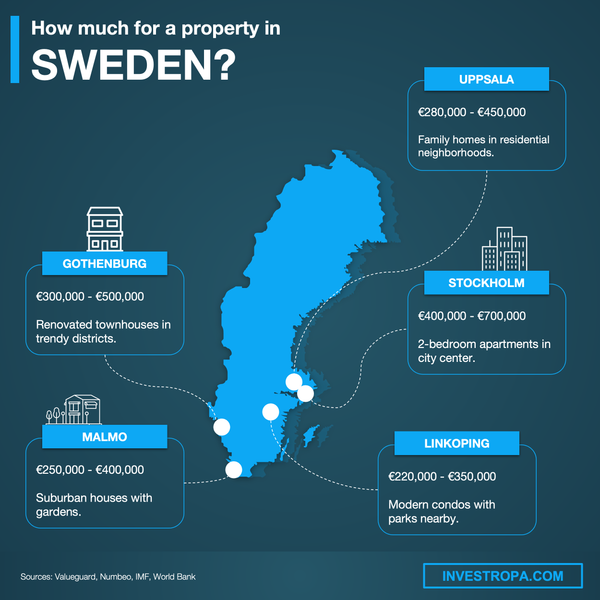
We created this infographic to give you a simple idea of how much it costs to buy property in different parts of Sweden. As you can see, it breaks down price ranges and property types for popular cities in the country. We hope this makes it easier to explore your options and understand the market.
Does my nationality or residency status change anything in Sweden?
Does my nationality change what I can buy in Sweden right now in 2026?
As of early 2026, your nationality does not affect what types of property you can legally buy in Sweden, as the country does not differentiate property ownership rights based on passport.
Sweden does not maintain any list of restricted nationalities for residential property purchases, meaning buyers from any country face the same legal framework.
However, while no nationalities receive official preferential treatment, buyers from countries with strong banking ties to Sweden or familiar documentation systems often experience smoother practical processes when dealing with Swedish banks and institutions.
Do EU/US/UK citizens get easier property access in Sweden?
There is no legal preferential property access for EU, US, or UK citizens in Sweden, as all foreigners have the same ownership rights regardless of where they come from.
EU citizens do benefit from easier residence and administrative processes in Sweden due to freedom of movement rules, which can make setting up Swedish bank accounts and getting personal numbers simpler.
US and UK citizens face no legal disadvantages for property purchases, but they may encounter more friction with Swedish banking systems and identity verification compared to EU buyers who benefit from standardized European documentation.
Can I buy property in Sweden without local residency?
Non-residents and tourist-visa holders can legally purchase property in Sweden, as there is no residency requirement for property ownership.
Swedish residents have practical advantages over non-residents, primarily in mortgage access and housing association approvals, but these are bank policies and BRF decisions rather than legal restrictions on ownership rights.
Tourist-visa holders buying property in Sweden need valid identification documents, proof of funds, and should be prepared to work with a Swedish real estate agent and potentially a lawyer, though the purchase itself does not require any special visa or residency permit.
The traps foreign buyers keep discovering in Sweden
Foreign buyers use different agents, documents and assumptions. See the problems that show up when you do not know the local shortcuts yet.
What are the biggest legal grey areas for foreigners in Sweden?
What are the biggest legal grey zones for foreigners in Sweden in 2026?
As of early 2026, Sweden has relatively few legal grey zones compared to other countries, but foreigners commonly stumble into three practical traps that feel like grey areas.
The riskiest grey zone is misunderstanding bostadsrätt ownership: many foreigners treat it like buying an apartment outright, when in reality they are buying a share in a housing association whose finances, rules, and fee structures directly affect their investment value and living conditions.
The best precaution is to thoroughly investigate any BRF's financial statements, maintenance debt, and bylaws before bidding, and to work with a Swedish lawyer or advisor who can explain what you are actually buying.
If you are getting close to a purchase, see what buyers in Sweden say they missed before signing.
Can foreigners safely buy property using a local nominee in Sweden?
Nominee arrangements in Sweden are generally unnecessary and create significant legal risk, since foreigners can already buy property directly in their own name without restrictions.
The main risk of using a non-spouse nominee is that Swedish law would recognize them as the legal owner, leaving you with only a private agreement that could be difficult to enforce if the relationship sours or the nominee faces financial problems.
Buying through a Swedish spouse provides some relationship-based trust but introduces marital property complications that vary depending on your marriage contract and applicable family law.
Purchasing through a Swedish-registered company is legal and sometimes used for tax or business reasons, but it changes your financing options, increases administrative complexity, and triggers different tax treatment compared to personal ownership.
What happens if a foreigner dies owning property in Sweden?
When a foreigner dies owning property in Sweden, the inheritance process is structured and manageable, with specific provisions for international estates that have been in place since EU succession regulations took effect.
Foreign heirs need to provide proper documentation such as a European Certificate of Succession (for deaths after August 16, 2015) or equivalent probate documents from their home country, which must then be submitted to Lantmäteriet to register the ownership transfer.
Foreign heirs face no special restrictions when reselling inherited property in Sweden and can sell under the same conditions as any other owner.
The most common inheritance complication is delayed paperwork when heirs are unfamiliar with Swedish requirements, so the best prevention is to keep clear records of ownership documents and consider consulting a Swedish lawyer to prepare succession planning in advance.

We did some research and made this infographic to help you quickly compare rental yields of the major cities in Sweden versus those in neighboring countries. It provides a clear view of how this country positions itself as a real estate investment destination, which might interest you if you’re planning to invest there.
Can foreigners realistically get a mortgage in Sweden in 2026?
Do banks give mortgages to foreigners in Sweden in 2026?
As of early 2026, Swedish banks can and sometimes do provide mortgages to foreigners, but approval rates vary significantly based on your profile, with non-residents facing the toughest conditions and often needing to bring 30% to 50% down payment or pay entirely in cash.
The main eligibility requirements Swedish banks impose on foreign mortgage applicants include proof of stable income (preferably Swedish or easily verifiable), a Swedish personal number or coordination number, existing banking relationships, and documentation that meets Swedish verification standards.
Are mortgage approvals harder for non-residents in Sweden in 2026?
As of early 2026, mortgage approvals are significantly harder for non-residents compared to Swedish residents, primarily because banks view non-residents as higher risk due to difficulties verifying income and enforcing repayment if the borrower leaves Sweden.
Swedish residents can typically access loan-to-value ratios up to 85% (meaning a 15% down payment of around 750,000 SEK, or roughly 65,000 EUR / 70,000 USD, on a 5 million SEK property), while non-residents often face requirements of 50% or more down payment, and some banks simply decline non-resident applications altogether.
Non-residents must typically provide additional documentation including proof of income translated into Swedish or English, tax returns from their home country, bank statements showing financial stability, and sometimes a larger cash reserve beyond the down payment.
Mortgage problems faced by foreign buyers are also covered in our buyer-mistake research for Sweden.
Before the bidding turns into a race, read what buyers learned
The details that feel routine at this stage are often where buyers get caught. See the real cases, the paperwork they trusted and what they should have checked first.
Are foreigners protected by the law in Sweden during disputes?
Are foreigners legally protected like locals in Sweden right now?
Foreigners receive the same legal protections as Swedish citizens in property matters, as Swedish law does not distinguish between owners based on nationality once ownership is registered.
Foreigners and locals share equal rights to enforce contracts, challenge unlawful actions, access the court system, and have their registered ownership protected by Swedish property law.
The main protection gap foreigners face is not legal but practical: unfamiliarity with Swedish contract structures, BRF rules, and procedural requirements can leave foreigners more vulnerable to making mistakes that locals would naturally avoid.
The most important safeguard a foreigner should put in place is working with a qualified Swedish lawyer or real estate advisor before signing any binding documents, especially for bostadsrätt purchases where BRF finances and bylaws require careful review.
Do courts treat foreigners fairly in property disputes in Sweden right now?
Sweden is widely recognized as a strong rule-of-law jurisdiction where courts treat foreigners fairly in property disputes, with outcomes depending on contract terms and evidence rather than nationality.
Property disputes in Swedish courts typically take 6 to 18 months to resolve and can cost anywhere from 50,000 to 300,000 SEK (roughly 4,500 to 27,000 EUR / 5,000 to 29,000 USD) in legal fees depending on complexity, though many cases settle before trial.
The most common property disputes foreigners bring to court involve misunderstandings about what was included in a sale, undisclosed defects in bostadsrätt units, or conflicts with housing associations over rules and fees.
Alternative dispute resolution options include mediation services, arbitration clauses that may be written into purchase contracts, and direct negotiation with BRF boards, all of which can resolve issues faster and cheaper than court proceedings.

We made this infographic to show you how property prices in Sweden compare to other big cities across the region. It breaks down the average price per square meter in city centers, so you can see how cities stack up. It’s an easy way to spot where you might get the best value for your money. We hope you like it.
What do foreigners say after buying in Sweden in 2026?
Do foreigners feel treated differently during buying in Sweden right now?
Based on buyer surveys and broker feedback, roughly 30% to 40% of foreigners report feeling some form of differential treatment during the buying process in Sweden, though most describe it as friction rather than discrimination.
The most commonly reported difference is extra scrutiny during BRF approval processes and mortgage applications, where foreigners feel they must provide more documentation and face more questions than Swedish buyers would.
On the positive side, many foreigners report that Swedish real estate agents and the Lantmäteriet registration process are highly professional, transparent, and procedurally fair compared to property markets in other countries.
For a practical reality check, read the problems other buyers actually ran into in Sweden.
Do foreigners overpay compared to locals in Sweden in 2026?
As of early 2026, foreigners in Sweden tend to overpay by an estimated 5% to 15% compared to locals for similar properties, which on a typical Stockholm apartment of 5 million SEK means roughly 250,000 to 750,000 SEK extra (about 22,000 to 67,000 EUR / 24,000 to 72,000 USD).
The main reason foreigners pay more in Sweden is that they often focus on apartment aesthetics and location prestige while underestimating the BRF's financial health, leading them to buy units in associations with high debt, rising fees, or upcoming special assessments that Swedish buyers would recognize and price into their bids.
The expensive mistakes property buyers keep repeating
Deposits lost, defects missed, documents misunderstood and costs discovered too late. See the real cases before your savings are on the line.
What sources have we used to write this blog article?
Whether it’s in our blog articles or our buyer-mistake research for Sweden, we rely on the strongest methodology we can and don’t throw out numbers at random.
We also aim to be fully transparent, so below we've listed the authoritative sources we used, and explained how we used them and the methods behind our estimates.
| Source | Why we trust it | How we used it |
|---|---|---|
| Lantmäteriet | Sweden's official land registration authority. | We used it to confirm ownership registration rules and processes. We also referenced it for stamp duty rates and documentation requirements. |
| Swedish Parliament (Riksdagen) | Official source for Swedish law texts. | We used it to anchor legal definitions of property ownership. We referenced the Swedish Land Code for accurate legal framing. |
| DLA Piper REALWORLD | Major international law firm with consistent country summaries. | We used it to verify no foreign ownership restrictions exist. We cross-checked their findings against Swedish government sources. |
| Notar | Large Swedish brokerage with direct market experience. | We used it to understand real-world buying friction for foreigners. We drew on their practical guidance for BRF-related risks. |
| Riksbank | Sweden's central bank with authoritative economic data. | We used it for interest rate and macro context. We referenced their forecasts to frame mortgage market conditions. |
| Deloitte Legal | Global advisory firm with consistent legal research standards. | We used it to explain Swedish property law in plain language. We cross-checked their framework explanations against primary sources. |
| Wise | Major consumer finance platform with practical banking insights. | We used it to describe mortgage challenges foreigners face. We treated it as real-world context rather than legal authority. |
| Global Property Guide | Long-running international property research site. | We used it to cross-check typical foreign buyer issues. We treated it as secondary confirmation alongside official sources. |
| Eurostat (via Trading Economics) | EU's official statistics authority for comparable data. | We used it to anchor market trend statements. We referenced it for internationally comparable price index context. |
| Handelsbanken (via MarketScreener) | Major Swedish bank with market forecasting expertise. | We used it to reflect Swedish bank projections on prices. We treated it as sentiment context rather than guaranteed outcomes. |

We have made this infographic to give you a quick and clear snapshot of the property market in Sweden. It highlights key facts like rental prices, yields, and property costs both in city centers and outside, so you can easily compare opportunities. We’ve done some research and also included useful insights about the country’s economy, like GDP, population, and interest rates, to help you understand the bigger picture.
