
Reviewed by the researcher who helped assess buyer mistakes and real-world purchase problems in Sweden.

Before buying in Sweden, read the mistakes and real buyer experiences we collected so you can see what tends to go wrong.
Sweden is one of the most open countries in Europe when it comes to foreign property ownership, but there are a few specific rules that can catch buyers off guard.
We constantly update this blog post to reflect the latest regulations and market conditions in Sweden.
And if you’re planning to buy here, read what went wrong for other property buyers in Sweden before you commit.
Insights
- Sweden charges 1.5% stamp duty for individuals but 4.25% for companies, which means buying through a Swedish company costs almost three times more in registration taxes alone.
- The only real restriction foreigners face in Sweden involves agricultural or forest land in designated rural areas, where an acquisition permit from the County Administrative Board may be required.
- Swedish buyers must apply for ownership registration (lagfart) within 3 months of purchase, and the processing time at Lantmäteriet can add several more weeks on top of that.
- Mortgage deed fees (pantbrev) at 2% of the loan amount often surprise foreign buyers in Sweden because they are separate from and additional to the standard stamp duty.
- Sweden does not require foreigners to have residency, a visa, or even a Swedish personal number to legally purchase residential property.
- The 2026 municipal property fee cap for houses in Sweden is set by Skatteverket and applies regardless of the property's market value, keeping annual holding costs predictable.
- Tomträtt (site leasehold) is Sweden's main alternative to freehold ownership, offering indefinite use of public land with the right to sell, mortgage, and build on the property.
- Foreign buyers commonly underestimate Sweden's buyer investigation duty (undersökningsplikt), which places the legal responsibility on the buyer to discover defects before purchase.
Can a foreigner legally own land in Sweden right now?
Can foreigners own land in Sweden in 2026?
As of early 2026, Sweden allows foreigners to buy and own residential land and houses with essentially the same process as Swedish citizens, making it one of the most open property markets in Europe.
The main exception involves agricultural or forest property (called lantbruksegendom), where Sweden may require an acquisition permit in certain designated rural or sparsely populated areas under the Jordförvärvslagen law.
If direct land ownership is not possible for your situation, the closest legal alternative in Sweden is tomträtt (site leasehold), which lets you own the building and hold a long-term, mortgageable right to use public land while paying an annual ground rent.
Sweden does not apply nationality-based restrictions to residential property purchases, meaning the rules are the same whether you are from an EU country, the United States, or anywhere else in the world.
Can I own a house but not the land in Sweden in 2026?
As of early 2026, Sweden has a well-established legal framework called tomträtt that allows you to own a building while holding a long-term leasehold right to the underlying land, which is typically owned by a municipality or the state.
When you hold tomträtt in Sweden, you receive a registered title for the site leasehold right that can be mortgaged and sold just like freehold property, and this right is recorded in the official property register maintained by Lantmäteriet.
Because tomträtt is generally granted for an indefinite period rather than a fixed term, there is no standard expiration date, and specific termination rules under the Swedish Land Code (Jordabalken) protect the holder's interests.
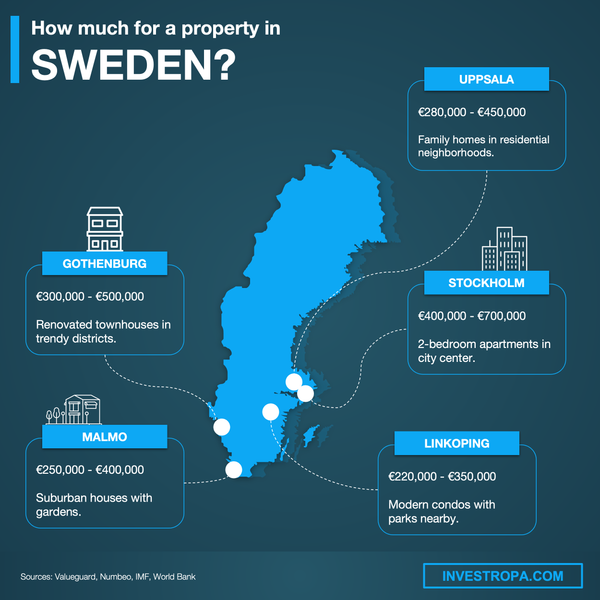
We created this infographic to give you a simple idea of how much it costs to buy property in different parts of Sweden. As you can see, it breaks down price ranges and property types for popular cities in the country. We hope this makes it easier to explore your options and understand the market.
Do rules differ by region or city for land ownership in Sweden right now?
For standard residential houses and plots in Sweden, the foreign ownership rules are consistent nationwide, meaning you can buy in Stockholm, Gothenburg, or Malmö under the same basic framework.
The main regional variation applies to agricultural and forest properties, where acquisition permits are administered by the County Administrative Board (Länsstyrelsen) and depend on whether the property falls within designated areas like sparsely populated regions or archipelago zones.
These regional differences exist because Sweden wants to maintain local ownership and prevent consolidation of agricultural land in certain rural areas, not because of any restriction on foreigners specifically.
You can also read the mistakes and real buyer experiences we collected for Sweden.
Can I buy land in Sweden through marriage to a local in 2026?
As of early 2026, marriage to a Swedish citizen does not grant any special property rights because foreigners can already buy residential land in Sweden without such arrangements.
If you do purchase property jointly with a Swedish spouse, standard Swedish family law and property agreements (like prenuptial agreements or samboavtal for cohabiting partners) provide legal protection for both parties' interests in the property.
In the event of divorce, Swedish law generally divides marital property equally unless there is a prenuptial agreement stating otherwise, so a foreign spouse's interest in jointly owned land would typically be protected through normal divorce proceedings.

We have made this infographic to give you a quick and clear snapshot of the property market in Sweden. It highlights key facts like rental prices, yields, and property costs both in city centers and outside, so you can easily compare opportunities. We’ve done some research and also included useful insights about the country’s economy, like GDP, population, and interest rates, to help you understand the bigger picture.
What eligibility and status do I need to buy land in Sweden?
Do I need residency to buy land in Sweden in 2026?
As of early 2026, Sweden does not require foreigners to have residency status, a residence permit, or any specific visa to purchase residential property.
You can complete a land transaction in Sweden as a tourist or non-resident, though having proper identification documents will be necessary for the registration process with Lantmäteriet.
Remote purchases are legally possible in Sweden, and many foreign buyers complete transactions through a combination of Swedish real estate agents (a regulated profession), lawyers, and secure document-signing arrangements without being physically present.
Do I need a local tax number to buy lands in Sweden?
Sweden does not legally require foreigners to have a Swedish personal identity number (personnummer) to purchase land, though you will need to be identifiable for the registration and any banking relationships.
If you are not registered as a Swedish resident, you can apply for a coordination number (samordningsnummer) through Skatteverket, which typically takes a few weeks and serves as your identifier for banking, utilities, and official transactions.
Opening a Swedish bank account is not strictly required by law, but it is practically very helpful for paying the deposit, completion funds, and ongoing costs, and some banks do offer accounts to non-residents under certain conditions.
Is there a minimum investment to buy land in Sweden as of 2026?
As of early 2026, Sweden has no official minimum investment amount for foreigners to purchase residential land or property.
The practical minimum you will encounter is driven by market prices and, if you need financing, by Swedish mortgage lenders' credit assessment requirements, which focus on your income, affordability, and loan-to-value ratios rather than any legal threshold.
Are there restricted zones foreigners can't buy in Sweden?
Sweden does not have general "foreigner-only" restricted zones for residential property purchases, meaning you can buy a house or plot in virtually any city or neighborhood.
The restricted contexts that do exist relate to property classification rather than location: agricultural and forest properties in certain designated areas may require an acquisition permit, but this applies based on land type, not your nationality.
To verify whether a specific plot falls within any restricted category, you can order a property register extract from Lantmäteriet, which will show the property's classification, any registered easements, and other relevant encumbrances.
Can foreigners buy agricultural, coastal or border land in Sweden right now?
Sweden allows foreigners to purchase agricultural, coastal, and border land, but agricultural and forest properties may require an acquisition permit (förvärvstillstånd) depending on the property classification and location.
For agricultural land specifically, the permit requirement under the Jordförvärvslagen applies in certain designated areas, and the decision is made by the County Administrative Board based on factors like maintaining local agricultural activity rather than the buyer's nationality.
Coastal land in Sweden does not have special foreigner restrictions, though building permits and environmental regulations under the Planning and Building Act (administered by Boverket) may affect what you can do with the property.
Border land in Sweden also has no specific nationality-based purchasing restrictions, unlike some other countries, so the same agricultural permit rules apply regardless of how close the property is to Norway or Finland.
Know what to look for before you visit a property
Buyers often notice the problem only after moving in. See what others missed during viewings and which questions would have exposed it earlier.
What are the safest legal structures to control land in Sweden?
Is a long-term lease equivalent to ownership in Sweden right now?
Sweden's tomträtt (site leasehold) comes very close to ownership in practical terms because it is a registered, mortgageable right that can be bought, sold, and inherited, though you pay annual ground rent instead of owning the land outright.
Tomträtt in Sweden is typically granted for an indefinite period rather than a fixed lease term, and the Land Code (Jordabalken) provides strong protections against termination, with ground rent adjustments happening periodically according to the contract terms.
You can legally sell, transfer, or bequeath your tomträtt rights to another party in Sweden, and banks routinely accept tomträtt as collateral for mortgages, making it functionally similar to freehold ownership for most practical purposes.
Can I buy land in Sweden via a local company?
Sweden allows foreigners to purchase land through a locally registered company, but this structure comes with a significantly higher stamp duty of 4.25% compared to the 1.5% rate for individual buyers.
There are no specific ownership percentage requirements for a foreign-owned Swedish company to hold land, but company acquisitions of agricultural or forest property may face stricter permit scrutiny than individual purchases under the Jordförvärvslagen framework.
What "grey-area" ownership setups get foreigners in trouble in Sweden?
Grey-area arrangements are relatively uncommon in Sweden compared to countries with strict foreign ownership bans, but foreigners still encounter problems from misunderstanding Swedish property forms rather than trying to circumvent restrictions.
The most common issues include accidentally buying a rural property that is legally classified as agricultural land (triggering unexpected permit requirements), purchasing tomträtt without realizing you do not own the land (and underestimating future ground rent increases), and skipping proper due diligence because "Sweden is safe."
If Swedish authorities find that you failed to obtain a required acquisition permit for agricultural property, your application for registration of ownership (lagfart) can be blocked until you either obtain the permit or the sale is unwound, which can be costly and time-consuming.
If you are getting close to a purchase, see what buyers in Sweden say they missed before signing.

We did some research and made this infographic to help you quickly compare rental yields of the major cities in Sweden versus those in neighboring countries. It provides a clear view of how this country positions itself as a real estate investment destination, which might interest you if you’re planning to invest there.
How does the land purchase process work in Sweden, step-by-step?
What are the exact steps to buy land in Sweden right now?
The typical process to buy a house or plot in Sweden involves finding the property and ordering a register extract from Lantmäteriet, participating in the bidding process (budgivning), signing the purchase contract (köpekontrakt), paying a 10% deposit (handpenning), completing the transaction on the access date (tillträde), and then applying for registration of ownership (lagfart) within 3 months.
From accepted offer to moving in, the process usually takes a few weeks to about 2 months depending on negotiations, inspections, and financing, though the administrative processing of your lagfart application at Lantmäteriet can add several more weeks.
The key documents you will sign include the purchase contract meeting Swedish formal requirements for property transfers, and then the documents needed for your lagfart application, along with any mortgage deed (pantbrev) paperwork if you are financing the purchase.
What scams are common when it comes to buying land in Sweden right now?
What scams target foreign land buyers in Sweden right now?
Sweden has a well-regulated property market with supervised real estate agents and a transparent registry system, so outright fraud is relatively rare compared to many other countries.
The most common problems for foreign buyers in Sweden are "soft scams" and expensive mistakes: paying deposits directly to individuals instead of through regulated agent escrow arrangements, underestimating pantbrev costs when getting a mortgage, and failing to conduct proper due diligence because of Sweden's trustworthy reputation.
Warning signs that a deal may be problematic include pressure to pay money before verifying ownership through Lantmäteriet, sellers who are not the registered owners in the property register, and agents who are not registered with the Swedish Estate Agents Inspectorate (FMI).
If you do fall victim to fraud in Sweden, you have legal recourse through the Swedish courts, and regulated agents carry mandatory insurance, but recovering money from individual scammers can still be difficult and time-consuming.
For a practical reality check, read the problems other buyers actually ran into in Sweden.
How do I verify the seller is legit in Sweden right now?
The most reliable way to verify a seller in Sweden is to order a property register extract (fastighetsutdrag) from Lantmäteriet, which will show the registered owner and confirm whether the person you are dealing with actually has the right to sell.
The same register extract will show whether the title is clean by listing any registered encumbrances, easements (servitut), and the status of ownership registration (lagfart).
To check for mortgages or liens, look at the pantbrev (mortgage deeds) section of the Lantmäteriet extract, which shows all registered mortgage deeds and their amounts against the property.
While Sweden does not require a lawyer to complete a purchase, using a regulated real estate agent (supervised by FMI) provides an important layer of verification, as they are required to check ownership and handle client funds through proper escrow arrangements.
How do I confirm land boundaries in Sweden right now?
The standard procedure to confirm land boundaries in Sweden starts with reviewing the official property maps and boundary information available through Lantmäteriet, which maintains the national cadastral register.
You should review the property's registered boundary coordinates and any available cadastral maps (fastighetskartan) from Lantmäteriet, which show the legal boundaries as recorded in the official register.
Hiring a licensed surveyor is not legally required in Sweden, but it is strongly recommended for rural properties, plots with unclear markers, or any situation where boundary certainty is critical for your intended use like building a fence or extension.
Common boundary problems foreign buyers encounter in Sweden include unclear or disputed boundaries in older rural properties, assumptions about shoreline access that do not match the legal boundary, and forest road rights that were never properly registered.
The traps foreign buyers keep discovering in Sweden
Foreign buyers use different agents, documents and assumptions. See the problems that show up when you do not know the local shortcuts yet.
What will it cost me, all-in, to buy and hold land in Sweden?
What purchase taxes and fees apply in Sweden as of 2026?
As of early 2026, the total purchase taxes and fees for an individual buying residential property in Sweden typically range from about 1.6% to 3% of the purchase price, depending on whether you need new mortgage deeds.
For a cash buyer who does not need new pantbrev, the closing costs are around 1.6% (the 1.5% stamp duty plus a small fixed Lantmäteriet fee of 825 SEK, roughly 75 USD or 70 EUR).
The main components are the lagfart stamp duty at 1.5% of the purchase price (or tax assessment value if higher), plus a 2% stamp duty on any new mortgage deeds (pantbrev) you need to issue, along with a 375 SEK (about 35 USD or 32 EUR) expedition fee per deed.
These rates are the same for foreign and Swedish individual buyers, though companies face a higher stamp duty of 4.25% instead of 1.5%.
What hidden fees surprise foreigners in Sweden most often?
Hidden fees in Sweden typically add between 0.5% and 2% to what buyers initially expect, with the exact amount depending heavily on your mortgage needs and the property type.
The top hidden fees that surprise foreigners are pantbrev costs (2% of any new mortgage deed amount plus 375 SEK per deed, which can easily add 30,000 SEK or about 2,800 USD / 2,600 EUR on a 1.5 million SEK mortgage increase), tomträtt ground rent adjustments if you bought a site leasehold, and the cost of addressing defects you should have discovered under Sweden's buyer investigation duty.
Pantbrev costs hit at closing when your mortgage is finalized and you discover the existing deeds on the property are insufficient, while ground rent and investigation duty issues can emerge months or years after purchase.
To protect yourself, always ask the seller how many pantbrev exist on the property and at what amounts, budget conservatively for new deed issuance, and take your buyer investigation duty seriously by commissioning a proper inspection before signing the contract.

We made this infographic to show you how property prices in Sweden compare to other big cities across the region. It breaks down the average price per square meter in city centers, so you can see how cities stack up. It’s an easy way to spot where you might get the best value for your money. We hope you like it.
What sources have we used to write this blog article?
Whether it’s in our blog articles or our buyer-mistake research for Sweden, we rely on the strongest methodology we can and don’t throw out numbers at random.
We also aim to be fully transparent, so below we've listed the authoritative sources we used, and explained how we used them and the methods behind our estimates.
| Source | Why It's Authoritative | How We Used It |
|---|---|---|
| Lantmäteriet (Stamp Duty and Fees) | The official authority that registers ownership and publishes actual fee rules. | We used it to pin down exact stamp duty rates for individuals versus companies. We cross-checked all registration fee figures against this source. |
| Sveriges Riksdag (Jordabalken / Land Code) | The actual Swedish statute defining property rights, registration, and leases. | We used it to ground all legal concepts like ownership, tomträtt, and registration. We treated it as the source of truth for describing legal structures. |
| Sveriges Riksdag (Jordförvärvslagen) | The statute creating acquisition permit rules for agricultural and forest property. | We used it to explain the main exception in Sweden's open property market. We verified permit triggers and exemptions against this law. |
| Länsstyrelsen (County Administrative Board) | The authority that actually decides permits under the Jordförvärvslagen. | We used it to translate the law into practical guidance on when permits apply. We relied on their regional implementation explanations. |
| Skatteverket (2026 Rates) | The official tax authority publishing exact caps and percentages for 2026. | We used it to cite the 2026 property fee caps and ensure current accuracy. We verified all tax-related figures against their published rates. |
| Konsumentverket (Consumer Agency) | The Swedish consumer authority with excellent guidance on buyer duties and risks. | We used it to highlight the buyer investigation duty and common pitfalls. We built our due diligence checklist based on their recommendations. |
| FMI (Estate Agents Inspectorate) | The authority supervising Swedish real estate agents. | We used it to explain agent regulation and buyer protections. We referenced their standards when discussing verification procedures. |
| Finansinspektionen (Mortgage Market Report) | The regulator supervising mortgage lenders in Sweden. | We used it to explain mortgage assessment criteria and loan requirements. We avoided relying on broker hearsay about financing constraints. |
| Statistics Sweden (SCB) | The national statistics office publishing official property price indices. | We used it for market context and price trend grounding. We kept our analysis tied to official data rather than anecdotal reports. |
What agents and sellers may not warn you about
The person selling the property is there to close the deal. See the checks, clauses and problems buyers say they had to discover for themselves.
