
Reviewed by the researcher who helped assess buyer mistakes and real-world purchase problems in Sweden.

Before buying in Sweden, read the mistakes and real buyer experiences we collected so you can see what tends to go wrong.
This guide covers everything a foreign investor needs to know about renting out residential property in Sweden in 2026, from legal requirements to realistic yields and the best neighborhoods for rental income.
We constantly update this blog post to reflect the latest regulations, market data, and rental trends in Sweden.
Whether you are considering a long-term lease strategy or exploring short-term rentals, you will find practical, numbers-based answers here.
And if you’re planning to buy here, read what went wrong for other property buyers in Sweden before you commit.
Insights
- Sweden's bostadsrätt (condo) associations can block or restrict subletting, which means the building you buy matters as much as the location for rental investors.
- Gross rental yields in Sweden typically range from 3.5% in Stockholm to 6% in Malmö, but net yields often drop by 1.5 to 2 percentage points after holding costs.
- Foreigners do not need residency to own and rent out property in Sweden, but obtaining a coordination number (samordningsnummer) is essential for tax reporting and local admin.
- Sweden has no statutory cap on rental deposits, which is unusual compared to most European countries, so landlords typically ask for one to two months' rent.
- Stockholm's short-term rental occupancy averages around 63%, but Gothenburg and Malmö sit closer to 53% to 54%, making long-term leasing safer in smaller cities.
- The municipal property fee for houses in Sweden is capped at about SEK 10,400 per year in 2026, which translates to roughly SEK 870 per month.
- Furnished apartments in Sweden rent faster among expats and students, but wear-and-tear costs can erode the revenue advantage over unfurnished units.
- High-yield neighborhoods in Stockholm like Enskede-Skarpnäck and Spånga-Kista offer better returns than central Östermalm because purchase prices are lower while tenant demand stays strong.
Can I legally rent out a property in Sweden as a foreigner right now?
Can a foreigner own-and-rent a residential property in Sweden in 2026?
As of early 2026, Sweden allows foreign individuals to buy and own residential property and rent it out without requiring citizenship or special permits in most cases.
The main ownership structures available to foreigners are buying a house (småhus or villa) outright or purchasing a bostadsrätt, which is a condo where you own the right to use a unit within a housing association.
The single most common limitation foreigners encounter is that bostadsrätt associations often restrict or require approval for subletting, which can complicate rental plans if the building's rules are strict.
Additionally, if the property you want to buy is classified as agricultural land, you may need an acquisition permit from the County Administrative Board, though this rarely affects typical urban residential purchases.
Do I need residency to rent out in Sweden right now?
No, Sweden does not require you to be a resident to own and rent out a residential property, so non-resident foreign landlords can operate legally.
However, you will typically need a Swedish coordination number (samordningsnummer) to handle tax filings and other administrative tasks, since a personal number (personnummer) is only issued to residents.
A local Swedish bank account is not legally mandatory, but it is practically very helpful because most Swedish tenants prefer paying rent via domestic systems like Bankgiro or Swish.
Managing a rental in Sweden remotely is feasible if you hire a local property manager or have a trusted contact to handle tenant relations, inspections, and emergencies.
The traps foreign buyers keep discovering in Sweden
Foreign buyers use different agents, documents and assumptions. See the problems that show up when you do not know the local shortcuts yet.
What rental strategy makes the most money in Sweden in 2026?
Is long-term renting more profitable than short-term in Sweden in 2026?
As of early 2026, long-term renting in Sweden is generally simpler and more predictable, while short-term rentals can generate higher revenue but face more operational costs and building-level restrictions.
A well-managed long-term rental in Stockholm might bring in SEK 15,000 to 20,000 per month (around $1,600 to $2,100 or €1,400 to €1,850), whereas a comparable short-term rental could gross SEK 25,000 to 35,000 monthly at good occupancy, though costs eat into that significantly.
Short-term renting tends to outperform long-term only in central Stockholm locations with consistent year-round demand and in buildings where the bostadsrätt association explicitly permits Airbnb-style use.
What's the average gross rental yield in Sweden in 2026?
As of early 2026, the average gross rental yield for residential property in Sweden ranges from about 3.5% in Stockholm to around 5% in Gothenburg and up to 6% in Malmö.
Most investors in Sweden can realistically expect gross yields between 3.5% and 5.5%, with the exact figure depending heavily on whether you access second-hand market rents or lower regulated first-hand rents.
Smaller apartments like studios and one-bedrooms typically achieve the highest gross yields in Sweden because their price-to-rent ratio is more favorable than larger family homes.
Before relying on these numbers to buy, read what went wrong for other property buyers in Sweden and what they wish they had checked earlier.
What's the realistic net rental yield after costs in Sweden in 2026?
As of early 2026, the average net rental yield after typical holding costs in Sweden falls between 2% and 4%, depending on the city and property type.
Most landlords in Sweden experience net yields in the range of 2% to 3.2% in Stockholm, 2.5% to 3.8% in Gothenburg, and 2.8% to 4.2% in Malmö.
The three main cost categories that reduce gross yield in Sweden are the bostadsrätt association monthly fee (avgift), which can be substantial, the rental income tax after deductions, and maintenance reserves that Swedish tenants expect landlords to maintain at high standards.
What monthly rent can I get in Sweden in 2026?
As of early 2026, typical monthly rents in Sweden's private market are around SEK 12,000 ($1,250 / €1,100) for a studio, SEK 16,000 ($1,700 / €1,450) for a one-bedroom, and SEK 21,000 ($2,200 / €1,900) for a two-bedroom in major cities.
A realistic entry-level rent for a decent studio in Stockholm ranges from SEK 11,500 to 14,000 per month, which translates to roughly $1,200 to $1,500 or €1,050 to €1,250.
For a typical one-bedroom apartment in Sweden's metro areas, mid-range monthly rents fall between SEK 14,000 and 18,000, or about $1,500 to $1,900 (€1,250 to €1,600).
A standard two-bedroom apartment in central Stockholm or Gothenburg commands SEK 18,000 to 24,000 per month, equivalent to approximately $1,900 to $2,500 or €1,600 to €2,150.

We did some research and made this infographic to help you quickly compare rental yields of the major cities in Sweden versus those in neighboring countries. It provides a clear view of how this country positions itself as a real estate investment destination, which might interest you if you’re planning to invest there.
What are the real numbers I should budget for renting out in Sweden in 2026?
What's the total "all-in" monthly cost to hold a rental in Sweden in 2026?
As of early 2026, the total monthly holding cost for a typical rental property in Sweden ranges from SEK 3,500 to 7,500 ($370 to $790 / €320 to €680) for a bostadsrätt and SEK 4,000 to 9,000 ($420 to $950 / €360 to €810) for a house.
Most landlords in Sweden should budget between SEK 4,000 and 8,000 per month to cover association fees, insurance, minor repairs, and utilities depending on what is included in the rent.
The single largest cost category for bostadsrätt owners in Sweden is typically the monthly association fee (avgift), which covers building maintenance, heating, water, and common area upkeep.
What's the typical vacancy rate in Sweden in 2026?
As of early 2026, the typical vacancy rate for well-priced rental properties in Sweden's major cities is around 3%, meaning roughly one month empty every three years.
A prudent landlord in Sweden should budget for about two to four weeks of vacancy per year, which accounts for tenant turnover and the time needed to find quality renters.
The main factor driving vacancy differences across Sweden is neighborhood demand, where areas near universities, transit hubs, and job centers see faster re-letting than peripheral locations.
Tenant turnover in Sweden tends to peak around summer months, particularly June through August, when students and young professionals relocate for studies or new jobs.
You can also read the mistakes and real buyer experiences we collected for Sweden.
The expensive mistakes property buyers keep repeating
Deposits lost, defects missed, documents misunderstood and costs discovered too late. See the real cases before your savings are on the line.
Where do rentals perform best in Sweden in 2026?
Which neighborhoods have the highest long-term demand in Sweden in 2026?
As of early 2026, the neighborhoods with the highest long-term rental demand in Sweden include Vasastan, Södermalm, and Kungsholmen in Stockholm, Linnéstaden in Gothenburg, and Västra Hamnen in Malmö.
Families in Sweden tend to favor neighborhoods like Bromma and Hägersten-Liljeholmen in Stockholm, Örgryte in Gothenburg, and Limhamn in Malmö because of schools, green spaces, and family-friendly amenities.
Students gravitate toward areas with good transit to universities, such as Vasastan and Solna near KTH and Stockholm University, or Johanneberg in Gothenburg near Chalmers.
Expats and international professionals in Sweden typically prefer central, well-connected neighborhoods like Östermalm, Vasastan, and Södermalm in Stockholm or Centrum in Gothenburg.
Which neighborhoods have the best yield in Sweden in 2026?
As of early 2026, the neighborhoods offering the best rental yields in Sweden include Enskede-Skarpnäck, Spånga-Kista, and Hässelby-Vällingby in Stockholm, plus outer areas of Gothenburg and Malmö.
These higher-yielding neighborhoods in Sweden typically deliver gross yields between 4.5% and 6%, compared to 3% to 4% in prime central areas like Östermalm or Linnéstaden.
The main characteristic allowing these neighborhoods to outperform on yield is that purchase prices are significantly lower than central districts while tenant demand remains strong due to good transit connections and local employment.
If you are getting close to a purchase, see what buyers in Sweden say they missed before signing.
Where do tenants pay the highest rents in Sweden in 2026?
As of early 2026, the neighborhoods where tenants pay the highest rents in Sweden are Östermalm, Vasastan, and Norrmalm in Stockholm, where two-bedroom apartments can command SEK 22,000 to 28,000 ($2,300 to $2,950 / €2,000 to €2,550) per month.
In these premium Stockholm neighborhoods, a standard one-bedroom apartment typically rents for SEK 16,000 to 22,000 per month, equivalent to $1,700 to $2,300 or €1,450 to €2,000.
What makes these neighborhoods command Sweden's highest rents is their combination of historic architecture, walkability to business districts, excellent schools, and proximity to Stockholm's cultural amenities.
The typical tenant profile in these high-rent areas includes senior professionals, diplomats, executives at multinational companies, and affluent families who prioritize location and prestige over value.
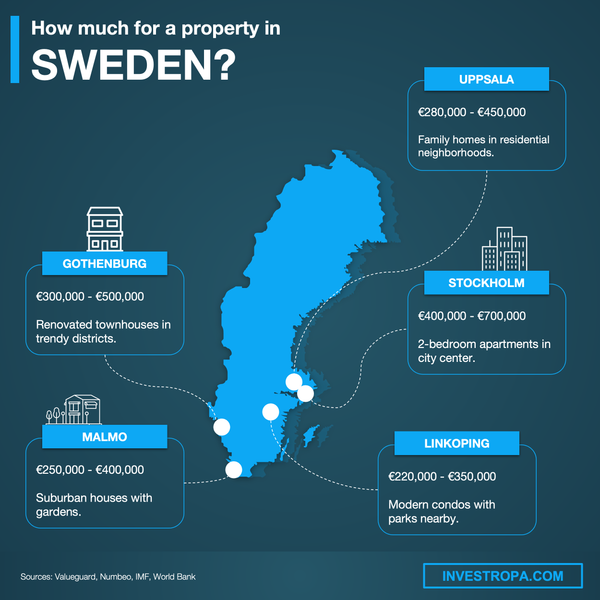
We created this infographic to give you a simple idea of how much it costs to buy property in different parts of Sweden. As you can see, it breaks down price ranges and property types for popular cities in the country. We hope this makes it easier to explore your options and understand the market.
What do tenants actually want in Sweden in 2026?
What features increase rent the most in Sweden in 2026?
As of early 2026, the top three features that increase monthly rent the most in Sweden are in-unit laundry facilities, a dishwasher, and energy-efficient heating systems that keep utility costs low during harsh winters.
Having in-unit laundry in Sweden can add a rent premium of around 5% to 10% because many older Swedish apartments rely on shared laundry rooms (tvättstuga), which tenants find less convenient.
One commonly overrated feature that Swedish landlords invest in but tenants rarely pay extra for is high-end kitchen countertops, since renters prioritize functionality over luxury finishes.
An affordable upgrade that delivers strong returns in Sweden is installing fast, reliable internet infrastructure, as tenants increasingly expect high-speed connectivity included in their rent.
Do furnished rentals rent faster in Sweden in 2026?
As of early 2026, furnished apartments in Sweden typically rent one to three weeks faster than unfurnished ones, especially among expats and students who want to avoid the hassle of buying furniture.
Furnished rentals in Sweden can command a rent premium of around 10% to 20% over unfurnished units, though the extra income is partially offset by higher wear-and-tear and replacement costs.
Don't take our word for it. Read what buyers actually said
Every trap comes from a real buyer experience, dispute, review, forum post or local report. Open the original source and judge it for yourself.
How regulated is long-term renting in Sweden right now?
Can I freely set rent prices in Sweden right now?
In Sweden, your freedom to set rent depends on the type of rental arrangement, with private subletting under the 2012 Private Subletting Act offering more flexibility than traditional first-hand regulated rentals.
Rent increases during a tenancy in Sweden are not formally capped for private sublets, but tenants can challenge rent levels they consider unreasonable through the rent tribunal (Hyresnämnden), which provides a practical ceiling on pricing.
What's the standard lease length in Sweden right now?
The most common lease structure in Sweden is an open-ended contract (tillsvidare) or a fixed-term lease of 12 months, with strong tenant protections making it difficult to end tenancies without proper notice.
Sweden has no statutory cap on security deposits, which is unusual in Europe, so landlords typically request one to two months' rent as a deposit (SEK 12,000 to 40,000 / $1,250 to $4,200 / €1,100 to €3,600 depending on the property).
Swedish law does not specify detailed rules for returning deposits, so landlords should document the property condition thoroughly at move-in and move-out to justify any deductions for damages.

We made this infographic to show you how property prices in Sweden compare to other big cities across the region. It breaks down the average price per square meter in city centers, so you can see how cities stack up. It’s an easy way to spot where you might get the best value for your money. We hope you like it.
How does short-term renting really work in Sweden in 2026?
Is Airbnb legal in Sweden right now?
There is no nationwide ban on Airbnb-style rentals in Sweden, but legality depends heavily on your building's rules, especially if you own a bostadsrätt where the housing association can restrict or prohibit short-term subletting.
Sweden does not require a specific short-term rental license at the national level, though you must still comply with local building rules and report rental income to Skatteverket for tax purposes.
There are no universal night limits on short-term rentals in Sweden, but individual bostadsrätt associations may impose their own caps, so you must check your specific building's regulations before listing.
The most common consequence of operating a non-compliant short-term rental in Sweden is losing your subletting permission from the housing association, which can ultimately affect your right to keep the bostadsrätt.
What's the average short-term occupancy in Sweden in 2026?
As of early 2026, the average annual occupancy rate for short-term rentals in Sweden is around 63% in Stockholm, 54% in Gothenburg, and 53% in Malmö.
Most short-term rental hosts in Sweden experience occupancy rates between 45% and 70%, with top performers in prime Stockholm locations reaching higher levels.
The highest occupancy months in Sweden are typically June through August, when summer tourism peaks, plus December around the holiday season in Stockholm.
The lowest occupancy periods fall during late autumn (November) and early spring (February to March), when tourism drops and business travel slows down.
Before relying on these numbers to buy, read what went wrong for other property buyers in Sweden and what they wish they had checked earlier.
What's the average nightly rate in Sweden in 2026?
As of early 2026, the average nightly rate for short-term rentals in Sweden is approximately SEK 1,550 ($165 / €140) in Stockholm, SEK 1,400 ($150 / €125) in Gothenburg, and SEK 1,100 ($120 / €100) in Malmö.
Most short-term rental listings in Sweden fall within a nightly rate range of SEK 800 to 2,500 ($85 to $265 / €70 to €225), depending on location, size, and amenities.
Peak season rates in Sweden (summer and Christmas) typically run 20% to 40% higher than off-season, meaning a Stockholm listing averaging SEK 1,550 might charge SEK 2,000 or more during July.
Is short-term rental supply saturated in Sweden in 2026?
As of early 2026, short-term rental supply in Sweden is moderately competitive in Stockholm with around 3,000 active listings, while Gothenburg has roughly 3,500 and Malmö about 1,700.
Listing counts in Sweden's major cities have been relatively stable, with modest growth in suburban areas as some hosts move away from oversaturated central zones.
The most oversaturated neighborhoods for short-term rentals in Sweden include Södermalm and Gamla Stan in Stockholm, where competition keeps occupancy rates under pressure.
Neighborhoods that still have room for new short-term supply in Sweden include outer Stockholm areas like Hammarby Sjöstad and parts of Gothenburg's Hisingen, where demand is growing but listings remain limited.
One evening of reading can save years of expensive mistakes
Before you commit a large part of your savings, spend one evening learning what went wrong for buyers who were in your position before you.
What sources have we used to write this blog article?
Whether it’s in our blog articles or our buyer-mistake research for Sweden, we rely on the strongest methodology we can and don’t throw out numbers at random.
We also aim to be fully transparent, so below we've listed the authoritative sources we used, and explained how we used them and the methods behind our estimates.
| Source | Why it's authoritative | How we used it |
|---|---|---|
| Statistics Sweden (SCB) | Sweden's official statistics agency and the gold standard for housing data. | We used SCB's average rent tables to anchor typical rent levels in Sweden. We then adjusted these baselines to reflect private market rates that foreign investors are likely to encounter. |
| Svensk Mäklarstatistik | The main nationwide price statistics provider used by Swedish media. | We used their district-level SEK per square meter figures to anchor purchase price assumptions. We then combined these with rent estimates to calculate gross yields. |
| Cushman & Wakefield | A major global real estate consultancy with transparent research publications. | We used their prime yield requirements as an institutional benchmark for yield ranges. We then translated those into realistic figures for small private landlords. |
| Skatteverket | Sweden's tax authority and the definitive reference for landlord taxation. | We used it to explain tax reporting requirements and typical deductions for foreign owners. We then applied these rules to estimate realistic net yields. |
| Lantmäteriet | Runs Sweden's land registry and is the authority on ownership registration. | We used it to explain the lagfart process and stamp duty for foreign buyers. We then incorporated these transaction costs into our all-in budget estimates. |
| Sveriges Domstolar | Sweden's official courts website explaining tenancy rules in practice. | We used it to describe standard lease lengths and notice periods. We then translated these into practical implications for vacancy risk and landlord flexibility. |
| Sveriges Riksdag | The official publication of Swedish law including the Private Subletting Act. | We used it to explain the special rules for renting out your owned home or condo. We then used these rules to frame rent-setting freedom for small investors. |
| Boverket | Sweden's national housing authority running the official municipal housing survey. | We used it to support demand strength and low vacancy risk in metro regions. We then explained why tenant demand remains structurally strong in major cities. |
| AirDNA | A widely used short-term rental analytics provider tracking Airbnb and Vrbo. | We used it to anchor occupancy rates, daily rates, and implied revenue for short-term rentals. We then compared these with long-term benchmarks to assess strategy profitability. |
| Global Property Guide | A long-running international property index with comparable cross-country data. | We used it to cross-check whether our calculated gross yields were in the right range for Sweden. We then relied more heavily on Swedish primary sources for the underlying analysis. |

We have made this infographic to give you a quick and clear snapshot of the property market in Sweden. It highlights key facts like rental prices, yields, and property costs both in city centers and outside, so you can easily compare opportunities. We’ve done some research and also included useful insights about the country’s economy, like GDP, population, and interest rates, to help you understand the bigger picture.
