
Authored by the expert who managed and guided the team behind the France Property Pack
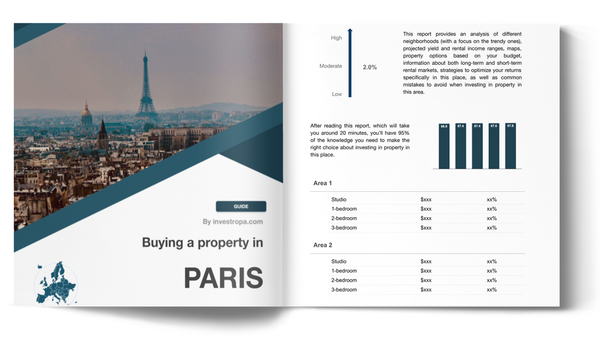
Yes, the analysis of Paris' property market is included in our pack
Buying property in Paris as a foreigner is more straightforward than most people expect, but the local rules on short-term rentals and building regulations catch many buyers off guard.
This guide covers everything from ownership rights and visa requirements to mortgages, taxes, and the step-by-step buying process in Paris as of January 2026.
We constantly update this blog post to reflect the latest regulations and market conditions in Paris.
And if you're planning to buy a property in this place, you may want to download our pack covering the real estate market in Paris.
Insights
- France places no nationality restrictions on foreign property buyers in Paris, meaning a buyer from any country can purchase apartments or houses in their own name through the standard notarial process.
- Closing costs in Paris for existing properties typically run between 7% and 8% of the purchase price, with transfer taxes making up the largest share of that total.
- Non-resident foreign buyers in Paris can expect mortgage rates roughly 0.2 to 0.6 percentage points higher than residents, putting typical offers in the 3.6% to 4.2% fixed range as of early 2026.
- Paris enforces some of the strictest short-term rental rules in Europe, requiring registration for all tourist lets and prior authorization for most second homes used as Airbnb-style rentals.
- Buying property in Paris does not grant any residency rights in France, and the visa process remains entirely separate from property ownership.
- Annual property taxes for a typical Paris apartment range from 900 to 1,800 euros for taxe foncière alone, with second homes facing an additional taxe d'habitation that can push the total above 3,000 euros.
- The notary in Paris is not optional but legally required to execute the authentic deed that transfers ownership, while hiring a lawyer remains the buyer's choice for additional protection.
- French banks do lend to non-resident foreigners in Paris, though they typically require larger down payments of 20% to 40% and thorough documentation of income sources.

What can I legally buy and truly own as a foreigner in Paris?
What property types can foreigners legally buy in Paris right now?
As of January 2026, foreigners can legally purchase any type of residential property in Paris, including apartments, houses, duplexes, lofts, and even historic private mansions known as hôtels particuliers.
The key legal condition is not your nationality but rather passing through France's notarial system, where the notary verifies your identity, checks the source of your funds, and executes the authentic deed that officially transfers ownership.
Paris is overwhelmingly an apartment market, so most foreign buyers end up purchasing a lot within a copropriété, which means you own your private unit plus an undivided share of the building's common areas and land.
Standalone houses do exist in Paris, particularly in arrondissements near the city edges like the 16th or 20th, though they remain rare and command significant premiums compared to apartments.
Finally, please note that our pack about the property market in Paris is specifically tailored to foreigners.
Can I own land in my own name in Paris right now?
Yes, foreigners can own land in their own name in Paris without any legal restrictions, whether that land comes with a standalone house or as a shared portion within a copropriété building.
When you buy a house in Paris, you typically receive full ownership of both the building and the land parcel it sits on, with the notary's authentic deed serving as your legal proof of ownership.
For apartments, land ownership works differently because you own an undivided share of the building's land and common parts proportional to your lot, meaning you are not landless but your land rights are shared with other co-owners in the copropriété.
As of 2026, what other key foreign-ownership rules or limits should I know in Paris?
As of January 2026, Paris does not impose foreign-ownership quotas, nationality-based restrictions, or government approval requirements for residential property purchases by individuals from any country.
There is no condominium foreign ownership quota in Paris like you might find in some Asian countries, so foreigners can buy any apartment in any building without worrying about percentage caps.
The main requirement that applies to all buyers, foreign or French, is going through the notarial process, where the notary handles registration with the property registry and ensures all legal formalities are completed.
One recent regulatory change worth noting is Law 2024-1039, which strengthened local tools to regulate short-term tourist rentals, giving Paris even more enforcement power over Airbnb-style letting starting in late 2024.
What's the biggest ownership mistake foreigners make in Paris right now?
The single biggest ownership mistake foreigners make in Paris is assuming they can freely rent their property on Airbnb or other short-term platforms without realizing that Paris treats tourist rentals as a heavily regulated activity requiring registration and often prior authorization.
If you rent out a second home in Paris without proper authorization, the city actively enforces violations with fines that can reach 50,000 euros per property, and you may be forced to stop renting entirely.
Other classic pitfalls in Paris include underestimating copropriété risks like major building works voted by other owners, not checking energy performance ratings that affect rental eligibility, and failing to verify what renovations are actually permitted under the building's rules or the city's planning constraints.

We have made this infographic to give you a quick and clear snapshot of the property market in France. It highlights key facts like rental prices, yields, and property costs both in city centers and outside, so you can easily compare opportunities. We’ve done some research and also included useful insights about the country’s economy, like GDP, population, and interest rates, to help you understand the bigger picture.
Which visa or residency status changes what I can do in Paris?
Do I need a specific visa to buy property in Paris right now?
You do not need any specific visa to buy property in Paris, and many foreign buyers complete their purchases while visiting on a tourist visa or even entirely from abroad using a power of attorney.
The only administrative hurdle unrelated to the property itself is that your notary will need proper identification documents, and once you own property, you will eventually need to interact with the French tax administration as a non-resident owner.
You do not strictly need a French tax ID before buying, but you will need one after ownership to handle local property taxes and any rental income filings, and the notary can help guide you through this onboarding.
A typical document set for a foreign buyer includes a valid passport, proof of address in your home country, proof of funds or mortgage pre-approval, and sometimes translated civil status documents if required by the notary.
Does buying property help me get residency and citizenship in Paris in 2026?
As of January 2026, buying property in Paris does not automatically grant you any residency rights or path to citizenship, because France's residence permits are tied to specific legal categories like work, family, study, or sufficient resources rather than property ownership.
France does not offer a golden visa or investor visa program based on real estate purchases, unlike some European countries such as Portugal or Greece.
If you want to live in France long-term, the main pathways include work permits, family reunification, student visas, the visitor visa for those with sufficient passive income, or the talent passport for entrepreneurs and investors meeting specific criteria unrelated to property.
We give you all the details you need about the different pathways to get residency and citizenship in Paris here.
Can I legally rent out property on my visa in Paris right now?
Your visa status does not affect your legal ability to own and rent out property in Paris, meaning non-residents and tourists who own property can collect rental income just like French residents.
You do not need to live in France to rent out your Paris property, and many foreign owners manage rentals remotely by appointing a local property manager or rental agency.
The important details foreigners must know are that unfurnished rental income is taxed as revenus fonciers while furnished rentals are taxed as BIC, and short-term tourist rentals face strict Paris-specific rules including mandatory registration and limits on second homes.
We cover everything there is to know about buying and renting out in Paris here.
Get fresh and reliable information about the market in Paris
Don't base significant investment decisions on outdated data. Get updated and accurate information with our guide.

How does the buying process actually work step-by-step in Paris?
What are the exact steps to buy property in Paris right now?
The standard sequence to buy property in Paris starts with your offer being accepted, then signing a preliminary contract called a compromis or promesse de vente, followed by a cooling-off period, then the notary's due diligence checks, and finally signing the authentic deed at the notary's office to complete the transfer.
You do not need to be physically present at any step of the purchase in Paris, because French law allows you to sign via a notarized power of attorney, including remote options where your signature can be authenticated abroad.
The step that makes the deal legally binding for both parties is typically the signing of the compromis de vente after the 10-day cooling-off period expires, at which point the buyer's deposit is at risk if they withdraw without a valid condition.
The typical end-to-end timeline from accepted offer to final deed signing in Paris runs between two and three months, allowing time for the notary's title checks, preemption clearances, and mortgage arrangements if applicable.
We have a document entirely dedicated to the whole buying process our pack about properties in Paris.
Is it mandatory to get a lawyer or a notary to buy a property in Paris right now?
A notary is effectively mandatory for buying property in Paris because only a notary can execute the authentic deed that legally transfers ownership under French law, while hiring a lawyer is entirely optional.
The most important difference is that the notary is a public officer who authenticates the transaction and ensures legal compliance for both parties, while a lawyer acts solely as your private advisor to protect your specific interests and negotiate on your behalf.
If you do hire a lawyer, one key item to include in their scope is reviewing the preliminary contract before you sign it, checking for unfavorable clauses, and ensuring all necessary conditions precedent protect you as the buyer.

We did some research and made this infographic to help you quickly compare rental yields of the major cities in France versus those in neighboring countries. It provides a clear view of how this country positions itself as a real estate investment destination, which might interest you if you’re planning to invest there.
What checks should I run so I don't buy a problem property in Paris?
How do I verify title and ownership history in Paris right now?
The official way to verify title and ownership history in Paris is through the Service de la publicité foncière, which is the French property registry where all ownership transfers and encumbrances are recorded.
The key document to request is an état hypothécaire, which shows the current owner, the chain of previous owners, and any mortgages or liens registered against the property.
A realistic look-back period for ownership history checks in Paris is typically 30 years, which covers potential issues from previous sales and ensures the title is clean across multiple transactions.
One clear red flag that should pause a purchase is finding an unresolved inheritance dispute or multiple conflicting claims to ownership in the property's history, which could indicate legal complications ahead.
You will find here the list of classic mistakes people make when buying a property in Paris.
How do I confirm there are no liens in Paris right now?
The standard way to confirm there are no liens on a Paris property is to request a certificate from the Service de la publicité foncière, which your notary typically handles as part of the standard due diligence before the sale completes.
One common type of lien buyers should specifically ask about in Paris is a privilège de prêteur de deniers or mortgage inscription from previous bank financing, which must be released before you can take clean title.
The single best form of written proof is the état hypothécaire certificate, which lists all registered mortgages, legal charges, and other encumbrances affecting the property as of the date of the request.
How do I check zoning and permitted use in Paris right now?
The authority to check zoning and permitted use in Paris is the city's urbanisme department, and you can access the rules through the official Règles d'urbanisme portal that shows applicable planning constraints for any address.
The document that confirms zoning classification in Paris is the Plan Local d'Urbanisme bioclimatique, which you can consult online through the city's dedicated portal to see what is and is not permitted for your property.
One common zoning pitfall foreign buyers miss in Paris is assuming they can convert a residential unit to commercial use or combine apartments without checking the PLU rules, which can block renovations or change-of-use plans entirely.
Buying real estate in Paris can be risky
An increasing number of foreign investors are showing interest. However, 90% of them will make mistakes. Avoid the pitfalls with our comprehensive guide.

Can I get a mortgage as a foreigner in Paris, and on what terms?
Do banks lend to foreigners for homes in Paris in 2026?
As of January 2026, French banks do lend to foreigners for home purchases in Paris, including non-residents, though they apply more conservative underwriting standards than for local borrowers.
The realistic loan-to-value range for foreign borrowers in Paris typically falls between 60% and 80%, meaning you should plan for a down payment of at least 20% to 40% of the purchase price.
The single most common eligibility factor that determines whether a foreigner qualifies is the stability and verifiability of your income, with banks preferring steady employment or documented self-employment income in a currency they can assess.
You can also read our latest update about mortgage and interest rates in France.
Which banks are most foreigner-friendly in Paris in 2026?
As of January 2026, the banks most commonly cited as foreigner-friendly for Paris mortgages include BNP Paribas, HSBC France, and Crédit Agricole, all of which have dedicated non-resident or international client services.
The single most important feature that makes these banks more accessible is that they have staff experienced in processing foreign income documentation and understand international employment situations better than purely domestic lenders.
These banks do lend to non-residents who do not have French residency, though they typically require stronger files with higher down payments and more thorough documentation of your financial situation.
We actually have a specific document about how to get a mortgage as a foreigner in our pack covering real estate in Paris.
What mortgage rates are foreigners offered in Paris in 2026?
As of January 2026, foreigners buying property in Paris can expect fixed mortgage rates typically ranging from 3.6% to 4.2%, which is roughly 0.2 to 0.6 percentage points higher than rates offered to French residents with equivalent profiles.
Most French mortgages are fixed-rate products, and variable rates are less common in the market, so the main pricing difference you will encounter is not fixed versus variable but rather how your profile as a foreign borrower affects the rate within the fixed-rate range.

We made this infographic to show you how property prices in France compare to other big cities across the region. It breaks down the average price per square meter in city centers, so you can see how cities stack up. It’s an easy way to spot where you might get the best value for your money. We hope you like it.
What will taxes, fees, and ongoing costs look like in Paris?
What are the total closing costs as a percent in Paris in 2026?
The typical total closing cost for buying an existing property in Paris in 2026 is approximately 7.5% of the purchase price, covering notary fees, taxes, and various administrative costs.
The realistic range for most standard transactions in Paris runs from 7% to 8% for existing properties, while new-build purchases have much lower closing costs of around 2% to 3% because transfer taxes are reduced.
The specific fee categories that make up closing costs in Paris include transfer taxes, notary's regulated fees, land registry fees, and various smaller disbursements for certificates and administrative filings.
The single biggest contributor to closing costs is the transfer tax component, which accounts for most of that 7% to 8% total and goes to the département and commune rather than the notary.
If you want to go into more details, we also have a blog article detailing all the property taxes and fees in Paris.
What annual property tax should I budget in Paris in 2026?
As of January 2026, the typical annual property tax budget for a standard apartment in Paris ranges from 900 to 1,800 euros for taxe foncière alone, which translates to roughly 1,000 to 2,000 USD or 900 to 1,700 EUR depending on unit size and cadastral valuation.
Annual property tax in Paris is assessed by applying the commune's voted rate to the property's cadastral rental value, which is an administrative estimate that does not match your actual purchase price but rather a standardized rental value set by the tax authority.
How is rental income taxed for foreigners in Paris in 2026?
As of January 2026, non-resident foreigners earning rental income from Paris property face a minimum effective tax rate of 20% on net rental income, though higher brackets apply for income above certain thresholds, plus social contributions may apply depending on tax treaty provisions.
The basic filing requirement for foreign owners is to submit an annual French tax return declaring the rental income, choosing between the simplified micro regime with a standard deduction or the real regime where you deduct actual expenses against your rental receipts.
What insurance is common and how much in Paris in 2026?
As of January 2026, the typical annual insurance premium for a standard apartment in Paris ranges from 200 to 450 euros for owner-occupant coverage and 150 to 300 euros for non-occupant owner policies, which translates to roughly 220 to 500 USD or 200 to 450 EUR.
The most common type of property insurance coverage in Paris is multirisque habitation, which bundles liability, fire, water damage, theft, and natural disaster coverage into a single comprehensive policy.
The biggest factor that makes insurance premiums higher or lower in Paris is the property's location and floor level, with ground-floor units and buildings in flood-prone areas commanding higher premiums than upper-floor apartments in standard buildings.
Get the full checklist for your due diligence in Paris
Don't repeat the same mistakes others have made before you. Make sure everything is in order before signing your sales contract.
What sources have we used to write this blog article?
Whether it's in our blog articles or the market analyses included in our property pack about Paris, we always rely on the strongest methodology we can and we don't throw out numbers at random.
We also aim to be fully transparent, so below we've listed the authoritative sources we used, and explained how we used them and the methods behind our estimates.
| Source | Why it's authoritative | How we used it |
|---|---|---|
| Service-Public.fr | Official French government guidance portal for individuals | We used it to explain how anyone can request official property information from the registry. We relied on it for title verification procedures. |
| impots.gouv.fr | France's official tax authority website for non-residents | We used it to frame what taxes non-residents face when owning property. We relied on it for rental income taxation guidance. |
| Notaires de France | Official national notariat explaining legal processes | We used it to explain notary fees and closing cost breakdowns. We relied on it for understanding the authentic deed transfer process. |
| Immobilier.notaires.fr | Official notaries' property portal with transparent calculators | We used it to triangulate typical closing cost percentages. We verified our fee estimates against their official calculator. |
| Ville de Paris | City of Paris official page for local compliance requirements | We used it to explain Paris-specific short-term rental constraints. We relied on it for registration and authorization pathway details. |
| Légifrance | Official publication of French law | We used it to ground mentions of strengthened tourist rental regulations. We verified the 2024 law text on local regulatory tools. |
| Paris Règles d'urbanisme | City's official portal for consulting planning rules | We used it as the practical source for zoning constraint checks. We directed readers to this portal for address-specific lookups. |
| Banque de France | Central bank's official lending rate statistics | We used it to anchor typical mortgage rates in France. We based our 2026 rate estimates on their published averages. |
| Observatoire Crédit Logement/CSA | Long-running French mortgage market observatory | We used it to cross-check market direction and rate bands. We verified our rate estimates against their published studies. |
| France-Visas | French government's official visa information site | We used it to ground visa section guidance in official processes. We confirmed that property ownership does not grant residency. |
| Interior Ministry | Official French immigration authority website | We used it to confirm long-stay visa requirements. We cross-checked residency pathway information against their guidance. |
| France Assureurs | Main French insurance industry federation with market statistics | We used it to estimate typical annual insurance costs. We based our premium ranges on their 2024 market averages. |
| economie.gouv.fr | Ministry page explaining consumer obligations clearly | We used it to confirm when insurance is mandatory for owners. We relied on it for copropriété insurance requirements. |
| Ministry of Justice | Official Ministry statement on remote legal procedures | We used it to confirm that remote notarized power of attorney is possible. We relied on it for overseas buyer guidance. |

We created this infographic to give you a simple idea of how much it costs to buy property in different parts of France. As you can see, it breaks down price ranges and property types for popular cities in the country. We hope this makes it easier to explore your options and understand the market.
Related blog posts