
Authored by the expert who managed and guided the team behind the France Property Pack
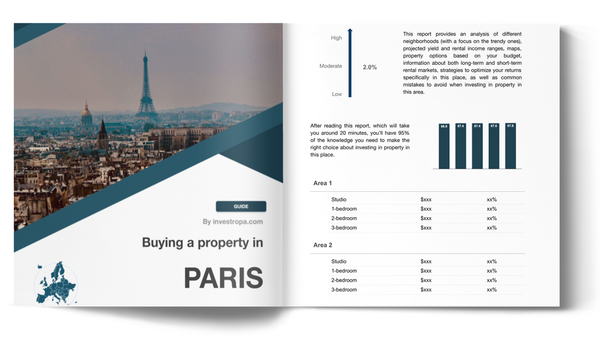
Get all the data you need about the real estate market in Paris
Paris remains one of Europe’s most watched residential property markets in 2026, but the Paris housing market is now calmer than during the 2023 and 2024 correction.
In this article, we look at current housing prices in Paris in 2026, buyer demand, rental demand, neighborhoods, financing and the risks foreign buyers should understand.
We constantly update this blog post so the Paris real estate market data stays fresh and useful for people preparing a purchase.
And if you’re planning to buy a property in this place, you may want to download our pack covering the real estate market in Paris.

How’s the real estate market going in Paris in 2026?
The Paris real estate market in 2026 is no longer falling fast, but it is also not booming, so foreign buyers should think of Paris as a stable, selective and expensive market.
Average apartment prices in Paris in June 2026 are close to €9,700 to €9,900 per square meter, which means a €400,000 budget usually buys a modest apartment of about 38 to 42 square meters before fees.
The most important point is simple: good Paris apartments still sell, but buyers are no longer accepting every price asked by sellers.
What's the average days-on-market in Paris in 2026?
As of 2026, the estimated average days-on-market for a correctly priced residential property in Paris is around 60 days from listing to an accepted offer.
This average hides a wide range, because a bright and renovated Paris apartment near the metro can sell in 30 to 45 days, while an overpriced, dark or energy-inefficient apartment can stay on the market for 90 to 120 days.
This is still slower than the very hot Paris market of 2021 and 2022, but it feels more liquid than the difficult 2023 and 2024 period, when higher mortgage rates pushed many buyers away.
Are properties selling above or below asking in Paris in 2026?
As of 2026, residential properties in Paris usually sell below asking, with a realistic average sale-to-asking ratio around 94% to 97% for standard apartments.
In simple terms, we estimate that only about 5% to 10% of Paris properties sell above asking, while most sell at or below asking, and our confidence is medium because France does not publish one official sale-to-asking database.
The Paris properties most likely to trigger above-asking offers are renovated one-bedroom and two-bedroom apartments in places like Le Marais, Saint-Germain-des-Prés, Canal Saint-Martin, Batignolles, Jourdain and parts of the 9th arrondissement.
By the way, you will find much more detailed data in our property pack covering the real estate market in Paris.
Get fresh and reliable information about the market in Paris
Don't base significant investment decisions on outdated data. Get updated and accurate information.

What kinds of residential properties can I realistically buy in Paris?
For a foreign individual buyer, Paris is mainly an apartment market, and the normal purchase is an older apartment in a copropriété rather than a house.
Most Paris buyers should expect small or medium apartments, high building charges in some cases, and very different quality from one building to the next.
What property types dominate in Paris right now?
The residential property market in Paris is dominated by apartments, which likely represent more than 95% of realistic purchase options, while houses, townhouses and private villas are rare and expensive niches.
Apartments are by far the largest share of the Paris property market because Paris is dense, old and built around multi-family residential buildings.
This apartment dominance became normal because Paris has very little spare land, strong heritage constraints and a long history of Haussmann, post-war and modern apartment buildings rather than detached homes.
If you want to know more, you should read our dedicated analyses:
Are new builds widely available in Paris right now?
New-build properties are not widely available in Paris in 2026, and a realistic estimate is that they represent less than 10% of normal private residential buying opportunities inside Paris.
As of 2026, the highest concentration of new-build or recently delivered homes is around Saint-Vincent-de-Paul, Bercy-Charenton, Chapelle International, Porte de la Chapelle, Clichy-Batignolles, Paris Rive Gauche and Porte de Bagnolet.
Get to know the market before buying a property in Paris
Better information leads to better decisions. Get all the data you need before investing a large amount of money.
Which neighborhoods are improving fastest in Paris in 2026?
The fastest-improving parts of Paris in 2026 are not the classic luxury districts, but the transition areas where public works, culture and transport are changing daily life.
This matters because a foreign buyer can overpay for a famous arrondissement and miss better risk-adjusted value in a less obvious area.
Which areas in Paris are gentrifying in 2026?
As of 2026, the clearest gentrification areas in Paris are Porte de la Chapelle and Marx Dormoy in the 18th, Belleville and Jourdain in the 19th and 20th, La Villette and Porte de Pantin in the 19th, Place des Fêtes in the 19th, and Gambetta and Porte de Bagnolet in the 20th.
The visible signs are specific: more renovated shopfronts near Marx Dormoy, cafés and cultural venues around Belleville and Jourdain, student and creative activity near La Villette, and public-space upgrades around Porte de la Chapelle.
Over the past two to three years, these improving Paris neighborhoods have likely moved from flat to moderately positive, with the best streets gaining around 3% to 8% while weaker streets stayed almost flat.
By the way, we’ve written a blog article detailing what are the current best areas to invest in property in Paris.
Where are infrastructure projects boosting demand in Paris in 2026?
As of 2026, infrastructure is boosting demand most clearly around Porte de la Chapelle, Porte de Clichy and Clichy-Batignolles, Bercy-Charenton, Porte de Montreuil, Paris Rive Gauche and Montparnasse.
The key projects are the Grand Paris Express around the wider metro area, the Line 14 extension, the Bercy-Charenton redevelopment, the Porte de la Chapelle public-space upgrade, the Montparnasse transformation and several eastern Paris renewal projects.
The timeline is mixed, because Line 14 is already extended, while Grand Paris Express lines and large Paris redevelopment zones are being delivered in stages through the late 2020s and early 2030s.
In Paris, prices often react first when a project becomes credible, but the stronger resale benefit usually appears when streets, stations and public spaces are actually usable.
Make a profitable investment in Paris
Better information leads to better decisions. Save time and money. Download our data.
What do locals and insiders say the market feels like in Paris?
Locals usually describe the Paris housing market in 2026 as expensive, less frantic and more negotiable than before.
This creates a strange feeling: Paris is no longer rising quickly, but it still feels out of reach for many local households.
Do people think homes are overpriced in Paris in 2026?
As of 2026, many locals and market insiders still see homes in Paris as overpriced for salary-based buyers, even if the market looks more reasonable than it did at the peak.
The evidence locals usually cite is simple: prices are still close to €10,000 per square meter, mortgage rules cap borrowing capacity, and many apartments need expensive energy or building work.
The counterargument is also strong, because Paris has scarce land, global buyer demand, strong universities, tourism, jobs, culture and a very deep long-term rental pool.
Compared with most French cities, the price-to-income ratio in Paris remains much higher, so Paris property is more of a wealth-preservation market than a normal affordability market.
What are common buyer mistakes people regret in Paris right now?
The most common buyer mistake in Paris is paying too much for charm while ignoring energy rating, renovation cost, co-ownership charges and future building works.
The second common mistake is buying the cheapest square meters in a noisy, dark or poorly managed building, because resale liquidity in Paris depends heavily on light, floor level, noise and building quality.
If you want to go deeper, you can check our list of risks and pitfalls people face when buying property in Paris.
It’s because of these mistakes that we have decided to build our pack covering the property buying process in Paris.
Don't buy the wrong property, in the wrong area of Paris
Buying real estate is a significant investment. Don't rely solely on your intuition. Gather the right information to make the best decision.
How easy is it for foreigners to buy in Paris in 2026?
For foreigners, buying in Paris is legally possible and usually secure, but the process is paperwork-heavy and not especially fast.
The key is to understand that the French notaire system protects buyers, while the practical burden falls on financing, documents and due diligence.
Do foreigners face extra challenges in Paris right now?
Foreign buyers face a medium difficulty level in Paris compared with local buyers, because the legal route is open but financing, taxes, language and remote paperwork are more demanding.
France does not impose a simple nationality ban on foreigners buying residential property in Paris, but buyers must follow the same notarial process, anti-money-laundering checks, tax rules and ownership declarations as everyone else.
The practical Paris-specific challenges are fast decisions on good apartments, French co-ownership documents, DPE concerns, building works, strict short-term rental rules and the need to verify recent street-level sale prices before offering.
We will tell you more in our blog article about foreigner property ownership in Paris.
Do banks lend to foreigners in Paris in 2026?
As of 2026, French banks do lend to foreign buyers in Paris, but they are selective and usually prefer strong income, clean documents and a larger cash contribution.
A realistic foreign-buyer mortgage in Paris often means 60% to 70% loan-to-value, sometimes 70% to 80% for very strong files, with interest rates generally around the low-3% range in 2026.
Banks usually ask for passports, proof of address, tax returns, employment contracts or company accounts, bank statements, proof of savings, debt details and translated documents when needed.
You can also read our latest update about mortgage and interest rates in France.

We made this infographic to show you how property prices in France compare to other big cities across the region. It breaks down the average price per square meter in city centers, so you can see how cities stack up. It’s an easy way to spot where you might get the best value for your money. We hope you like it.
How risky is buying in Paris compared to other nearby markets?
Paris is generally lower risk than many nearby markets, but it also gives lower rental yields and less explosive upside.
This means Paris suits buyers who care about liquidity, long-term value and international recognition more than high income returns.
Is Paris more volatile than nearby places in 2026?
As of 2026, Paris looks less volatile than nearby markets such as Saint-Denis, Aubervilliers and parts of Seine-Saint-Denis, but it may grow less quickly than selected Grand Paris Express station areas.
Over the past decade, Paris had a strong rise, then a clear 2023 and 2024 correction, while nearby markets had more uneven swings depending on transport access, local safety, income levels and new-build supply.
If you want to go into more details, we also have a blog article detailing the updated housing prices in Paris.
Is Paris resilient during downturns historically?
Paris property values have historically been relatively resilient during downturns because the city has limited land, deep rental demand, global recognition and many high-income buyers.
During the most recent major downturn in 2023 and 2024, Paris prices fell meaningfully from peak levels, and the 2025 to 2026 period looks more like stabilization than a full boom-style recovery.
The Paris properties that usually hold value best are bright upper-floor apartments in well-run buildings near metro, shops and schools in areas like the 5th, 6th, 7th, 9th, 11th, 15th, 16th and northern 17th.
Get the full checklist for your due diligence in Paris
Don't repeat the same mistakes others have made before you. Make sure everything is in order before signing your sales contract.

How strong is rental demand behind the scenes in Paris in 2026?
Rental demand in Paris is very strong, but this does not automatically make Paris a high-yield investment market.
The problem is easy to understand: rents are high, but purchase prices are even higher.
Is long-term rental demand growing in Paris in 2026?
As of 2026, long-term rental demand in Paris is stable to growing, mainly because supply is tight and many students, young workers and international tenants compete for small apartments.
The tenant groups driving Paris rental demand are students around the Latin Quarter and Paris Rive Gauche, young professionals around the 9th, 10th, 11th and 17th, expats in central and western districts, and workers near major transport hubs.
The strongest long-term rental demand is currently in the 5th, 9th, 10th, 11th, 15th, 17th, Batignolles, Jourdain, Canal Saint-Martin, République, Montparnasse and parts of the 18th close to transport.
You might want to check our latest analysis about rental yields in Paris.
Is short-term rental demand growing in Paris in 2026?
Short-term rental operations in Paris are heavily affected by rules, especially the 90-day annual cap for primary residences and the stricter authorization process for second homes.
As of 2026, short-term guest demand in Paris remains strong because tourism recovered after the Olympics, but legal supply is constrained by City of Paris rules.
A typical legal short-term rental in Paris can have strong occupancy during peak periods, but a foreign buyer should not assume year-round Airbnb income unless the property is properly authorized.
Guest demand is mainly driven by international tourists, business travelers, cultural visitors, students’ families and event visitors, especially in central Paris, Le Marais, Saint-Germain, the Eiffel Tower area, Montmartre and Canal Saint-Martin.
By the way, we also have a blog article detailing whether owning an Airbnb rental is profitable in Paris.
We made this infographic to show you how property prices in France compare to other big cities across the region. It breaks down the average price per square meter in city centers, so you can see how cities stack up. It’s an easy way to spot where you might get the best value for your money. We hope you like it.
What are the realistic short-term and long-term projections for Paris in 2026?
The realistic projection for Paris property in 2026 is calm recovery, not a new boom.
The base case is modest price growth, with strong differences between renovated, well-located apartments and difficult apartments needing work.
What's the 12-month outlook for demand in Paris in 2026?
As of 2026, the 12-month demand outlook for residential property in Paris is stable to slightly stronger, especially for renovated apartments near metro stations and shops.
The main factors that will influence demand are mortgage rates, French credit rules, household confidence, non-resident lending, renovation costs and any tax pressure on landlords.
Our base forecast is that Paris apartment prices move between 0% and +2% over the next 12 months, with better results for efficient, bright and well-located apartments.
By the way, we also have an update regarding price forecasts in France.
What's the 3–5 year outlook for housing in Paris in 2026?
As of 2026, the 3 to 5 year outlook for Paris housing is moderate appreciation, with a realistic cumulative nominal gain of about 8% to 15% by 2030 for good apartments.
The main projects shaping Paris over the next 3 to 5 years are Grand Paris Express connections around the wider metro area, Bercy-Charenton, Porte de la Chapelle, Paris Rive Gauche, Clichy-Batignolles and eastern Paris renewal zones.
The biggest uncertainty is credit, because Paris prices can only rise strongly again if borrowing conditions improve enough for local and foreign buyers to pay high prices comfortably.
Are demographics or other trends pushing prices up in Paris in 2026?
As of 2026, demographics support Paris prices indirectly rather than directly, because Paris city is not a strong population-growth story but remains a strong scarcity and demand story.
The main demographic shifts are fewer family-sized local buyers in central Paris, strong demand from students and young workers, older wealthy owners staying longer, and more pressure from the wider Grand Paris population.
Non-demographic trends also matter, especially wealth preservation, international buyers, tourism, return-to-office demand near central jobs and lifestyle demand for walkable neighborhoods.
These pressures should continue through the late 2020s, but they will support prices more than they will create a new Paris property boom.
What scenario would cause a downturn in Paris in 2026?
As of 2026, the most likely downturn scenario for Paris is a renewed credit squeeze, with mortgage rates rising clearly above current levels and banks becoming tougher on foreign and local buyers.
The early warning signs would be rising days-on-market, larger discounts on old apartments, weaker mortgage production, more failed compromises de vente and bigger price cuts on poor-DPE apartments.
Based on recent history, a realistic Paris downturn would be around 5% to 8% over 12 to 18 months, while a fall above 10% would likely need a deeper national or financial shock.
Make a profitable investment in Paris
Better information leads to better decisions. Save time and money. Download our data.
What sources have we used to write this blog article?
Whether it’s in our blog articles or the market analyses included in our property pack about Paris, we always rely on the strongest methodology we can, and we don’t throw out numbers at random.
We also aim to be fully transparent, so below we’ve listed the authoritative sources we used, and explained how we used them and the methods behind our estimates.
| Source | Why this source matters | How we used it |
|---|---|---|
| Notaires du Grand Paris | This is the official notarial source for completed residential transactions in Greater Paris. | We used it to anchor Paris price momentum in real completed sales. We treated it as stronger than listing portals for market direction. |
| Notaires Paris price map | This map shows notarial transaction prices by area and nearby transport point. | We used it to cross-check Paris neighborhood price levels. We also used it to compare Paris with nearby Greater Paris markets. |
| DVF, data.gouv.fr | This is the official French tax administration database of property transactions. | We used it to verify that Paris is overwhelmingly an apartment resale market. We also used it to sanity-check price-per-square-meter estimates. |
| Service-public DVF guide | This official guide explains the DVF dataset in clear administrative language. | We used it to confirm that DVF is based on notarial deeds and cadastral data. We used it as a reliability check for transaction evidence. |
| INSEE Paris local data | INSEE is France’s official statistics agency. | We used it for Paris population, housing stock, households and tourism context. We compared it with rent and market data to avoid relying only on portals. |
| Banque de France housing loans | Banque de France is the central bank and tracks mortgage production and rates. | We used it to assess buyer financing conditions in 2026. We connected credit availability to Paris demand and transaction liquidity. |
| HCSF mortgage rules | HCSF sets binding French mortgage-risk rules. | We used it to explain why borrowing capacity remains constrained. We applied the 35% debt-service and 25-year maturity framework to foreign buyers too. |
| FNAIM market outlook | FNAIM is one of France’s main real estate agents’ federations. | We used it for current practitioner sentiment and national transaction outlook. We cross-checked it against notarial and central-bank data. |
| SeLoger Paris price page | SeLoger is a major French listing portal with live asking-market data. | We used it to compare listing-side Paris apartment prices with notarial closed-sale data. We did not treat it as the final transaction price. |
| Meilleurs Agents Paris price page | Meilleurs Agents is a recognized French price index using listings, transactions and public data. | We used it for June 2026 price momentum and micro-market variation. We compared it with SeLoger and Notaires to estimate negotiation room. |
| OLAP rent observatory | OLAP is the official rent observatory for the Paris area. | We used it to assess long-term rental demand and achievable rents. We also used it to explain why gross yields remain low despite rental pressure. |
| Ville de Paris short-term rental rules | This is the City of Paris official rulebook for furnished tourist rentals. | We used it to evaluate short-term rental risk. We treated Paris as a regulation-heavy market, not as a simple Airbnb-yield market. |
Related blog posts