
Authored by the expert who managed and guided the team behind the United Kingdom Property Pack
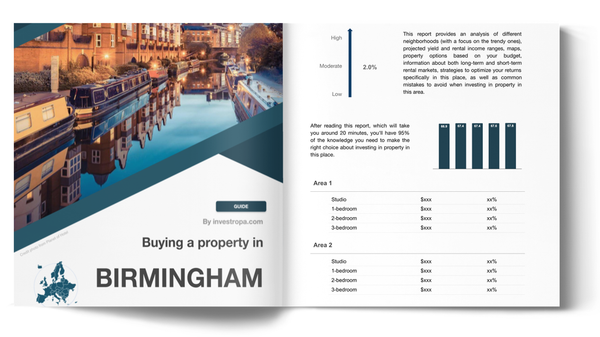
Get all the data you need about the real estate market in Birmingham
Thinking about starting an Airbnb in Birmingham in 2026 can make sense, but only if you treat the city as an event, business, hospital and university market, not as a simple tourist market.
In this article, we look at short-term rental rules, Airbnb income, occupancy, competition, operating costs and current housing prices in Birmingham with fresh and easy-to-read data.
We constantly update this blog post so buyers can compare Birmingham Airbnb returns with the latest local property prices, rents and market rules.
And if you’re planning to buy a property in this place, you may want to download our pack covering the real estate market in Birmingham.
Insights
- A normal Birmingham Airbnb listing in 2026 can earn around £1,700 to £1,900 per month before expenses, but the best profits usually come from event-ready homes, not from average city-centre flats.
- The Birmingham Airbnb market is large enough to be competitive, with around 1,600 to 2,600 active listings depending on how each data provider counts active short-term rentals.
- Birmingham has no clear local Airbnb night cap in 2026, but full-time serviced-apartment use can still create planning risk if a normal C3 home starts operating like a business.
- Two-bedroom Birmingham Airbnb properties usually offer the best balance because they suit business colleagues, event visitors, families, hospital stays and university-related demand.
- The city-centre apartment market is crowded, especially around Digbeth, Jewellery Quarter, Brindleyplace and Gas Street Basin, so a basic one-bed flat can struggle without strong pricing.
- Parking is more valuable in Birmingham than many new hosts expect, especially near the NEC, Queen Elizabeth Hospital, Edgbaston, Selly Oak and family-friendly residential areas.
- Airbnb demand in Birmingham is not only about weekends, because the NEC, ICC, universities and hospitals can create midweek stays that help smooth monthly revenue.
- Flats are usually easier to buy because Birmingham flats cost much less than houses, but leasehold rules and building management restrictions can block short-term letting.
- A self-managed Birmingham Airbnb can often net about £500 to £1,000 per month before mortgage and tax, but professional management can reduce that profit sharply.


Can I legally run an Airbnb in Birmingham in 2026?
Is short-term renting allowed in Birmingham in 2026?
As of early 2026, short-term renting is generally allowed in Birmingham, but an Airbnb host still has to check planning use, safety rules, tax treatment, lease terms and private-rental rules before accepting guests.
The main legal framework for Airbnb in Birmingham is England-wide short-term holiday-let guidance from GOV.UK, combined with Birmingham City Council planning control where a home may have moved from normal residential use into more intensive guest accommodation.
The most important condition is that a Birmingham Airbnb must not create a material change of use through constant guest turnover, noise, waste, parking pressure or a hotel-like operating pattern without the right planning position.
Hosts also need to respect fire safety, gas safety, electrical safety, insurance, EPC rules where relevant, and any mortgage, leasehold or building-management limits on short-term guests.
If a Birmingham Airbnb is operated illegally, the likely consequence is not a simple fixed Airbnb fine but planning enforcement, a requirement to stop or regularise the use, possible licensing action, and extra tax or business-rate exposure.
For a more general view, you can read our article detailing what exactly foreigners can own and buy in The United Kingdom.
If you are an American, you might want to read our blog article detailing the property rights of US citizens in The United Kingdom.
Are there minimum-stay rules and maximum nights-per-year caps for Airbnbs in Birmingham as of 2026?
As of early 2026, Birmingham has no clear citywide Airbnb minimum-stay rule and no local maximum annual night cap like London’s 90-night rule.
That means there is no special Birmingham night limit for flats, terraced houses, semi-detached homes or detached homes, and there is also no citywide cap that changes just because the host lives in the property.
The 90-night figure in England’s short-term-let reform is different, because it refers to a proposed main-home allowance under national planning reforms, not a confirmed Birmingham-only cap for every Airbnb.
Do I have to live there, or can I Airbnb a secondary home in Birmingham right now?
Birmingham does not have a clear rule saying an Airbnb host must live in the property, so occasional main-home letting and secondary-home short-term letting can both exist.
However, a secondary-home Airbnb in Birmingham is more exposed because a full-time guest property looks more like serviced accommodation than normal residential occupation.
There is no separate Birmingham secondary-home Airbnb permit clearly in force in early 2026, but the owner may need planning permission, business-rate treatment, stronger insurance and proper safety compliance.
The main difference is simple: a spare room or occasional main-home Airbnb usually looks residential, while a dedicated Birmingham Airbnb investment property can look commercial if guest turnover is constant.
Get fresh and reliable information about the market in Birmingham
Don't base significant investment decisions on outdated data. Get updated and accurate information.

Can I run multiple Airbnbs under one name in Birmingham right now?
There is no clear Birmingham rule in early 2026 that prevents one person from operating several Airbnb listings under the same name.
There is also no obvious citywide maximum number of Birmingham Airbnb properties that one individual or company can list.
Even so, multiple whole-home Airbnb listings in Birmingham can trigger more scrutiny around planning use, business rates, insurance, fire safety, waste management and anti-social behaviour.
The main regulatory issue is not the number of listings by itself, but whether the properties have stopped being normal residential homes and started operating like a serviced-apartment business.
Do I need a short-term rental license or a business registration to host in Birmingham as of 2026?
As of early 2026, Birmingham does not appear to have a standalone citywide Airbnb licence, while England’s national short-term-let register is expected but still described by GOV.UK as not yet in force.
Because the national register is not yet operating, there is no full Birmingham Airbnb registration process, timeline, document list or renewal fee to follow at this stage.
However, a Birmingham host may still need planning permission, council-tax or business-rate treatment, safety certificates, insurance, and private-rented-property licensing if the arrangement is actually a tenancy or HMO rather than guest accommodation.
This matters because Birmingham selective licensing covers designated private rented homes, but that scheme is not the same thing as a simple Airbnb licence.
Are there neighborhood bans or restricted zones for Airbnb in Birmingham as of 2026?
As of early 2026, Birmingham has no clear citywide Airbnb neighborhood ban or official Airbnb restricted-zone map.
The strictest practical areas are usually leasehold apartment blocks, conservation-sensitive streets, dense city-centre buildings, and residential streets in areas such as Jewellery Quarter, Digbeth, Edgbaston, Harborne and Selly Oak where guest turnover can cause complaints.
The reason is usually not a formal Airbnb zoning ban, but a mix of lease rules, building-management rules, planning impact, neighbour disturbance, parking pressure and private-rented-sector licensing boundaries.
Get to know the market before buying a property in Birmingham
Better information leads to better decisions. Get all the data you need before investing a large amount of money.
How much can an Airbnb earn in Birmingham in 2026?
What's the average and median nightly price on Airbnb in Birmingham in 2026?
As of early 2026, the average nightly price for an Airbnb listing in Birmingham is about £105 to £112, or roughly $142 to $151 and €122 to €130.
A realistic nightly price range covering most Birmingham Airbnb listings is about £75 to £160, or roughly $100 to $215 and €85 to €185, depending on size, quality and location.
The single biggest pricing factor for an Airbnb in Birmingham is whether the property is near a strong demand node such as the City Centre, NEC access routes, Jewellery Quarter, Digbeth, Queen Elizabeth Hospital, University of Birmingham or a major event venue.
By the way, you will find much more detailed rent ranges in our property pack covering the real estate market in Birmingham.
How much do nightly prices vary by neighborhood in Birmingham in 2026?
As of early 2026, Birmingham Airbnb nightly prices can vary from about £80 to £95 in cheaper areas to £130 to £170 or more in stronger areas such as Jewellery Quarter, Gas Street Basin and premium City Centre locations.
The three higher-priced Birmingham Airbnb zones are typically Jewellery Quarter, Gas Street Basin and Brindleyplace, where strong listings can often sit around £125 to £170 per night, or about $170 to $230 and €145 to €200.
The more affordable Birmingham Airbnb zones often include Digbeth, Aston and student-adjacent parts of Selly Oak, where guests still book because these areas offer nightlife, university access, transport links or lower prices.
What's the typical occupancy rate in Birmingham in 2026?
As of early 2026, a realistic typical occupancy rate for a well-run Birmingham Airbnb is around 50% to 60%, with 55% as a practical planning assumption.
Most Birmingham Airbnb listings are likely to sit between about 35% and 65% occupancy, with weaker listings near the low end and strong event-ready homes near the high end.
Compared with many purely leisure UK locations, Birmingham occupancy is less summer-dependent, but the city still needs careful pricing because private datasets show a wide gap between broad-market and active-listing performance.
The single biggest factor behind above-average Airbnb occupancy in Birmingham is matching the property to a demand driver, such as NEC events, city-centre work trips, hospital stays, university visits or family weekends.
Make a profitable investment in Birmingham
Better information leads to better decisions. Save time and money. Download our data.
What's the average monthly revenue per listing in Birmingham in 2026?
As of early 2026, the average monthly revenue for an active Airbnb listing in Birmingham is about £1,700 to £1,900, or roughly $2,300 to $2,565 and €1,970 to €2,205.
A realistic monthly revenue range covering most Birmingham Airbnb listings is about £900 to £2,700, or roughly $1,215 to $3,645 and €1,045 to €3,130.
Top Birmingham Airbnb listings can reach about £3,000 to £4,500 per month, or roughly $4,050 to $6,075 and €3,480 to €5,220, when they combine location, quality, beds, parking and event pricing.
For example, a strong Birmingham short-term rental at £150 per night and 75% occupancy earns about £3,375 per month before expenses.
Finally, note that we give here all the information you need to buy and rent out a property in Birmingham.
What's the typical low-season vs high-season monthly revenue in Birmingham in 2026?
As of early 2026, a typical Birmingham Airbnb may earn around £1,100 to £1,500 per month in slower months and £2,200 to £3,000 per month in event-heavy months, or roughly $1,485 to $4,050 and €1,275 to €3,480 across the full range.
Low season is usually January, early February and quiet parts of August, while stronger months include March, June, September, November and December because of NEC shows, arena events, conferences, university movement and Christmas shopping.
What's a realistic Airbnb monthly expense range in Birmingham in 2026?
As of early 2026, a realistic monthly expense range for operating an Airbnb in Birmingham is about £650 to £1,250, or roughly $880 to $1,690 and €755 to €1,450, before mortgage and income tax.
The largest cost category for a self-managed Birmingham Airbnb is usually cleaning, laundry, utilities and repairs together, often adding up to £350 to £700 per month, or about $470 to $945 and €405 to €810.
Most Birmingham Airbnb hosts should expect operating expenses to absorb about 35% to 60% of gross revenue before mortgage, with the higher end more likely for professionally managed or lower-revenue properties.
If you want to go into more details, we also have a blog article detailing all the property taxes and fees in Birmingham.
What's realistic monthly net profit and profit per available night for Airbnb in Birmingham in 2026?
As of early 2026, a self-managed Airbnb in Birmingham can realistically net about £500 to £1,000 per month before mortgage and tax, or about £16 to £33 per available night, which equals roughly $675 to $1,350 and €580 to €1,160 per month.
Most Birmingham Airbnb listings will likely fall between about £100 and £1,200 per month of pre-mortgage net profit, or roughly $135 to $1,620 and €115 to €1,390, depending on location and management cost.
A typical net profit margin for a Birmingham Airbnb is about 25% to 45% before mortgage and income tax, with lower margins when a manager takes 15% to 25% of revenue.
The break-even occupancy rate for a typical Birmingham Airbnb is often around 35% to 45%, assuming a £105 nightly price and operating costs near £1,000 per month.
In our property pack covering the real estate market in Birmingham, we explain the best strategies to improve your cashflows.
Don't buy the wrong property, in the wrong area of Birmingham
Buying real estate is a significant investment. Don't rely solely on your intuition. Gather the right information to make the best decision.
How competitive is Airbnb in Birmingham as of 2026?
How many active Airbnb listings are in Birmingham as of 2026?
As of early 2026, Birmingham has roughly 1,600 to 2,600 active Airbnb listings, with about 2,000 listings as a practical midpoint for market sizing.
Compared with the previous year, Birmingham Airbnb supply appears broadly stable to moderately larger, while the longer trend is toward more professional hosts, better pricing tools and more competition in central apartment zones.
Which neighborhoods are most saturated in Birmingham as of 2026?
As of early 2026, the most saturated Birmingham Airbnb neighborhoods are City Centre, Digbeth, Jewellery Quarter, Brindleyplace, Gas Street Basin, Eastside, Ladywood, Edgbaston and parts of Selly Oak.
These Birmingham areas are saturated because they sit close to New Street, Moor Street, nightlife, offices, canals, ICC, Utilita Arena, universities, hospitals and the most obvious visitor routes.
Relatively less saturated opportunities may exist in Harborne, Bournville, Moseley, Sutton Coldfield, NEC-accessible residential pockets and family-friendly areas near Queen Elizabeth Hospital, as long as the property offers parking and a clear guest use case.
What local events spike demand in Birmingham in 2026?
As of early 2026, the main Airbnb demand spikes in Birmingham come from NEC exhibitions, Utilita Arena concerts, ICC conferences, university graduations, football weekends, Christmas retail demand, and hospital or university-related family stays.
During the strongest Birmingham event weeks, good Airbnb listings can often lift nightly rates by about 20% to 50%, while bookings can fill much faster than on normal weekends.
Birmingham hosts should usually adjust prices and availability two to four months before major NEC and arena dates, and even earlier for large multi-day exhibitions, graduation periods and Christmas weekends.
What occupancy differences exist between top and average hosts in Birmingham in 2026?
As of early 2026, top-performing Birmingham Airbnb hosts can often reach around 65% to 80% occupancy in strong locations and strong months.
An average Birmingham Airbnb host should plan closer to 50% to 60% occupancy, while weaker or badly priced listings can sit below 40%.
A new Birmingham Airbnb host often needs 6 to 12 months to approach top-performer occupancy because reviews, pricing history, photos, guest fit and event-calendar knowledge take time to build.
We give more details about the different Airbnb strategies to adopt in our property pack covering the real estate market in Birmingham.
Which price points are most crowded, and where's the "white space" for new hosts in Birmingham right now?
The most crowded Birmingham Airbnb price range is about £80 to £130 per night, or roughly $110 to $175 and €95 to €150, especially for one-bed and two-bed city-centre apartments.
The better white space in Birmingham is around £140 to £200 per night, or roughly $190 to $270 and €160 to €230, when the listing offers parking, two bathrooms, family comfort, NEC access or a strong hospital and university location.
A new Birmingham Airbnb host can compete in the underserved segment with a two-bed or three-bed home, self check-in, parking, proper desks, blackout blinds, quiet bedrooms, family equipment and clear rules against parties.

We made this infographic to show you how property prices in the UK compare to other big cities across the region. It breaks down the average price per square meter in city centers, so you can see how cities stack up. It’s an easy way to spot where you might get the best value for your money. We hope you like it.
What property works best for Airbnb demand in Birmingham right now?
What bedroom count gets the most bookings in Birmingham as of 2026?
As of early 2026, two-bedroom properties are the safest all-round bedroom count for Airbnb demand in Birmingham.
A practical booking mix for Birmingham Airbnb demand is about 10% to 15% for studios, 30% to 35% for one-beds, 35% to 40% for two-beds, and 15% to 20% for three-bed-plus homes.
Two-bedroom Birmingham Airbnb homes perform well because they work for business colleagues, couples, families, event visitors, graduation trips and hospital stays without the party risk of larger houses.
What property type performs best in Birmingham in 2026?
As of early 2026, the best risk-adjusted property type for Airbnb in Birmingham is usually a modern two-bedroom apartment or a small terraced house in a strong location.
Modern apartments can reach strong occupancy in City Centre, Jewellery Quarter and Digbeth, while terraced houses can perform better for families and hospital, university or NEC-linked stays if they offer parking and quiet sleeping space.
This property type outperforms because Birmingham Airbnb guests often want practical access, enough beds, clean interiors and value, rather than a luxury villa or unusual stay.
What sources have we used to write this blog article?
Whether it’s in our blog articles or the market analyses included in our property pack about Birmingham, we always rely on the strongest methodology we can, and we don’t throw out numbers at random.
We also aim to be fully transparent, so below we’ve listed the authoritative sources we used, and explained how we used them and the methods behind our estimates.
| Source | Why we trust it | How we used it |
|---|---|---|
| GOV.UK short-term holiday-let guidance | It is the official UK government guidance for self-catering and short-term holiday accommodation in England. | We used it to set the legal baseline for registration, safety, tax, insurance, EPCs and business-rate issues. We cross-checked it with Birmingham local planning and licensing sources. |
| GOV.UK registration scheme statement | It is the central-government statement on England’s short-term-let registration scheme. | We used it to explain the incoming national register. We treated the scheme as expected rather than fully operational because GOV.UK still describes registration as not yet in force. |
| GOV.UK short-term-let planning announcement | It is an official government announcement on England’s planned short-term-let planning reforms. | We used it to explain the 90-night main-home concept and the proposed separation between homes and short-term lets. We did not treat it as a Birmingham local licence. |
| Birmingham City Council planning applications | It is the local planning authority’s own route for checking planning applications and documents. | We used it to explain why Birmingham Airbnb legality is mainly planning-led. We also used it to show that property-specific checks matter before buying. |
| Birmingham City Council selective licensing | It is Birmingham City Council’s official page for selective licensing in private rented homes. | We used it to separate ordinary landlord licensing from Airbnb guest accommodation. We also used it to explain why some residential investors may still need licensing checks. |
| Birmingham private-rented property licensing | It is the council’s overview of mandatory HMO, additional HMO and selective licensing rules. | We used it to flag when a property moves from guest accommodation into landlord or HMO territory. We kept this separate from pure Airbnb rules. |
| Birmingham HMO Article 4 direction | It is Birmingham’s official citywide planning rule for small HMOs. | We used it as a boundary issue because some Airbnb buyers also consider room-by-room letting. We did not mix HMO returns with normal whole-home Airbnb returns. |
| ONS Birmingham housing prices | ONS and HM Land Registry data are the official benchmark for local house prices and rents. | We used it to compare Airbnb returns with acquisition costs and long-term rent alternatives. We used property-type prices to keep yield estimates realistic. |
| Birmingham City Observatory Census housing factsheet | It is Birmingham City Council’s Census-based local housing profile. | We used it to identify common residential property types in Birmingham. We excluded uncommon holiday-style property types from the main analysis. |
| Airbtics Birmingham Airbnb data | Airbtics is a specialist short-term-rental analytics provider with market-level Airbnb metrics. | We used it for ADR, occupancy, revenue, active listings and neighborhood signals. We cross-checked it against AirROI and GuestFavorites because private STR datasets can differ. |
| AirROI Birmingham data portal | AirROI provides listing-level schema and market-level short-term-rental performance estimates. | We used it as a conservative benchmark for occupancy, listing counts and annual revenue. We treated the gap with Airbtics as a useful warning for investors. |
| GuestFavorites Birmingham Airbnb data | It provides a recent short-term-rental snapshot for Birmingham with occupancy, ADR, revenue and listing counts. | We used it as a third private-market benchmark. We used it to keep the article closer to June 2026 market conditions. |
| NEC Birmingham events calendar | The NEC is one of Birmingham’s biggest event-demand generators and publishes its own calendar. | We used it to identify event weeks that can lift Airbnb occupancy and rates. We also used it to explain why NEC-accessible homes may outperform central flats on some dates. |
| Utilita Arena Birmingham events | It is the official city-centre arena source for concerts, shows and major entertainment events. | We used it to explain weekend and concert-driven short-stay demand. We cross-checked this with NEC demand because the two venues serve different guest patterns. |
| Planning Portal | It is the national planning application route used across England. | We used it to explain that planning permission may be needed when use changes. We paired it with Birmingham’s planning portal because local decisions matter most. |
| ONS private rent and house prices bulletin | It is an official ONS update for rents and house prices in the UK. | We used it to sense-check rent and housing-market context. We also used it to compare Airbnb revenue with ordinary rental-market alternatives. |
Get fresh and reliable information about the market in Birmingham
Don't base significant investment decisions on outdated data. Get updated and accurate information.
Related blog posts
- Is now a good time to invest in property in Birmingham (England)?