
Authored by the expert who managed and guided the team behind the France Property Pack
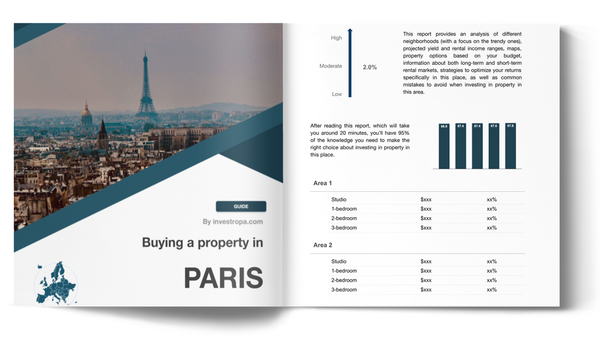
Get all the data you need about the real estate market in Paris
Paris rents in 2026 are high, tightly regulated, and still pushed up by very strong tenant demand.
We constantly update this blog post so Paris landlords and buyers can work with fresh rent data, not old market guesses.
In this guide, we explain typical rents in Paris, the neighborhoods that rent best, tenant demand, landlord costs, and taxes in simple terms.
And if you’re planning to buy a property in this place, you may want to download our pack covering the real estate market in Paris.

What are typical rents in Paris as of 2026?
What's the average monthly rent for a studio in Paris as of 2026?
As of 2026, the average monthly rent for a studio in Paris is about €800, or about $865, which is still €800 because the local currency in Paris is the euro.
In practice, most Paris studios rent for about €700 to €1,050 per month, or roughly $755 to $1,135, with the lower end usually found in outer eastern and northern districts and the higher end in central or western Paris.
This difference mainly comes from the exact Paris neighborhood, the size of the studio, whether the unit is furnished, the floor level, the presence of an elevator, and whether the flat respects Paris rent-control and energy-performance rules.
What's the average monthly rent for a 1-bedroom in Paris as of 2026?
As of 2026, the average monthly rent for a 1-bedroom apartment in Paris is about €1,200, or about $1,295, which is a good working estimate for a normal long-term private rental.
For most Paris 1-bedroom apartments, a realistic rent range is about €1,000 to €1,550 per month, or roughly $1,080 to $1,675, depending on location, size, furniture, and building quality.
The cheapest Paris 1-bedroom rents are usually found around parts of the 18th, 19th, and 20th arrondissements, while the highest rents are usually found in Saint-Germain-des-Prés, Le Marais, Invalides, Passy, and the central riverbank areas.
What's the average monthly rent for a 2-bedroom in Paris as of 2026?
As of 2026, the average monthly rent for a 2-bedroom apartment in Paris is about €1,780, or about $1,920, before charges in a standard long-term lease.
Most Paris 2-bedroom apartments rent for about €1,500 to €2,500 per month, or roughly $1,620 to $2,700, with furnished family-ready homes often landing near the upper part of that range.
The cheapest 2-bedroom rents are usually found in parts of the 18th, 19th, and 20th arrondissements, while the most expensive 2-bedroom rents are usually in Saint-Germain-des-Prés, Invalides, Gros-Caillou, Passy, Auteuil, Ternes, and Le Marais.
By the way, you will find much more detailed rent ranges in our property pack covering the real estate market in Paris.
What's the average rent per square meter in Paris as of 2026?
As of 2026, the average rent per square meter in Paris is about €29 per m² per month, or about $31 per m² per month, for a new private long-term lease.
Across Paris neighborhoods, most long-term private rents sit between about €24 and €38 per m² per month, or about $26 to $41 per m², with small furnished flats often above larger unfurnished homes.
Compared with most French cities, Paris remains much more expensive per square meter than Lyon, Marseille, Toulouse, Lille, Nantes, or Bordeaux, mainly because Paris combines small homes, high incomes, students, tourism, and limited supply in one dense market.
In Paris, the rent per square meter usually rises above average when the flat is small, furnished, renovated, bright, quiet, close to metro lines, in a central arrondissement, or located in a building with an elevator.
How much have rents changed year-over-year in Paris in 2026?
As of 2026, average rents in Paris are likely up by about 1% to 2% year over year, while the tightest new-let segments are probably up by about 2% to 3%.
The main reason Paris rents are still rising is simple: tenant demand is strong, rental supply is limited, and many older flats face energy-performance or rent-control constraints.
Compared with 2025, Paris rent growth in 2026 looks calmer because the INSEE rent index slowed, but tenants still feel pressure because good homes rent very quickly.
What's the outlook for rent growth in Paris in 2026?
As of 2026, projected rent growth in Paris is about 1% to 2.5% for the year, with stronger pressure on small furnished flats and renovated energy-compliant homes.
The key forces behind Paris rent growth are limited private rental supply, high student and young-professional demand, international mobility, low household size, and strict rules on rent increases.
The Paris neighborhoods most likely to see the strongest rental pressure are Canal Saint-Martin, République, Oberkampf, Batignolles, Belleville, Nation, Quartier Latin, and areas near major RER or metro hubs.
The main risk to this forecast is regulation, because rent control, DPE rules, tax changes, or weaker tenant purchasing power can all reduce what landlords can legally and practically charge.
Get fresh and reliable information about the market in Paris
Don't base significant investment decisions on outdated data. Get updated and accurate information.

Which neighborhoods rent best in Paris as of 2026?
Which neighborhoods have the highest rents in Paris as of 2026?
As of 2026, the top three high-rent Paris areas are Saint-Germain-des-Prés at about €35 to €40 per m², Le Marais at about €34 to €39 per m², and Invalides or Gros-Caillou at about €33 to €38 per m², which is roughly $36 to $43 per m².
These Paris neighborhoods command premium rents because they offer central locations, historic buildings, strong transport, restaurants, parks, museums, river access, and a lifestyle that tenants cannot easily replace elsewhere.
The typical tenants in these high-rent Paris neighborhoods are senior professionals, wealthy students with family support, international executives, diplomats, expats, and couples who want a central furnished home.
By the way, we’ve written a blog article detailing Sources and methodology: we used OLAP rent medians, Ville de Paris, and APUR. We grouped official rent geography into names buyers actually use, like Le Marais and Saint-Germain-des-Prés. We also cross-checked the ranking with our own Paris prime-rental observations.
Where do young professionals prefer to rent in Paris right now?
Young professionals in Paris usually prefer République, Canal Saint-Martin, and Oberkampf, with Batignolles, South Pigalle, Sentier, Bastille, Belleville, Gambetta, and Nation also very strong.
In these Paris neighborhoods, young professionals usually pay about €1,000 to €1,500 per month, or about $1,080 to $1,620, for a studio or 1-bedroom apartment.
These areas attract young professionals because they combine metro access, restaurants, bars, coworking, nightlife, bike routes, and shorter commutes to central offices.
By the way, you will find a detailed tenant analysis in our property pack covering the real estate market in Paris.
Where do families prefer to rent in Paris right now?
Families in Paris usually prefer Auteuil, Passy, and Batignolles, with Convention, Vaugirard, Ternes, Pereire, Alésia, Denfert-Rochereau, Daumesnil, Picpus, and the 5th arrondissement also popular.
For 2- to 3-bedroom apartments in these family-friendly Paris neighborhoods, typical monthly rents are about €1,900 to €3,500, or about $2,050 to $3,780, depending on size, elevator, school access, and condition.
Families choose these Paris areas because they offer calmer streets, larger apartments, elevators, parks, schools, food shops, and simple metro or bus access.
Well-known education options near these areas include École Jeannine Manuel near the 15th, Lennen Bilingual School near the 7th, International School of Paris in the 16th, Lycée Janson de Sailly, and public schools around Auteuil, Passy, Convention, and Batignolles.
Which areas near transit or universities rent faster in Paris in 2026?
As of 2026, the fastest-renting Paris areas near transit or universities are Quartier Latin, Denfert-Rochereau, and Nation, with Jussieu, Censier, Port-Royal, Montparnasse, Saint-Lazare, République, Gare de Lyon, Gare du Nord, and Bibliothèque François-Mitterrand also very liquid.
In these high-demand Paris areas, well-priced studios and 1-bedrooms often stay listed for only 7 to 15 days, while larger homes usually need about 15 to 30 days.
A flat within easy walking distance of a major metro, RER, university, or station can often command a premium of about €50 to €200 per month, or about $55 to $215, if the rent-control ceiling still allows it.
Which neighborhoods are most popular with expats in Paris right now?
The Paris neighborhoods most popular with expats are Le Marais, Saint-Germain-des-Prés, and Passy, with Invalides, Gros-Caillou, Ternes, Batignolles, South Pigalle, Canal Saint-Martin, Auteuil, and the Latin Quarter also strong.
Expats in these Paris neighborhoods often pay about €1,300 to €2,300 per month, or about $1,405 to $2,485, for a furnished studio or 1-bedroom, and much more for a family-sized apartment.
These neighborhoods attract expats because they offer furnished rentals, English-friendly services, cafés, international schools, strong public transport, safety, parks, and easy access to offices or cultural life.
The most visible expat groups in these Paris areas include Americans, British residents, Italians, Germans, Spaniards, international students, corporate assignees, and French returnees with international careers.
And if you are also an expat, you may want to read our Sources and methodology: we used Lodgis, APUR tourist rentals, and OLAP medians. We treated expat demand as mainly furnished and mobility-driven. We also used our own expat-rental map for Paris neighborhoods.
Get to know the market before buying a property in Paris
Better information leads to better decisions. Get all the data you need before investing a large amount of money.
Who rents, and what do tenants want in Paris right now?
What tenant profiles dominate rentals in Paris?
The top three tenant profiles in Paris rentals are young professionals, students or interns, and mobile professionals or expats.
A practical 2026 split is about 35% young professionals, 25% students and interns, 20% mobile professionals and expats, and the remaining 20% made up of families, couples, and other households.
Young professionals usually want studios and 1-bedrooms, students and interns usually want studios or shared flats, and families usually want 2- or 3-bedroom apartments with practical layouts and transport access.
If you want to optimize your cashflow, you can read our Sources and methodology: we used INSEE, OLAP, and Lodgis. We turned broad housing data into simple tenant groups that a landlord can understand. We refined the split with our own Paris leasing-pattern analysis.
Do tenants prefer furnished or unfurnished in Paris?
In Paris, a practical 2026 estimate is that about 55% of small-apartment tenants prefer furnished rentals, while about 45% prefer unfurnished rentals, although families often prefer unfurnished homes.
A furnished Paris apartment can often earn about 10% to 15% more than a comparable unfurnished unit, which means roughly €100 to €200 more per month, or about $110 to $215, for many studios and 1-bedrooms.
Furnished rentals in Paris are especially popular with students, interns, young professionals, corporate tenants, expats, and people staying for less than two years.
Which amenities increase rent the most in Paris?
The five amenities that increase Paris rent the most are a strong DPE rating, an elevator, a balcony or terrace, a high-quality fitted kitchen, and a modern furnished setup.
In Paris, a better DPE can protect €50 to €150 per month, an elevator can add €40 to €120, outdoor space can add €80 to €250, a renovated kitchen can add €50 to €150, and good furniture can add €100 to €250, or about $55 to $270 depending on the item.
In our property pack covering the real estate market in Paris, we cover what are the best investments a landlord can make.
What renovations get the best ROI for rentals in Paris?
The five best ROI renovations for Paris rentals are DPE upgrades, bathroom refreshes, compact fitted kitchens, double glazing, and smart storage with durable flooring.
In Paris, DPE work can cost about €5,000 to €25,000 and protect or lift rent by €50 to €200 per month, bathrooms can cost €4,000 to €10,000 and add €50 to €150, kitchens can cost €4,000 to €12,000 and add €50 to €150, double glazing can cost €3,000 to €10,000 and add €30 to €100, and storage or flooring can cost €2,000 to €8,000 and add €30 to €100, with dollar figures about 8% higher.
Poor ROI renovations in Paris usually include luxury materials in ordinary neighborhoods, oversized appliances in small studios, heavy decorative work, and upgrades that look good but do not improve DPE, comfort, storage, or photos.
Make a profitable investment in Paris
Better information leads to better decisions. Save time and money. Download our data.
How strong is rental demand in Paris as of 2026?
What's the vacancy rate for rentals in Paris as of 2026?
As of 2026, the practical vacancy rate for compliant long-term private rentals in Paris is about 1% to 3%, even though the wider official housing-vacancy figure is much higher.
Across Paris neighborhoods, practical rental vacancy is often below 2% in central, student, and metro-rich districts, and closer to 3% to 5% for overpriced, poorly rated, or less convenient homes.
Compared with Paris’s historical vacancy data, the 2026 rental market feels tighter for tenants because many “vacant” homes are not actually ready or available for normal long-term rental.
Finally please note that you will have all the indicators you need in our property pack covering the real estate market in Paris.
How many days do rentals stay listed in Paris as of 2026?
As of 2026, a well-priced rental in Paris usually stays listed for about 10 to 20 days, with studios and 1-bedrooms often moving the fastest.
In practice, a strong Paris studio can rent in 7 to 15 days, a good 1-bedroom in 10 to 20 days, a family apartment in 15 to 30 days, and an overpriced or non-compliant flat in more than 45 days.
Compared with one year ago, days on market in Paris are broadly stable or slightly shorter for good homes, because demand remains strong while many owners are cautious about DPE and rent-control compliance.
Which months have peak tenant demand in Paris?
The peak tenant-demand months in Paris are May to September, with the strongest pressure usually from late August to September.
This Paris rental season is driven by students, internships, new jobs, international moves, university calendars, and landlords timing small furnished rentals toward summer demand.
The quietest months for Paris tenant demand are usually November, December, and sometimes February, although good studios near universities or metro hubs can still rent quickly.
Don't buy the wrong property, in the wrong area of Paris
Buying real estate is a significant investment. Don't rely solely on your intuition. Gather the right information to make the best decision.
What will my monthly costs be in Paris as of 2026?
What property taxes should landlords expect in Paris as of 2026?
As of 2026, a Paris landlord should typically expect annual property tax of about €900 to €2,000, or about $970 to $2,160, for a normal apartment.
The realistic low-to-high annual property-tax range in Paris is about €500 to €4,000, or about $540 to $4,320, with small studios often near the low end and large or high-cadastral-value homes near the high end.
Paris property tax is based on the cadastral rental value of the home, not the market price, and the local built-property tax rate used in recent Paris budget documents is 20.50%.
Please note that, in our property pack covering the real estate market in Paris, we cover what exemptions or deductions may be available to reduce property taxes for landlords.
What utilities do landlords often pay in Paris right now?
In Paris, landlords often advance building charges, cold water, collective heating when present, lift maintenance, building insurance, caretaker costs, and waste-related charges before recovering some of these costs from tenants.
A typical Paris landlord-paid or advanced utility and charge budget is about €80 to €250 per month, or about $85 to $270, depending on building services, collective heating, water use, elevator, and co-ownership fees.
The common Paris practice is that tenants pay electricity, gas, internet, and home insurance directly, while landlords handle co-ownership charges and recover eligible tenant charges through monthly provisions.
How is rental income taxed in Paris as of 2026?
As of 2026, unfurnished rental income in Paris is taxed as revenus fonciers, while furnished rental income is taxed as BIC, and the landlord’s final tax depends on the chosen regime and personal tax situation.
Paris landlords can usually deduct eligible items under real regimes, such as mortgage interest, co-ownership charges, insurance, repairs, management fees, property tax, and, for furnished rentals, furniture costs and often depreciation.
The biggest Paris-specific tax mistakes are mixing furnished and unfurnished rules, ignoring rent-control limits, forgetting tourist-rental restrictions, underestimating co-ownership charges, and assuming that a gross Paris rent equals real net income.
We cover these mistakes, among others, in our Sources and methodology: we used impots.gouv.fr, Service-Public, and Ville de Paris rent control. We explain tax treatment in simple landlord terms, not as personal tax advice. We also use our own Paris net-yield model to flag common mistakes.

We did some research and made this infographic to help you quickly compare rental yields of the major cities in France versus those in neighboring countries. It provides a clear view of how this country positions itself as a real estate investment destination, which might interest you if you’re planning to invest there.
What sources have we used to write this blog article?
Whether it’s in our blog articles or the market analyses included in our property pack about Paris, we always rely on the strongest methodology we can … and we don’t throw out numbers at random.
We also aim to be fully transparent, so below we’ve listed the authoritative sources we used, and explained how we used them and the methods behind our estimates.
| Source | Why this source matters | How we used it |
|---|---|---|
| OLAP, Rapport Paris 2025 | OLAP is the official rent observatory for the Paris area, with a recognized public methodology. | We used it as the main anchor for rent per m², rent by room count, and recent-tenant rents. We updated the January 2025 figures to June 2026 with cautious market and index adjustments. |
| OLAP, loyers médians à Paris | This source gives observed and estimated Paris rent medians under official observatory rules. | We used it to cross-check the rent levels in the OLAP report. We also used it to separate observed market rents from legal rent-control ceilings. |
| Ville de Paris, encadrement des loyers | This is the official City of Paris page explaining the rent-control system. | We used it to explain why Paris rents cannot be treated like fully free-market rents. We also used it to keep the landlord guidance legally cautious. |
| Service-Public, Paris reference-rent tool | Service-Public is the French government’s official public-service portal. | We used it to verify how Paris reference rents apply to leases. We also used it to avoid mixing market rent estimates with legal rent ceilings. |
| APUR, impact de l’encadrement des loyers 2025 | APUR is Paris’s urban-planning agency and studies housing policy with local data. | We used it to understand how rent control moderates Paris rent growth. We also used it to avoid overstating 2026 rental increases. |
| INSEE, Paris territory profile | INSEE is France’s national statistics institute and is the strongest public source for demographic data. | We used it for population, housing stock, ownership, vacancy, and income context. We also used it to explain why Paris is structurally a renter-heavy city. |
| INSEE, IRL Q1 2026 | INSEE publishes the official rent reference index used for many French lease revisions. | We used the Q1 2026 IRL figure to keep rent-growth estimates realistic. We also used it to separate sitting-tenant increases from new-lease pressure. |
| Ville de Paris, taxes et impôts | This is the official local-tax page for Paris residents and property owners. | We used it to explain which local taxes matter to landlords. We also used it to separate owner costs from tenant-recoverable charges. |
| Conseil de Paris, 2025 direct local tax rates | This is an official Paris council document setting local tax rates. | We used it for the 20.50% built-property tax rate. We treated it as the latest voted rate available for practical landlord cost estimates. |
| Paris 2026 budget report | This is the adopted 2026 Paris budget document. | We used it to cross-check local finance assumptions. We did not use it as a rent source. |
| impots.gouv.fr, location meublée | impots.gouv.fr is the official French tax authority website. | We used it to classify furnished rental income as BIC. We also used it to explain the furnished-rental tax logic in simple landlord terms. |
| Service-Public, non-furnished rental income | This French government page explains the taxation of unfurnished rental income. | We used it to explain micro-foncier and régime réel for empty rentals. We also used it to compare furnished and unfurnished tax treatment. |
| APUR, furnished tourist rentals 2025 | APUR tracks furnished tourist-rental supply in Paris and Greater Paris. | We used it to understand how short-term rentals affect long-term supply. We only used it as context because this article focuses on residential rentals. |
| Lodgis, furnished rental barometer 2025 | Lodgis is an established Paris furnished-rental operator with useful market data. | We used it as a private-sector cross-check on furnished-rental demand. We did not use it as the primary benchmark for average Paris rents. |
Get fresh and reliable information about the market in Paris
Don't base significant investment decisions on outdated data. Get updated and accurate information.
Related blog posts