
Authored by the expert who managed and guided the team behind the Bulgaria Property Pack

Yes, the analysis of Sofia's property market is included in our pack
Sofia's property market in early 2026 is busy, credit-fueled, and shaped by Bulgaria's recent euro adoption on January 1, 2026.
For foreigners, the real risk in Sofia is not that apartments do not exist, but rather that paperwork games, forged documents, and hidden encumbrances can catch you off guard.
We constantly update this blog post to reflect the latest scam patterns, legal changes, and market conditions in Sofia.
And if you're planning to buy a property in this place, you may want to download our pack covering the real estate market in Sofia.
How risky is buying property in Sofia as a foreigner in 2026?
Can foreigners legally own properties in Sofia in 2026?
As of early 2026, foreigners can legally own apartments in Sofia without restriction, but direct land ownership remains limited for non-EU citizens under Bulgaria's Constitution and property laws.
The main condition for foreigners buying property in Sofia is that while EU citizens can purchase both apartments and land freely, non-EU citizens must establish a Bulgarian company to acquire any property that includes land, such as houses with gardens in neighborhoods like Simeonovo, Dragalevtsi, or Boyana.
When direct land ownership is restricted, non-EU foreigners in Sofia typically set up a Bulgarian limited liability company (EOOD or OOD) to hold the property title, which adds roughly 500 to 1,000 euros in formation costs and ongoing administrative requirements.
If you're interested, we go much more into details about the foreign ownership rights in Bulgaria in our comprehensive property pack.
Not sure what your passport allows in Bulgaria? Tell us and we'll check.
What buyer rights do foreigners actually have in Sofia in 2026?
As of early 2026, foreign buyers in Sofia have enforceable property rights once the notarial transfer is completed and registered in Bulgaria's Property Register, which is the legal moment ownership actually changes hands.
If a seller breaches a preliminary contract in Sofia, foreign buyers can pursue legal remedies through Bulgarian courts, including specific performance or damages, though enforcement timelines vary and the process can take years in complex cases.
The most common buyer right that foreigners mistakenly assume they have in Sofia is "reservation deposit protection," when in reality these deposits often go to agents rather than escrow accounts and may not be legally recoverable if a deal falls through.


Got a question about the paperwork in Bulgaria?
Notary, tax number, bank, residence permit: ask us. We reply within 12 hours, for free.
Ask us your question →
How strong is contract enforcement in Sofia right now?
Contract enforcement for real estate transactions in Sofia is workable but slower than in Western European countries like Germany or France, with property disputes sometimes taking several years to resolve through the courts.
The main weakness foreigners should know about in Sofia is that while institutions function and registers exist, rule-of-law perceptions and judicial efficiency remain lower than the EU average, meaning you should structure deals to avoid needing heroic enforcement later.
By the way, we detail all the documents you need and what they mean in our property pack covering Sofia.
Got a contract in front of you and not sure about it? Tell us.
Buying real estate in Sofia can be risky
An increasing number of foreign investors are showing interest. However, 90% of them will make mistakes. Avoid the pitfalls with our comprehensive guide.

Which scams target foreign buyers in Sofia right now?
Are scams against foreigners common in Sofia right now?
Real estate scams targeting foreigners in Sofia are common enough that you should plan for them, with Bulgarian authorities actively investigating over 60 fraud reports and Sofia prosecutors initiating dozens of pre-trial proceedings related to property crimes.
The type of property transaction most frequently targeted by scammers in Sofia involves off-plan or under-construction apartments, where permits, planning compliance, or promised features do not match what is actually approved.
The profile of foreign buyer most commonly targeted in Sofia is someone who is remote, does not speak Bulgarian, relies heavily on agents or intermediaries, and feels pressure to "reserve today" before verifying ownership or encumbrances.
The single biggest warning sign that a deal may be a scam in Sofia is urgency combined with avoidance of registry checks, such as when someone pushes you to pay a deposit immediately while discouraging you from pulling an official ownership certificate first.
What are the top three scams foreigners face in Sofia right now?
The top three scams foreigners most commonly face when buying property in Sofia are payment diversion through intermediaries who route money to their own accounts, forged documents or fake powers of attorney used to sell without legitimate owner consent, and off-plan properties sold without proper permits that cannot be legally occupied or insured.
The most common scam in Sofia typically unfolds when a "helpful" broker or compatriot convinces you to transfer your deposit or payment to their account "for convenience," then the actual seller or investor claims they never received the funds, leaving you trapped between two parties pointing fingers at each other.
The single most effective way to protect yourself from each of these three scams in Sofia is to always pay only to the legal seller named in the contract via traceable bank transfer, insist on verifying ownership and encumbrances through the official Property Register before any money moves, and for off-plan purchases never fully prepay until you have confirmed building permits and staged your payments contractually.
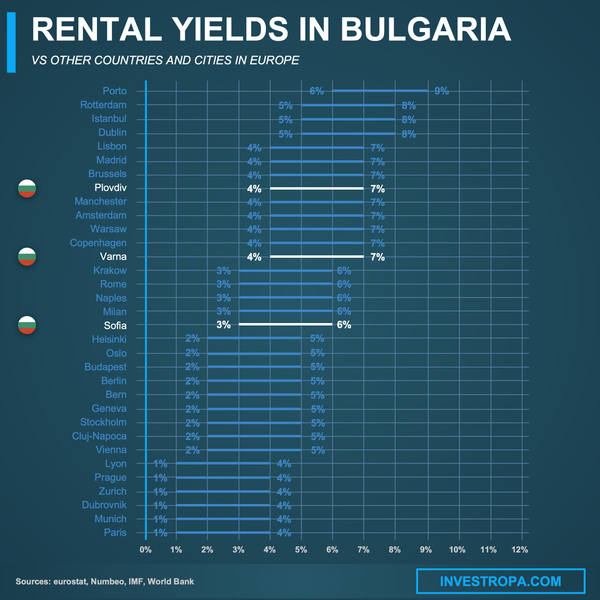
We did some research and made this infographic to help you quickly compare rental yields of the major cities in Bulgaria versus those in neighboring countries. It provides a clear view of how this country positions itself as a real estate investment destination, which might interest you if you’re planning to invest there.
How do I verify the seller and ownership in Sofia without getting fooled?
Buying real estate in Bulgaria?
Ask us anything about your purchase: taxes, contracts, banks, permits. A real person replies within 12 hours, for free.
Ask us your question →
How do I confirm the seller is the real owner in Sofia?
The standard verification process to confirm the seller is the real owner in Sofia involves obtaining an official extract or certificate from Bulgaria's Property Register, which shows the current registered owner and the chain of title.
The official document foreigners should check to verify ownership in Sofia is a registry certificate or copy from the Registry Agency's Property Register portal, which you can request using the property's address and cadastral identifiers.
The most common trick fake sellers use to appear legitimate in Sofia is presenting a power of attorney or claiming to act on behalf of an absent owner, which is common enough that Bulgarian authorities specifically warn about it in their fraud guidance and you should treat any proxy signer as "extra verification required."
Where do I check liens or mortgages on a property in Sofia?
The official registry where you check liens or mortgages on a property in Sofia is Bulgaria's Property Register, operated by the Registry Agency, where you can request a certificate showing all registered encumbrances, prior acts, and mortgages against the property.
When checking for liens in Sofia, you should specifically request information on registered mortgages, tax debts, court judgments, and any pending claims or restrictions that might transfer to you as the new owner upon purchase.
The type of lien or encumbrance most commonly missed by foreign buyers in Sofia is undisclosed tax debts or unpaid condominium fees that legally transfer to the new owner, because these often do not appear prominently unless you specifically ask about municipal and building-level obligations.
It's one of the aspects we cover in our pack about the real estate market in Sofia.
Got a question about the market in Bulgaria?
Prices, areas, rentals: ask us what you'd ask a friend who knows. Free reply within 12 hours.
Ask us your question →How do I spot forged documents in Sofia right now?
The most common type of forged document used in property scams in Sofia is a fake power of attorney or falsified identity documents, which is common enough that Bulgarian authorities have implemented notary-level database access specifically to combat this pattern.
The specific red flags that indicate a document may be forged in Sofia include urgency to close without registry verification, a seller who "cannot attend" and sends a representative with limited documentation, and any reluctance to provide property identifiers that can be checked against official records.
The official verification method you should use to authenticate documents in Sofia is to insist that your notary verifies all identity documents and powers of attorney through their direct database access, and independently confirm ownership continuity through the Property Register before any money changes hands.
Get the full checklist for your due diligence in Sofia
Don't repeat the same mistakes others have made before you. Make sure everything is in order before signing your sales contract.
What "grey-area" practices should I watch for in Sofia?
What hidden costs surprise foreigners when buying a property in Sofia?
The three most common hidden costs that foreigners overlook in Sofia are agency fees charged to buyers (typically 2% to 3% plus VAT, which can be 3,000 to 9,000 euros on a 150,000 euro apartment), unpaid condominium repair fund contributions that transfer with the property, and translation or legalization fees for documents that can add 200 to 500 euros.
The hidden cost most often deliberately concealed by sellers or agents in Sofia is the true state of condominium arrears or planned building repairs, which is common enough that locals routinely ask about these obligations early while foreigners often discover them only after purchase.
Residency rules change often. Ask us about your case.
Are "cash under the table" requests common in Sofia right now?
Cash under the table requests in property transactions in Sofia happen often enough that you should have a default policy of refusing them, especially now during the euro changeover period when dual pricing confusion creates additional opportunities for manipulation.
The typical reason sellers give for requesting undeclared cash payments in Sofia is to "reduce taxes" by declaring a lower official sale price, which they may frame as a mutual benefit but which creates serious legal exposure for you as the buyer.
The legal risks foreigners face if they agree to an undeclared cash payment in Sofia include potential tax evasion charges, difficulty proving your actual purchase price if disputes arise later, and vulnerability to having the transaction invalidated or renegotiated since the official paperwork does not reflect reality.
Got a question about buying in Bulgaria?
Ask our team. A real person replies within 12 hours, for free.
Ask us your question →Are side agreements used to bypass rules in Sofia right now?
Side agreements used to bypass official rules in property transactions in Sofia are common, particularly around declared price versus actual payment, "included furniture" pricing games to lower the taxable value, and reservation deposits with vague or unenforceable refund conditions.
The most common type of side agreement used to circumvent regulations in Sofia is an informal understanding that the notarized sale price will be lower than the actual amount paid, with the difference handled separately in cash or through a furniture invoice.
The legal consequences foreigners face if a side agreement is discovered by authorities in Sofia include tax reassessment with penalties, potential criminal liability for tax fraud, and the risk that your actual financial interest in the property is unprotected since only the official recorded amount has legal standing.

We made this infographic to show you how property prices in Bulgaria compare to other big cities across the region. It breaks down the average price per square meter in city centers, so you can see how cities stack up. It’s an easy way to spot where you might get the best value for your money. We hope you like it.
Can I trust real estate agents in Sofia in 2026?
Are real estate agents regulated in Sofia in 2026?
As of early 2026, real estate agents in Sofia are not regulated in the way foreigners might expect from countries with strict licensing requirements, meaning there is no state-guaranteed competence standard or mandatory professional certification.
There is no single official license that a legitimate real estate agent must have in Sofia, so you cannot simply ask for a "real estate license number" the way you might in the United States or United Kingdom.
Since there is no central licensing registry to check in Sofia, foreigners should verify an agent's legitimacy by asking for business registration documents, checking online reviews and reputation, and most importantly treating the agent as a sales channel rather than a verifier of legal title.
Please note that we have a list of contacts for you in our property pack about Sofia.
Buying in Bulgaria? Get a free answer in 12 hours
Ask our team anything about buying property in Bulgaria. No sales pitch, no newsletter.
Ask us your question →What agent fee percentage is normal in Sofia in 2026?
As of early 2026, the normal agent fee percentage in Sofia ranges from 2% to 3% of the property price plus VAT, though this is not regulated by law and some agents charge more to international buyers.
The typical range of agent fee percentages that covers most residential transactions in Sofia is 2.5% to 3% plus VAT, with a common minimum fee of around 1,000 to 1,200 euros regardless of the property's value.
In Sofia, both the buyer and seller often pay agent commissions separately, unlike some markets where only one party pays, so you should clarify upfront who pays what and ensure your deposit is escrowed safely rather than held in the agent's personal account.
Not sure how this works in your case? Tell us what you're buying in Bulgaria and we'll help you work it out.
Get the full checklist for your due diligence in Sofia
Don't repeat the same mistakes others have made before you. Make sure everything is in order before signing your sales contract.
What due diligence actually prevents disasters in Sofia?
What structural inspection is standard in Sofia right now?
The standard structural inspection process for property purchases in Sofia is lighter than foreigners from Western Europe or North America might expect, particularly for older panel buildings (panelki), so you may need to raise your standard intentionally by arranging an independent engineer visit.
A qualified inspector in Sofia should check specific structural elements including the building's load-bearing walls or panels, roof condition (especially for top-floor apartments), moisture intrusion points, heating system reality (district heating versus electric versus gas), and the condition of common areas like elevators and stairwells.
The type of professional qualified to perform structural inspections in Sofia is a licensed construction engineer (stroitelen inzhener) or an independent building surveyor, though you may need to arrange this yourself since pre-purchase inspections are not standard practice in the local market.
The most common structural issues that inspections reveal in Sofia properties are moisture problems and inadequate insulation in renovated older stock, elevator and common-area deterioration in Soviet-era panel buildings, and unapproved internal alterations that may create legal complications.
How do I confirm exact boundaries in Sofia?
The standard process for confirming exact property boundaries in Sofia involves checking the cadastral records maintained by Bulgaria's Geodesy, Cartography and Cadastre Agency, which holds the authoritative maps and property identifiers.
The official document that shows the legal boundaries of a property in Sofia is a cadastral extract (izvlechenie ot kadastralata karta), which displays the property's exact identifiers, boundaries, and ideal shares for apartment units.
The most common boundary dispute that affects foreign buyers in Sofia involves house plots in outskirts areas like Simeonovo or Boyana, where "fence lines" on the ground may not match cadastral reality, creating problems that only emerge when you try to sell or develop the property.
The professional you should hire to physically verify boundaries on the ground in Sofia is a licensed surveyor (geodezist) who can compare the official cadastral records with the actual physical markers and identify any discrepancies before you complete your purchase.
Property question in Bulgaria? We answer you.
If you're buying in Bulgaria and something isn't clear, ask us. A real person answers within 12 hours, for free.
Ask us your question →What defects are commonly hidden in Sofia right now?
The top three defects that sellers frequently conceal from buyers in Sofia are moisture and insulation problems in renovated older apartments (common), heating system realities that differ from listing descriptions (common), and unapproved internal alterations that create legal complications for resale or insurance (sometimes happens).
The inspection technique that helps uncover hidden defects in Sofia is a combination of thermal imaging for insulation and moisture issues, a physical inspection during the heating season to verify the actual heating system works, and a review of building permits to catch unapproved modifications.
Worried about what you can't see? Tell us about the place and we'll tell you what to check.
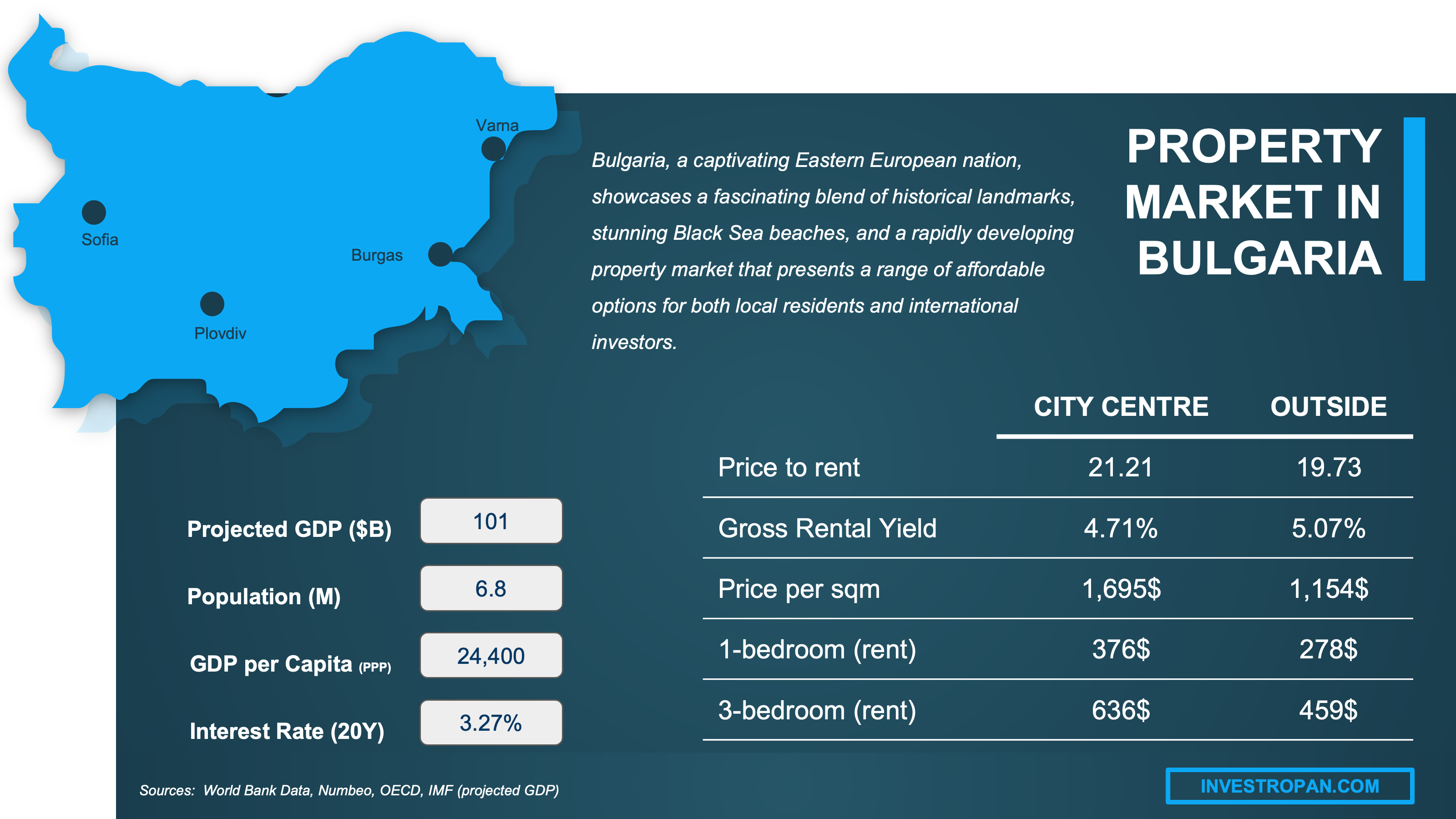
We have made this infographic to give you a quick and clear snapshot of the property market in Bulgaria. It highlights key facts like rental prices, yields, and property costs both in city centers and outside, so you can easily compare opportunities. We’ve done some research and also included useful insights about the country’s economy, like GDP, population, and interest rates, to help you understand the bigger picture.
What insider lessons do foreigners share after buying in Sofia?
What do foreigners say they did wrong in Sofia right now?
The most common mistake foreigners say they made when buying property in Sofia is paying money too early, whether as a "reservation deposit" to an agent or as a large preliminary payment before verifying ownership and encumbrances through the official Property Register.
The top three regrets foreigners most frequently mention after buying in Sofia are trusting the agent to be the verifier instead of checking the registers themselves, not checking ownership and encumbrances immediately upon expressing interest, and underestimating the importance of having an independent lawyer rather than relying on the seller's notary.
The single piece of advice experienced foreign buyers most often give to newcomers in Sofia is "no meaningful money moves until you have registry confirmation," because once your funds are with the wrong party, recovering them through Bulgarian courts can take years.
The mistake foreigners say cost them the most money or caused the most stress in Sofia is discovering hidden encumbrances or ownership disputes after they had already paid a substantial deposit, leaving them trapped in a transaction they could not easily exit or complete.
What do locals do differently when buying in Sofia right now?
The key difference in how locals approach buying property in Sofia compared to foreigners is that locals are quicker to demand registry reality (ownership, encumbrances, cadastral data) and treat it as a normal, non-negotiable step rather than an optional extra that might offend the seller.
The verification step locals routinely take that foreigners often skip in Sofia is checking the status of the building's repairs fund and any planned major renovations (such as elevator replacement or facade work), because these costs get socialized among all owners and can represent thousands of euros in unexpected obligations.
The local knowledge advantage that helps locals get better deals in Sofia is understanding which neighborhoods are genuinely improving versus just hyped (for example, knowing that Krastova Vada has strong infrastructure investment while some parts of Studentski Grad remain static), and having personal networks to hear about properties before they hit the public market.
Neighborhoods where foreigners actually buy in Sofia include more central and established areas like Lozenets, Oborishte (including Doctor's Garden), Iztok, Ivan Vazov, and Centrum, as well as newer development zones like Krastova Vada, Manastirski Livadi, Vitosha district, and Studentski Grad, plus value-oriented large-panel areas like Mladost and Lyulin.
Don't buy the wrong property, in the wrong area of Sofia
Buying real estate is a significant investment. Don't rely solely on your intuition. Gather the right information to make the best decision.

What sources have we used to write this blog article?
Whether it's in our blog articles or the market analyses included in our property pack about Sofia, we always rely on the strongest methodology we can and we don't throw out numbers at random.
We also aim to be fully transparent, so below we've listed the authoritative sources we used, and explained how we used them and the methods behind our estimates.
| Source | Why it's authoritative | How we used it |
|---|---|---|
| Property in Bulgaria (Government Portal) | Official Bulgarian government information portal built specifically for foreign property owners. | We used it to anchor the legal steps, officially described fraud patterns, and fee structures. We relied on it as our primary source for how foreigners get scammed. |
| Registry Agency Property Register | Official online gateway to Bulgaria's Property Register run by the Registry Agency. | We used it to explain how you verify ownership and encumbrances using real registry outputs. We referenced it for what you should demand before paying anything. |
| EU e-Justice Portal (Bulgaria) | EU's official cross-border justice portal describing how national registers work. | We used it to cross-check how the Bulgarian Property Register can be searched. We kept our verification guidance consistent with EU-level explanations. |
| Geodesy, Cartography and Cadastre Agency | National authority responsible for cadastre maps and cadastral registers in Bulgaria. | We used it to explain how to verify exact property identifiers and boundaries. We framed what "boundary confirmation" realistically means in Sofia. |
| European Commission 2025 Rule of Law Report | EU's annual structured assessment of rule-of-law conditions in each member state. | We used it to frame the institutional risk backdrop. We avoided either "Bulgaria is fine" or "Bulgaria is hopeless" stereotypes. |
| Transparency International Bulgaria | Primary publisher of the Corruption Perceptions Index used globally. | We used it to contextualize grey-area pressure like cash requests and shortcuts. We explained why you should build a process that doesn't rely on trust. |
| European Central Bank (Euro Adoption) | ECB's official confirmation of Bulgaria's euro entry including the conversion rate. | We used it to explain why currency confusion is a real scam vector in January 2026. We supported practical steps like writing euro amounts in contracts. |
| Bulgarian Telegraph Agency (BTA) | Bulgaria's national news agency directly citing prosecutorial authorities. | We used it to support that real-estate fraud is not theoretical. We kept the scams section tied to documented prosecution patterns. |
| Bulgarian National Television (BNT) | Bulgaria's public broadcaster reporting on official investigations. | We used it as a Sofia-specific signal that fraud clusters exist locally. We tailored the forged documents risk to Sofia specifically. |
| Bulgarian National Bank Economic Review | Bulgaria's central bank publication covering macro conditions and credit growth. | We used it to support the market vibe section on credit growth shaping buyer behavior. We justified extra caution in a fast-credit environment. |

We created this infographic to give you a simple idea of how much it costs to buy property in different parts of Bulgaria. As you can see, it breaks down price ranges and property types for popular cities in the country. We hope this makes it easier to explore your options and understand the market.
