

SUMMARY
Prague buyers should watch the individual deal much more carefully than the city's strong headline market, because today's prices leave very little room for overpaying, weak buildings, awkward ownership structures or optimistic rental assumptions.
Prices have accelerated again. Prague apartment transactions are now above CZK 165,000 per m² on average, while new first-sale apartments have reached roughly CZK 183,100 per m² and are still rising at double-digit annual rates.
The uncomfortable part is that buyers have not disappeared. Around 1,950 new apartments sold in the latest quarter despite those prices, so someone waiting for weak demand to create easy bargains may wait a long time.
More apartments are technically available, but that does not necessarily mean Prague's structural shortage is disappearing. Much of the recent increase in new-build stock came from large project launches, while apartment permitting weakened from a year earlier.
Price per square metre becomes dangerous when it is treated as a valuation rather than a starting point. Current new-build averages range from about CZK 166,800 per m² in Prague 10 to CZK 265,100 in Prague 2, and even those district figures hide enormous differences between individual streets and buildings.
Older apartments can look cheaper while carrying liabilities elsewhere in the building. SVJ reserves, loans, owner arrears and postponed work on roofs, façades, lifts or risers can turn an apparently attractive purchase into a much more expensive one after closing.
Ownership structure matters more than many foreign buyers expect. A cooperative apartment is normally a cooperative share with occupancy rights rather than direct ownership of the flat, which can affect financing, subletting and any promised future conversion to private ownership.
The investment case has become less forgiving too. A 50 m² apartment renting for CZK 24,000 per month produces only a 3.2% gross yield at a CZK 9 million purchase price, before vacancy, repairs, management and tax.
Financing now reinforces that pressure. Since April 2026, the Czech National Bank has recommended a 70% maximum LTV and a DTI limit of 7 for investment mortgages, meaning investors may need substantially more cash just as purchase prices remain high.
The cleanest test is to assume no appreciation for several years. If the apartment still works because the location is strong, the building is financially sound, the ownership and legal position are clean, and the rental or personal-use economics make sense, Prague remains a defensible place to buy. If the deal needs another 10% annual price rise to look good, the risk is already in the purchase.
Is buying property in Prague getting riskier now?
Buying in Prague is more unforgiving today because apartment prices are rising quickly again, so even a fairly ordinary mistake can cost a lot of money.
The latest Flat Zone transaction data published through ČBA Monitor put the average price of Prague apartments above CZK 165,000 per m² in the second quarter. New apartments sold for the first time reached CZK 183,100 per m², up 11.3% from a year earlier. Older apartments were rising almost as quickly.
Demand has held up surprisingly well at those prices. Trigema, Central Group and Skanska Residential counted about 1,950 new apartments sold in Prague during the second quarter, 11% more than a year earlier. Roughly 3,750 sold in the first half, making it the third-strongest first half in their historical series.
Supply has improved, but the details are less reassuring than the headline suggests. Developers had almost 6,500 new apartments available, the largest stock in a decade, yet much of that increase came from large projects launching new phases. From January through May, only 2,878 apartments in Prague apartment buildings received permits, more than 15% fewer than a year earlier.
Buyers therefore face an awkward combination: expensive apartments, strong competition and no obvious supply shock coming to make a poor purchase easy to correct. Prague can still be a good place to buy, but the market gives buyers less margin for error than it did when prices were softer.
| Prague market indicator | Latest level | Change | What it tells us |
|---|---|---|---|
| All apartment transactions | Above CZK 165,000/m² | Still rising | Entry prices are already high |
| New first-sale apartments | CZK 183,100/m² | +11.3% YoY | New-build prices remain very strong |
| New apartments sold in Q2 | ~1,950 | +11% YoY | Buyers have not disappeared |
| New apartments available | ~6,500 | 10-year high | Supply has improved |
| Apartments permitted Jan–May | 2,878 | >15% lower YoY | Future supply remains constrained |


Got a question about your Czech Republic purchase?
Taxes, contracts, banks, permits: tell us where you're stuck. We reply within 12 hours, for free.
Ask us your question →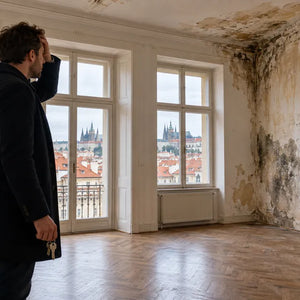
Can Prague buyers trust the advertised price per square metre?
Prague's advertised price per square metre is useful for orientation, but it is far too crude to tell us whether a particular apartment is fairly priced.
Deloitte's latest Develop Index shows why. The average asking price for new Prague developments reached roughly CZK 182,700 per m². Prague 2 averaged CZK 265,100, while Prague 10 averaged CZK 166,800. That puts Prague 2 almost 59% above Prague 10.
On a 70 m² apartment, those district averages differ by roughly CZK 6.9 million.
Even that comparison is still broad. Two apartments within the same district can trade very differently because of the street, metro access, floor, sunlight, noise, balcony, lift, parking, building condition and layout. An apartment five minutes from a metro entrance does not have the same resale market as one requiring two buses, even when both carry the same Prague district number.
Buyers should be especially careful when agents justify a price with a Prague-wide average. At today's values, being wrong by just CZK 15,000 per m² means CZK 1.05 million on a 70 m² apartment.
We would compare the property with recent apartments of similar age, ownership type, condition and micro-location. The broad Prague number should be the first reference point, not the valuation.
| New-build asking prices | Approx. CZK/m² | Approx. 70 m² price |
|---|---|---|
| Prague average | 182,700 | CZK 12.79m |
| Prague 2 | 265,100 | CZK 18.56m |
| Prague 10 | 166,800 | CZK 11.68m |
| Prague 2 premium over Prague 10 | ~59% | ~CZK 6.88m difference |
Not sure the price you're looking at is fair? Send it to us.
Are Prague new builds worth their premium today?
Prague new apartments can justify a premium, but the current gap is large enough that buyers should demand something concrete in return for it.
ČBA Monitor currently puts older Prague apartments built before 1995 at roughly CZK 149,000 per m². New apartments are around CZK 179,000 to CZK 183,000 depending on the exact Flat Zone series being used.
That leaves new stock roughly one-fifth more expensive before we even compare specific buildings.
Sometimes the premium makes sense. A modern apartment can bring better insulation, more efficient heating, a lift, underground parking, fewer immediate repairs and lower uncertainty about the roof, pipes or façade. These things have real financial value.
But buyers are also paying for Prague's shortage of new housing. Deloitte's developer asking-price index moved from CZK 157,000 per m² in Prague 10 in late 2025 to CZK 166,800 in the latest quarter. Prague 2 reached CZK 265,100 after a 10% increase in a single quarter. Quality alone did not suddenly improve by those percentages.
Off-plan buyers have another layer of risk because they are buying a contract before they are buying a finished home. Completion dates, payment milestones, floor-area tolerances, specification changes, defects, storage and parking rights all need to be clear in the paperwork.
A CZK 2 million new-build premium can be perfectly reasonable when it removes several years of renovation and building risk. Paying the same premium mainly because a new project launched into a hot market is harder to defend.
Got a question about a property in Czech Republic?
Found a place and not sure about it? Tell us about it and we'll tell you what we'd check. Free, within 12 hours.
Ask us your question →
Can an old Prague building turn a cheap apartment into an expensive one?
Yes, and this is one of the easiest ways to misprice an older Prague apartment because the expensive problems often sit outside the front door.
Prague has a huge stock of older brick buildings, and a renovated apartment inside one can look finished while the building itself still needs a roof, façade, lift, risers, windows, wiring or heating work.
The buyer therefore needs to understand the homeowners' association, commonly referred to as the SVJ, almost as carefully as the apartment.
We would read recent meeting minutes and financial statements, then check the reserve balance, existing loans, unpaid owner contributions and projects already discussed or approved. A building with little money saved and several postponed renovations is effectively carrying future costs that do not appear in the apartment's advertised price.
Scale matters as well. A CZK 12 million façade and roof project spread across 50 ownership shares is one thing. The same bill in a small building with 12 owners can change the economics of the purchase quickly.
Energy belongs in the same review. Sellers must provide the relevant building energy documentation under Czech rules, although advertisements can sometimes show a G rating when the agent has not received the certificate. We would investigate a G rather than automatically treating it as proof of terrible efficiency.
Actual heating bills, window quality, insulation and the building's renovation plan tell us more. An apartment with low current service charges can still become expensive if years of underinvestment are about to catch up with the owners.
| Building check | What we want to know | Warning sign |
|---|---|---|
| SVJ reserves | How much cash is available | Very little saved |
| SVJ loans | What owners are already repaying | Large debt plus unfinished works |
| Meeting minutes | What repairs are coming | Major projects repeatedly postponed |
| Owner arrears | Whether contributions are being collected | Persistent unpaid balances |
| Roof, façade and risers | Remaining useful life | Several major items due together |
| Energy performance | Likely running costs | Weak efficiency with no upgrade plan |
Wondering if now's the time to buy in Czech Republic? Tell us your plan.
Is a Prague cooperative apartment really the same as owning an apartment?
No. When someone buys a cooperative apartment in Prague, they normally acquire a cooperative share linked to the right to use the apartment rather than direct ownership of the apartment itself.
That difference is easy to underestimate because the property may look and feel exactly like any privately owned flat.
Under Czech cooperative housing rules, the cooperative owns the property and the member leases the relevant apartment. What changes hands in a typical transaction is the cooperative membership share.
That can affect the mortgage. A privately owned apartment can normally serve directly as mortgage collateral once properly registered. Cooperative housing often requires a different structure because the buyer does not initially own the real estate being occupied.
Banks do have solutions. Česká spořitelna, for example, offers financing designed for cooperative housing and situations where the apartment is expected to move into private ownership later. The important point is that financing needs to be checked for the particular cooperative before the buyer becomes contractually committed.
Subletting can also depend on the cooperative's statutes and decisions. An investor should never assume the same freedom they would have with a privately owned unit.
One phrase deserves particular suspicion: “conversion to private ownership planned.” Planned is very different from completed. We would want to see the legal route, remaining cooperative debt, required approvals, expected cost and realistic timetable before paying a price that assumes the conversion will happen.
Still have a question about Czech Republic?
If this article didn't answer it, ask us. A real person replies within 12 hours, for free.
Ask us your question →What legal problems can hide behind a normal-looking Prague apartment?
A normal Prague listing can hide mortgages, easements, restrictions and building-related debts, so legal due diligence needs to go further than confirming that the seller owns the apartment.
The Czech Cadastre of Real Estate shows the registered owner and rights attached to the property. Buyers should check mortgages, easements and restrictions on disposal or encumbrance, together with the exact unit and associated ownership shares.
Parking and storage deserve their own check. A parking place described casually as “included” may be a separately owned unit, a co-ownership share with an assigned space, part of the common property or a contractual right. Those arrangements can have different consequences when the apartment is mortgaged or sold again.
There is also a second layer that the cadastral extract cannot fully answer: the apartment's relationship with the building's finances.
Under Czech apartment-ownership rules, the seller should provide information from the body responsible for managing the building about relevant debts connected with that management. We would obtain that confirmation and reconcile it with the SVJ accounts.
The purchase payment needs careful sequencing too. Ownership of registered Czech real estate passes through entry into the cadastre. The current administrative charge for an application to begin the registration proceeding is CZK 2,000.
For a purchase worth several million koruna, the escrow conditions should spell out when the seller receives the money and what happens if registration fails. Those details are boring until something goes wrong.
Got a contract in front of you and not sure about it? Tell us.
Can a beautifully renovated Prague apartment still be a bad buy?
Absolutely. A renovated Prague apartment can look expensive for good reasons or simply hide the parts of the property that still need money.
New flooring, a polished bathroom and a fitted kitchen tell us very little about electrical wiring, plumbing, moisture, ventilation, windows or structural alterations.
We would ask what the renovation actually included and when it was done. “Complete reconstruction” is advertising language unless it can be translated into specific work: new electrical circuits, new water lines, waterproofing, heating changes, windows, insulation or properly documented alterations.
Layout changes deserve attention in Prague's older buildings. If walls were moved or structural work was carried out, the buyer needs to know whether the work required approvals and whether the current configuration matches the legal and technical documentation.
There is also a common pricing trap. Someone renovates the interior beautifully, buyers pay a premium for it, and the SVJ then decides to renovate the façade, lift and risers. The new owner ends up paying for both layers.
An unrenovated apartment in a building that has already completed the expensive common works can sometimes be the cleaner purchase. It gives the buyer control over the renovation budget instead of forcing them to pay for someone else's finishes while inheriting the building's next bill.
Are Prague rental yields still attractive at today's prices?
Prague rental yields are fairly thin at current purchase prices, and the latest rent data make it harder to argue that rents are quickly catching up.
Deloitte's most recent Rent Index found that rents actually edged down quarter-on-quarter in Prague while the national average rose by 1.2%. The highest Prague district average was Prague 7 at CZK 493 per m² per month, while Prague 9 reached CZK 468 after a 3.8% quarterly increase.
Compare that with apartment prices still increasing at double-digit annual rates in the latest transaction data. Purchase values and rents are currently moving at very different speeds.
Take a 50 m² apartment renting for CZK 24,000 a month, equivalent to CZK 480 per m². Annual rent is CZK 288,000. At a CZK 8 million purchase price, that is a 3.6% gross yield. At CZK 9 million it drops to 3.2%, and at CZK 10 million it is below 3%.
Those figures come before vacancy, repairs, insurance, management, furnishings and taxation. Some building and service costs can be passed through to tenants; others ultimately stay with the owner.
This does not make Prague a bad investment market. It does mean that investors paying current prices are relying partly on long-term appreciation rather than collecting a large income return from day one.
Recent property-price growth has been much stronger than the latest movement in rents. That gap is one of the most important things an investment buyer should watch now.
| 50 m² apartment at CZK 24,000/month rent | CZK 8m purchase | CZK 9m purchase | CZK 10m purchase |
|---|---|---|---|
| Annual gross rent | CZK 288,000 | CZK 288,000 | CZK 288,000 |
| Gross yield | 3.6% | 3.2% | 2.9% |
| Vacancy deducted? | No | No | No |
| Repairs and management deducted? | No | No | No |
| Tax deducted? | No | No | No |
Got a question about renting out in Czech Republic?
Rules, yields, managers: tell us your plan and we'll reply within 12 hours, for free.
Ask us your question →Did Prague investment mortgages get harder to obtain?
Yes. Financing a Prague investment apartment has become meaningfully tougher because the Czech National Bank now recommends tighter limits specifically for investment mortgages.
Since April 2026, the CNB has recommended that banks apply a maximum 70% loan-to-value ratio and a debt-to-income limit of 7 for investment mortgages.
The general LTV ceiling remains 80% for most owner-occupied borrowers and 90% for eligible borrowers under 36 buying their own home.
On a CZK 10 million apartment, the difference is substantial. An 80% mortgage requires CZK 2 million in buyer equity. A 70% investment mortgage requires CZK 3 million. The buyer has to bring 50% more cash to cover the same purchase price.
The CNB introduced the measure after noting that residential property prices were again rising at double-digit rates, mortgage activity had moved above long-run averages and investment mortgages were taking a larger share of lending.
Its definition also catches more than the obvious professional landlord. The stricter treatment can apply when the property is being bought for rental, expected rent is used in the affordability assessment, or the borrower already owns two residential properties and is purchasing another.
For investors, financing is therefore becoming stricter at the same time that yields remain modest. A deal that looked comfortable with 80% leverage can look quite different at 70%.
| CZK 10m Prague apartment | 80% LTV | 90% LTV | 70% investment LTV |
|---|---|---|---|
| Maximum loan | CZK 8.0m | CZK 9.0m | CZK 7.0m |
| Buyer equity | CZK 2.0m | CZK 1.0m | CZK 3.0m |
| Extra equity vs 80% case | — | -CZK 1.0m | +CZK 1.0m |
| Investment DTI recommendation | — | — | 7x |
Trying to get a mortgage in Czech Republic as a foreigner? Tell us your situation and we'll help you see what's realistic.
Should Prague buyers expect prices to keep rising by 10% a year?
No. Prague prices are rising fast today, but assuming another 10% every year would turn a housing decision into a very aggressive price forecast.
Flat Zone's first-sale series shows new Prague apartment prices up 11.3% year-on-year and around 17% above early 2023. Czech Statistical Office data, which use a different methodology, show an even larger increase from early 2023.
Older apartments have also participated. ČBA Monitor notes that Czech Statistical Office prices for older Prague apartments rose 11.5% year-on-year in the first quarter, close to the pace of new homes.
There are solid reasons for Prague to remain expensive. Demand is resilient, household incomes have recovered, developable land is scarce and permitting has struggled for years.
Still, the rate of growth already appears less explosive on a quarter-to-quarter basis. Flat Zone's new first-sale prices rose 2.3% in the latest quarter, and ČBA Monitor has pointed out that slower asking-price growth combined with higher market interest rates could eventually cool transaction-price growth.
The sensible stress test is simple: assume the apartment does not rise in value for several years.
An owner-occupier may still be happy because the property solves a long-term housing need. An investor may still be happy if the net rental return is good enough. When the numbers only work after adding another 10% annual appreciation, the buyer is taking a much bigger bet than the property advertisement suggests.
Got a question about the market in Czech Republic?
Prices, areas, rentals: ask us what you'd ask a friend who knows. Free reply within 12 hours.
Ask us your question →Is buying in a cheaper Prague district automatically better value?
No. A cheaper Prague district becomes good value only when the purchase-price discount is larger than the drawbacks buyers and tenants attach to that location.
The current price gaps are huge. Deloitte puts new developments in Prague 10 at about CZK 166,800 per m² and Prague 2 at CZK 265,100.
Yet district labels tell us surprisingly little about individual apartments.
A flat near a metro station in Prague 9 or Prague 10 can have a much larger pool of tenants and future buyers than a poorly connected apartment carrying a more prestigious postcode. Walking distance to rail or metro, tram frequency, schools, supermarkets, parks, noise and the quality of the immediate street all influence demand.
Future supply needs checking as well. A neighborhood receiving thousands of comparable new apartments may improve rapidly while also giving future buyers far more choice. That can cap rents or resale pricing for an undifferentiated unit.
For an investor, one of the cleaner comparisons is the purchase-price discount versus the rent discount. Suppose one location costs 25% less but rents for only 10% less. That can create a real yield advantage. If purchase prices and rents are both 25% cheaper, the bargain is mostly optical.
In Prague these days, we would rather own an ordinary apartment in an unusually convenient micro-location than an awkward apartment bought mainly because the district name sounded cheap.
Can noise and tourism ruin a central Prague apartment?
Yes. Noise can permanently reduce the appeal of a central Prague apartment even when the address itself looks excellent on paper.
Prague 1 and inner Prague 2 contain some of the city's most desirable streets, but the experience can change completely from one building to the next.
Trams, cobblestones, restaurants, bars, delivery vehicles and late-night pedestrian traffic can become much more intrusive after dark. Courtyard-facing and street-facing apartments in the same building may therefore deserve very different prices.
This risk is almost impossible to assess from a normal daytime viewing. We would visit the street during the morning commute, in the evening and again late on a Friday or Saturday before paying a central-Prague premium.
Windows matter too. Good modern acoustic glazing can transform a noisy apartment, while old windows can make a beautiful historic unit frustrating to live in.
Investors sometimes assume central location removes the problem because tourists or young tenants will accept more noise. That view ignores resale. A future owner-occupier may discount the apartment much more heavily.
The safest central Prague purchase combines the location people want with an apartment that still works when the streets outside are busy.
Got a question nobody's answered?
Buying in Czech Republic and can't find a clear answer anywhere? Ask us. Free reply within 12 hours.
Ask us your question →Should investors value a Prague apartment using Airbnb income?
No. We would value a Prague apartment on ordinary residential use first and treat short-term rental income as optional upside.
Airbnb-style accommodation introduces regulation, tourism demand, platform rules, cleaning, management, furnishing and higher operating turnover into the investment case.
The legal structure can create another constraint. Cooperative housing rules can restrict subletting, so an investor buying a cooperative share needs to check the statutes before assuming any short-term rental strategy is available.
Building politics matter as well. Even where an activity is possible today, short-term guests can create tension around noise, common areas and security, particularly in buildings where most apartments are occupied by residents.
Revenue projections can also be deceptive. A high nightly price multiplied by 365 is not a realistic annual return. Occupancy fluctuates, and cleaning, utilities, platform charges and management consume a meaningful part of gross revenue.
We would run the purchase under a normal long-term tenancy. If it still works, short-term accommodation may improve the return. If the entire valuation depends on keeping an Airbnb model running indefinitely, the buyer is paying for a business assumption as much as for the apartment.
Are the taxes and buying costs on a Prague apartment really low?
Czech transaction taxes are relatively light today, but Prague buyers can still underestimate how much cash they need beyond the purchase price.
The old Czech real-estate acquisition tax has been abolished, so a buyer no longer faces a large percentage tax simply for acquiring an apartment. The Czech cadastral authority currently charges CZK 2,000 for an application to register a property right.
That makes the headline transaction burden look attractive compared with countries that impose heavy transfer or stamp duties.
The larger surprises often come elsewhere: legal review, escrow, mortgage valuation, technical inspection, bank charges, furniture and immediate renovation.
Consider an older apartment bought for CZK 8 million that needs CZK 800,000 of work. The renovation alone adds 10% to the capital required. If the building subsequently asks owners to fund a major common repair, the actual entry cost climbs again.
Owners also pay recurring Czech real-estate tax. Rental investors then have income-tax obligations, with Czech rules allowing qualifying actual expenses or, for standard rental income, a 30% expense allowance subject to the applicable rules and limits.
Foreign buyers should check their own tax residence as well because Czech tax treatment does not automatically settle the tax consequences in another country.
The useful figure is therefore the amount of cash needed to buy, finance and make the apartment ready for its intended use. The number printed on the listing is only part of that calculation.
Got a question about taxes in Czech Republic?
Buying costs, yearly taxes, rental income: ask us and get a clear answer within 12 hours. Free.
Ask us your question →What should make a Prague buyer nervous before paying a reservation deposit?
A Prague buyer should become cautious when important documents, financing answers or building information are still missing but the seller wants a reservation deposit immediately.
Reservation agreements can put money at risk before the final purchase contract is negotiated. We would therefore settle the questions capable of killing the deal before signing one.
The legal form of ownership should already be clear. The cadastral extract should have been checked. For an apartment in an SVJ building, we would want the financial statements, recent meeting minutes and information about building-management debts. For a cooperative apartment, we would want the statutes and details of any remaining cooperative debt.
A mortgage buyer also needs to know that the bank can finance this particular property. The agreed purchase price and the bank valuation are not necessarily the same. If a bank values a CZK 10 million apartment at CZK 9 million, the buyer may suddenly need much more equity.
Pressure around paperwork is particularly revealing. “You can review everything after reserving it” gives the buyer almost the worst possible sequence because leverage falls once money has been committed.
Physical inconsistencies deserve the same treatment. Fresh paint covering one wall, unexplained moisture, major layout changes, unusually high service charges or a pristine apartment inside a visibly neglected building all justify another question before another payment.
| Before paying a reservation deposit | What should already be clear |
|---|---|
| Ownership | Private, cooperative or another structure |
| Cadastre | Owner, mortgage, easements and restrictions checked |
| Building finances | SVJ accounts, debts and planned works reviewed |
| Financing | Bank has no obvious problem with the property |
| Renovation | Major alterations and technical condition understood |
| Parking/storage | Exact legal rights confirmed |
| Deposit | Refund conditions are written clearly |
| Purchase payment | Escrow and cadastral-registration sequence understood |
What should buyers watch out for in Prague?
Prague buyers should currently watch the individual apartment much more carefully than the city's overall popularity, because a strong market can make weak properties look safer than they really are.
Prague housing demand is clearly still healthy. Around 1,950 new apartments sold in the latest quarter, first-half sales were among the strongest recorded, and transaction prices continue to rise quickly. We would not avoid Prague simply because prices are high.
The risks sit inside the deal.
At current prices, overpaying by CZK 15,000 per m² already costs more than CZK 1 million on a 70 m² apartment. An older building can add another large bill through deferred repairs. Cooperative ownership can change financing and rental rights. A weak micro-location can hurt liquidity even inside a good district. Investment mortgages now require more equity, while the latest Prague rent figures have softened quarter-on-quarter despite another strong increase in purchase prices.
That last contrast deserves particular attention. A 50 m² apartment renting for CZK 24,000 per month produces only a 3.2% gross yield at a CZK 9 million purchase price. There is not much income available to absorb an expensive mistake.
Our judgment is clear: Prague remains a defensible place to buy, but today's market rewards careful property selection far more than blind exposure to Prague housing.
For someone buying a home to keep for many years, the biggest things to check are the building's finances, ownership structure, legal record, noise, actual renovation quality and micro-location.
For an investor, we would add three harder tests: calculate the yield without optimistic rent assumptions, run the mortgage under today's investment rules, and see whether the deal still makes sense with zero property appreciation for several years.
If it passes those tests, Prague's long-term housing shortage can work in the buyer's favor. If it fails them, recent price growth is a poor reason to force the purchase.
OUR METHODOLOGY
We approached the question of what Prague buyers should watch out for by breaking the purchase into the parts that can materially change its risk: current pricing, demand and supply, rental economics, financing, ownership structure, building finances, legal rights, renovation quality and micro-location. Rather than relying on a single Prague-wide price trend, we looked at how those factors interact at the level of an actual apartment purchase.
We used realized transaction data from ČBA Monitor, Flat Zone and the Czech Statistical Office to understand what buyers are actually paying. Deloitte's Develop Index was used for current new-development asking prices and district comparisons, while the joint Trigema, Central Group and Skanska Residential market analysis provided recent sales, available-stock and new-build market data.
Rental economics were checked against Deloitte's Rent Index rather than assuming rents were rising at the same speed as purchase prices. The simple yield examples in the article are gross calculations designed to show how quickly returns compress as the acquisition price rises; they do not deduct vacancy, repairs, management, furnishings or tax.
For mortgage risk, we relied on the Czech National Bank's current borrower recommendations, including the 70% LTV and DTI 7 limits recommended for investment mortgages from April 2026. We kept those investment rules separate from the general LTV limits applying to owner-occupied borrowers.
Legal and ownership checks were based primarily on official Czech sources. The Czech government portal and Czech Office for Surveying, Mapping and Cadastre were used for cadastral registration and the CZK 2,000 filing fee. The Czech Civil Code and Business Corporations Act were used for apartment ownership, homeowners' associations and cooperative housing, while Česká spořitelna provided a practical first-hand example of cooperative-apartment financing.
Building-level risk was treated separately from the legal title because a clean cadastral extract does not tell a buyer whether an SVJ has weak reserves, outstanding loans, owner arrears or major repairs approaching. Energy-performance documentation was checked against official Ministry of Industry and Trade guidance.
Tax and short-term accommodation points were checked against the Czech Financial Administration and Ministry for Regional Development. The Financial Administration was also used for the abolition of the real-estate acquisition tax, recurring real-estate tax and the treatment of rental income, while official Czech Statistical Office data provided additional context on accommodation booked through online platforms.
Where the purchase depended on future price growth, we deliberately avoided turning recent appreciation into a forecast. The main stress test was whether the property could still make sense if prices stopped rising for several years. That makes building quality, legal clarity, financing, micro-location and realistic rental income more important than simply extrapolating Prague's latest annual growth rate.
Key sources include: ČBA Monitor on Q2 2026 transaction prices and Flat Zone market data, ČBA Monitor's Prague apartment-price series, Deloitte Develop Index, Deloitte Rent Index, Trigema's Q2 2026 Prague new-home market analysis, the Czech Statistical Office's realized apartment-price indices, the Czech National Bank's investment-mortgage decision, the Czech government portal on cadastral registration, the Czech Office for Surveying, Mapping and Cadastre, the Czech Civil Code, the Business Corporations Act, Česká spořitelna on cooperative-apartment financing, the Ministry of Industry and Trade on energy-performance certificates, the Czech Financial Administration on rental income, the Czech Financial Administration on the abolished acquisition tax, and the Ministry for Regional Development on short-term accommodation in residential buildings.
Related blog posts
- How much are property taxes and buying fees in Prague?
- How much property can you get for your money in Prague?
- Where should you buy property in Prague?
- Should you buy real estate in Prague now?
