
Authored by the expert who managed and guided the team behind the United Kingdom Property Pack
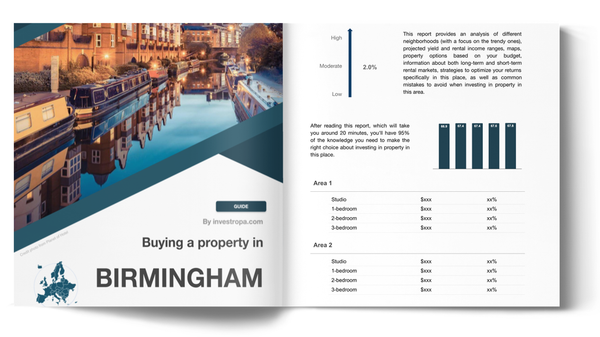
Get all the data you need about the real estate market in Birmingham
We constantly update this blog post so the rent figures for Birmingham stay fresh, simple and useful for buyers.
As of June 2026, Birmingham rents are still rising on official ONS data, but new advertised lets are more price-sensitive than before.
That means Birmingham landlords can still find demand, but rent expectations need to be realistic neighborhood by neighborhood.
And if you’re planning to buy a property in this place, you may want to download our pack covering the real estate market in Birmingham.

What are typical rents in Birmingham as of 2026?
As of 2026, typical private rent in Birmingham is about £1,090 per month, or roughly $1,470 and €1,275, based on the latest ONS local rent release for May 2026.
For a simple investor view, Birmingham rents in 2026 usually sit around £700 for a studio, £820 for a 1-bedroom flat, £1,000 for a 2-bedroom flat and £1,100 to £1,150 for a 3-bedroom house.
Birmingham is still cheaper than London and much of southern England, but Birmingham rents are high for the West Midlands because the city concentrates jobs, universities, hospitals, transport links and city-centre apartment demand.
What's the average monthly rent for a studio in Birmingham as of 2026?
As of 2026, the average monthly rent for a studio in Birmingham is about £700, or roughly $945 and €820, based on a careful estimate from official 1-bedroom and flat rent data.
For most Birmingham studios in 2026, a realistic rent range is £625 to £800 per month, or about $845 to $1,080 and €730 to €935.
This range matters because studios in Birmingham City Centre, Jewellery Quarter and Digbeth usually cost more, while smaller or older studios in Erdington, Handsworth, Perry Barr and parts of Yardley usually cost less.
What's the average monthly rent for a 1-bedroom in Birmingham as of 2026?
As of 2026, the average monthly rent for a 1-bedroom apartment in Birmingham is £821, or about $1,110 and €960, according to the latest ONS local rent data.
In practice, most 1-bedroom apartments in Birmingham rent for about £700 to £1,100 per month, or roughly $945 to $1,485 and €820 to €1,285.
The cheapest 1-bedroom rents in Birmingham are usually in Erdington, Perry Barr, Acocks Green and Yardley, while the highest 1-bedroom rents are usually in Birmingham City Centre, Jewellery Quarter, Brindleyplace and prime Edgbaston.
What's the average monthly rent for a 2-bedroom in Birmingham as of 2026?
As of 2026, the average monthly rent for a 2-bedroom apartment in Birmingham is £993, or about $1,340 and €1,160, so £1,000 is the clean number to remember.
For most 2-bedroom apartments in Birmingham in 2026, a realistic rent range is £900 to £1,500 per month, or roughly $1,215 to $2,025 and €1,055 to €1,755.
Cheaper 2-bedroom rents in Birmingham are more common in Kings Norton, Stechford, Erdington and Northfield, while the most expensive 2-bedroom rents are usually in City Centre, Jewellery Quarter, Digbeth, Harborne and Moseley.
By the way, you will find much more detailed rent ranges in our property pack covering the real estate market in Birmingham.
What's the average rent per square meter in Birmingham as of 2026?
As of 2026, the average rent per square meter in Birmingham is about £18 per month, or roughly $24 and €21 per square meter per month.
Across Birmingham, a realistic range is £15 to £16 per square meter for many suburban houses, £18 to £21 for normal flats and more than £22 for compact premium city-centre studios.
Compared with London, Bristol or Manchester, Birmingham rent per square meter is usually lower, but it is still one of the stronger rental markets in the West Midlands.
In Birmingham, small furnished flats, new apartment blocks, balconies, parking, lift access and short walks to New Street, Snow Hill, Moor Street, Five Ways or University station usually push rent per square meter above average.
How much have rents changed year-over-year in Birmingham in 2026?
As of 2026, average private rents in Birmingham are up about 3.3% year over year, rising from roughly £1,053 in May 2025 to £1,088 in May 2026.
The main drivers are steady tenant demand from jobs, students, hospitals and relocators, but rent growth is now limited by stretched affordability and more careful tenant behavior.
This is slower than the previous boom years, and Zoopla’s new-let data even points to softer fresh asking rents in Birmingham, which shows that the 2026 market is still active but no longer frantic.
What's the outlook for rent growth in Birmingham in 2026?
As of 2026, the most realistic rent-growth outlook for Birmingham is about 1% to 3% for the rest of the year.
The key support comes from Birmingham’s graduate market, hospitals, universities, public-sector workers, city-centre jobs and limited landlord supply.
The strongest rent growth in Birmingham is likely to be in well-connected areas such as Jewellery Quarter, Digbeth, Eastside, Selly Oak, Edgbaston and good family parts of Harborne and Moseley.
The main risks are weaker tenant affordability, extra city-centre apartment supply, high mortgage costs for landlords and more price reductions on listings that start too high.
Get fresh and reliable information about the market in Birmingham
Don't base significant investment decisions on outdated data. Get updated and accurate information.

Which neighborhoods rent best in Birmingham as of 2026?
The best-renting Birmingham neighborhoods in 2026 are split into two groups: central flat markets and established family-house markets.
For apartments, Birmingham City Centre, Jewellery Quarter, Digbeth, Brindleyplace, Eastside and Edgbaston usually perform best.
For houses, Harborne, Moseley, Kings Heath, Bournville, Sutton Coldfield, Yardley and Kings Norton are often stronger because families care about space, schools, parks and local transport.
Which neighborhoods have the highest rents in Birmingham as of 2026?
As of 2026, the top three high-rent Birmingham areas are City Centre at about £1,300 to £1,700 for many good 2-bedroom flats, Jewellery Quarter at about £1,250 to £1,600, and Harborne at about £1,200 to £1,600 for strong flats or family homes, which is roughly $1,620 to $2,295 and €1,405 to €1,990 at the broad range level.
These Birmingham neighborhoods command premium rents because they offer short commutes, modern homes, good restaurants, hospitals, universities, green space or fast access to New Street, Snow Hill, Five Ways and major employment areas.
The typical tenants in these high-rent Birmingham neighborhoods are young professionals, couples, corporate relocators, hospital workers, university staff and higher-income families.
By the way, we’ve written a blog article detailing Sources and methodology: we used ONS Birmingham housing prices, Transport for West Midlands and Deloitte Birmingham Crane Survey. We used ONS for the citywide anchor and local demand drivers for neighborhood premiums. We also checked portal patterns and our own Birmingham neighborhood files.
Where do young professionals prefer to rent in Birmingham right now?
Young professionals in Birmingham usually prefer City Centre, Jewellery Quarter and Digbeth, with Eastside, Brindleyplace, Southside and parts of Edgbaston also popular.
In these Birmingham neighborhoods, young professionals typically pay about £900 to £1,500 per month, or roughly $1,215 to $2,025 and €1,055 to €1,755, depending on size and building quality.
These areas attract young professionals because they offer walkability, gyms, bars, restaurants, modern flats, good broadband and quick access to New Street, Moor Street, Snow Hill, Colmore Business District and Paradise.
By the way, you will find a detailed tenant analysis in our property pack covering the real estate market in Birmingham.
Where do families prefer to rent in Birmingham right now?
Families in Birmingham usually prefer Harborne, Moseley and Sutton Coldfield, with Kings Heath, Bournville, Kings Norton, Yardley, Hall Green and parts of Erdington also popular.
In these family-friendly Birmingham neighborhoods, most families pay about £1,000 to £1,700 per month for 2-bedroom or 3-bedroom homes, or roughly $1,350 to $2,295 and €1,170 to €1,990.
Families like these Birmingham areas because they offer larger homes, gardens, parks, quieter streets, school options and practical train or road access to jobs.
Well-known education options near these areas include University of Birmingham School near Edgbaston, King Edward VI schools around the city, schools around Bournville and Sutton Coldfield, and local primary schools in Harborne, Moseley and Kings Heath.
Which areas near transit or universities rent faster in Birmingham in 2026?
As of 2026, the fastest-renting transit or university-linked areas in Birmingham are Selly Oak, City Centre and Eastside, with Edgbaston, Aston, Jewellery Quarter and Five Ways also strong.
In these high-demand Birmingham areas, well-priced rentals often stay listed for about 14 to 28 days, while overpriced or tired properties can still take longer.
Being within walking distance of a major station, university or campus can add about £75 to £200 per month in Birmingham, or roughly $100 to $270 and €90 to €235, if the home is also clean and well presented.
Which neighborhoods are most popular with expats in Birmingham right now?
Expats in Birmingham usually prefer City Centre, Jewellery Quarter and Edgbaston, with Harborne, Moseley, Brindleyplace and parts of Sutton Coldfield also popular.
In these Birmingham expat areas, typical monthly rents are about £900 to £1,700, or roughly $1,215 to $2,295 and €1,055 to €1,990, depending on whether the home is a compact furnished flat or a larger family property.
Expats like these Birmingham neighborhoods because they offer furnished homes, easy transport, short commutes, international restaurants, hospitals, universities and simple access to Birmingham Airport via rail or road.
The most visible expat demand in Birmingham often comes from international students, medical workers, university staff, finance and professional-services workers, and communities linked to South Asia, Europe, the Middle East and China.
And if you are also an expat, you may want to read our Sources and methodology: we used Office for Students, Transport for West Midlands and ONS Birmingham housing prices. There is no official expat-rent table for Birmingham. We estimated demand from tenant profiles, furnished supply and our own expat-focused analysis.
Get to know the market before buying a property in Birmingham
Better information leads to better decisions. Get all the data you need before investing a large amount of money.
Who rents, and what do tenants want in Birmingham right now?
Birmingham’s rental market in 2026 is broad, which is useful for landlords because demand does not depend on only one tenant group.
The city has students, graduates, hospital workers, university staff, public-sector workers, families priced out of buying and people moving for jobs.
The important point is that each Birmingham tenant group wants something different, so a good rental strategy depends on matching the property to the right neighborhood.
What tenant profiles dominate rentals in Birmingham?
The top three tenant profiles in Birmingham are young professionals, students and sharers, and families or lower-to-middle-income households needing 2-bedroom or 3-bedroom homes.
As a practical 2026 estimate, young professionals represent about 30% to 35% of active rental demand, students and sharers about 25% to 30%, and families about 25% to 30%, with the rest coming from corporate, expat and specialist tenants.
Young professionals usually want studios and 1-bedroom flats in central Birmingham, students and sharers usually want rooms or 3-bedroom to 6-bedroom houses near Selly Oak, Edgbaston and Aston, and families usually want 2-bedroom or 3-bedroom homes in Harborne, Moseley, Bournville, Yardley and Sutton Coldfield.
If you want to optimize your cashflow, you can read our Sources and methodology: we used Birmingham City Observatory, Office for Students and ONS Birmingham housing prices. We estimated tenant shares because no official source splits Birmingham rental demand this neatly. We cross-checked the mix with our own tenant-demand model.
Do tenants prefer furnished or unfurnished in Birmingham?
In Birmingham in 2026, about 55% of active renters for flats prefer furnished or part-furnished homes, while about 45% prefer unfurnished homes, mainly in family-house areas.
The furnished rent premium in Birmingham is usually about £50 to £150 per month for a good flat, or roughly $70 to $200 and €60 to €175, but the premium is weaker if the furniture is cheap or dated.
Furnished rentals in Birmingham are most popular with students, young professionals, expats, corporate relocators and short-stay tenants in City Centre, Jewellery Quarter, Digbeth, Eastside and Edgbaston.
Which amenities increase rent the most in Birmingham?
The five amenities that usually increase rent most in Birmingham are secure parking, strong EPC performance, modern kitchens, balconies or outdoor space, and fast broadband with good work-from-home space.
In Birmingham, secure parking can add about £75 to £150 per month, a strong EPC and lower bills can add £40 to £100, a modern kitchen can add £50 to £125, a balcony can add £40 to £100, and strong broadband or workspace can add £25 to £75, which is roughly $35 to $200 and €30 to €175 across the full set of premiums.
In our property pack covering the real estate market in Birmingham, we cover what are the best investments a landlord can make.
What renovations get the best ROI for rentals in Birmingham?
The five best-ROI renovations for Birmingham rentals are repainting, durable flooring, bathroom refreshes, kitchen refreshes and EPC improvements such as insulation, heating controls or better glazing.
In Birmingham, repainting may cost £800 to £2,000 and add £25 to £75 monthly rent, flooring may cost £1,500 to £4,000 and add £40 to £100, a bathroom refresh may cost £3,000 to £7,000 and add £50 to £125, a kitchen refresh may cost £4,000 to £10,000 and add £75 to £175, and EPC upgrades may cost £1,000 to £8,000 and add £40 to £150, or roughly $1,080 to $13,500 and €935 to €11,700 for costs.
Poor-ROI renovations in Birmingham often include luxury finishes in value areas, expensive design features, oversized extensions for normal rentals and premium furniture in family houses where tenants usually prefer unfurnished homes.
Make a profitable investment in Birmingham
Better information leads to better decisions. Save time and money. Download our data.
How strong is rental demand in Birmingham as of 2026?
Birmingham rental demand in 2026 is still strong, but tenants are more selective than they were during the very tight 2022 to 2024 market.
Good Birmingham rentals in the right location still let well, especially if they are clean, warm, fairly priced and close to jobs, universities or transport.
The weaker part of the market is overpriced, tired or poorly located stock, because tenants now have more choice and less room in their budgets.
What's the vacancy rate for rentals in Birmingham as of 2026?
As of 2026, a realistic private-rental vacancy estimate for Birmingham is about 4% to 6% per year, equal to roughly 2 to 3.5 empty weeks for a well-priced normal property.
Across Birmingham, strong city-centre flats, Selly Oak student homes and good family houses can be closer to 2% to 4% vacancy, while overpriced or tired rentals can be above 7%.
Compared with the very tight post-pandemic period, Birmingham vacancy feels a little higher in 2026, but it is still not loose enough to call the city an easy renter’s market.
Finally please note that you will have all the indicators you need in our property pack covering the real estate market in Birmingham.
How many days do rentals stay listed in Birmingham as of 2026?
As of 2026, a well-priced Birmingham rental usually stays listed for about 21 to 35 days before an agreed let.
Prime 1-bedroom flats in City Centre or Jewellery Quarter, good Selly Oak student homes and strong family houses can move in 14 to 28 days, while overpriced or low-quality homes can take 6 to 10 weeks.
Compared with one year ago, Birmingham listings generally take a little longer because tenants are more price-sensitive and landlords have less room to push ambitious asking rents.
Which months have peak tenant demand in Birmingham?
The peak months for tenant demand in Birmingham are usually July, August and September, with a smaller useful wave in January and early February.
This seasonality comes from students, graduates, new jobs, family moves before school terms and hospital or university-linked renters looking before autumn starts.
The quietest months in Birmingham are usually November and December, when fewer tenants want to move and pricing must be especially realistic.
Don't buy the wrong property, in the wrong area of Birmingham
Buying real estate is a significant investment. Don't rely solely on your intuition. Gather the right information to make the best decision.
What will my monthly costs be in Birmingham as of 2026?
For a normal Birmingham buy-to-let in 2026, landlords should budget 20% to 30% of rent for non-mortgage running costs before tax.
On a £1,000 monthly Birmingham rent, that means about £200 to £300 per month, or roughly $270 to $405 and €235 to €350.
Flats can have higher service charges, while houses can have more direct maintenance risk, so the right cost estimate depends on property type.
What property taxes should landlords expect in Birmingham as of 2026?
As of 2026, there is no separate Birmingham annual landlord property tax, but council tax during voids can cost about £1,615 per year for Band A and £2,423 for Band D, or roughly $2,180 to $3,270 and €1,890 to €2,835.
Across Birmingham, annual council tax exposure can range from about £1,600 to more than £4,800 depending on band and liability, or roughly $2,160 to $6,480 and €1,870 to €5,615.
Birmingham council tax is based on the property’s valuation band, and tenants usually pay it during a normal tenancy while landlords usually pay it during void periods or some inclusive-rent HMO arrangements.
Please note that, in our property pack covering the real estate market in Birmingham, we cover what exemptions or deductions may be available to reduce property taxes for landlords.
What utilities do landlords often pay in Birmingham right now?
In Birmingham, landlords most commonly pay building insurance, service charges, ground rent where applicable, communal electricity and sometimes water, broadband or energy in student lets and HMOs.
Typical monthly landlord-paid costs can be about £20 to £60 for insurance, £100 to £300 for flat service charges, £10 to £40 for communal costs, £25 to £45 for broadband and £150 to £300 for bills-inclusive energy and water in shared homes, or roughly $15 to $405 and €12 to €350 across these items.
For normal single-let Birmingham flats and houses, tenants usually pay gas, electricity, water, broadband, TV licence and council tax, while landlords usually pay the property ownership and building-related costs.
How is rental income taxed in Birmingham as of 2026?
As of 2026, rental income in Birmingham is taxed under UK rules, so an individual landlord pays income tax on rental profit at their marginal rate rather than a special Birmingham rental tax.
Landlords can usually deduct allowable costs such as repairs, insurance, agent fees, legal and accountancy fees, service charges and replacement domestic items, while residential mortgage interest normally gives a 20% finance-cost tax credit instead of a full deduction.
Common Birmingham landlord tax mistakes include treating tenant-paid council tax as a landlord expense, forgetting void-period council tax, mixing capital improvements with repairs, and underestimating service charges on city-centre leasehold flats.
We cover these mistakes, among others, in our Sources and methodology: we used GOV.UK Self Assessment property income guidance, HMRC Property Income Manual and Birmingham City Council council tax. We explained the rules for a simple individual landlord. We also translated the tax points into common Birmingham investor mistakes.

We did some research and made this infographic to help you quickly compare rental yields of the major cities in the UK versus those in neighboring countries. It provides a clear view of how this country positions itself as a real estate investment destination, which might interest you if you’re planning to invest there.
What sources have we used to write this blog article?
Whether it’s in our blog articles or the market analyses included in our property pack about Birmingham, we always rely on the strongest methodology we can and we don’t throw out numbers at random.
We also aim to be fully transparent, so below we’ve listed the authoritative sources we used, and explained how we used them and the methods behind our estimates.
| Source | Why we trust it | How we used it |
|---|---|---|
| Office for National Statistics, Housing prices in Birmingham | This is the clearest official local rent page for Birmingham. | We used it as the anchor for average rent, 1-bedroom rent, 2-bedroom rent and annual rent growth. We treated May 2026 as the best available proxy for June 2026. |
| ONS, Private rent and house prices, UK | This is the official UK rent inflation bulletin. | We used it to compare Birmingham with England, the West Midlands and the wider UK. We also used it to check whether Birmingham fits the national rent slowdown. |
| Valuation Office Agency private rental market statistics | VOA data is one of the main official evidence bases for private rents in England. | We used it as supporting evidence for bedroom categories and historic rent patterns. We did not use it as the final current rent figure because ONS PIPR was fresher. |
| Zoopla Rental Market Report, June 2026 | Zoopla is a major UK property portal with a regular rental-market index. | We used it to check new-let direction and asking-market momentum. We gave more weight to ONS for rent levels, but Zoopla helped us understand current tenant pressure. |
| Rightmove Rental Price Tracker | Rightmove is the UK’s largest property portal and is useful for live advertised-rent pressure. | We used it to judge pricing sensitivity, rent reductions and letting-time direction. We did not use it as the core rent level because advertised rents can differ from achieved rents. |
| RICS UK Residential Survey, May 2026 | RICS surveys professional agents and surveyors across the housing market. | We used it for demand, landlord supply and rent-growth outlook. We treated it as directional evidence, not as a Birmingham-specific rent table. |
| Birmingham City Observatory Housing Briefing Book | This is Birmingham’s local evidence platform for housing conditions and housing need. | We used it to understand local housing stock, tenure pressure and affordability. We used it to keep the tenant-demand discussion specific to Birmingham. |
| Birmingham City Council Private Rented Sector Strategy 2022 to 2027 | This is the council’s own strategy for Birmingham’s private rented sector. | We used it to frame the private rented sector as a key part of Birmingham housing supply. We also used it for quality, management and property-condition issues. |
| Birmingham City Council council tax bands and charges | This is the official council tax page for Birmingham. | We used it for council tax exposure during voids and some HMO arrangements. We did not treat council tax as a normal landlord cost for standard occupied tenancies. |
| GOV.UK live tables on dwelling stock and vacants | This is the official England source for dwelling stock and vacancy data. | We used it to estimate a realistic Birmingham vacancy range. We cross-checked it with listing-market evidence because there is no perfect live private-rental vacancy rate. |
| GOV.UK HMRC Property Income Manual | This is HMRC’s technical manual for UK property income. | We used it for the tax treatment of rental profit, allowable expenses and finance-cost relief. We then translated the technical rules into simpler landlord language. |
| GOV.UK Self Assessment property income guidance | This is the official public-facing tax guidance for landlords. | We used it to explain how rental income is taxed for an individual landlord. We cross-checked it with HMRC manuals rather than private tax blogs. |
| Office for Students student numbers | This is the official higher-education regulator dataset. | We used it to support student-rental demand around Selly Oak, Edgbaston, Aston and city-centre campuses. We used it as a demand signal, not as a rent source. |
| Deloitte Birmingham Crane Survey 2026 | Deloitte’s crane survey is a widely used city-centre development tracker. | We used it to assess new residential and student-residential supply in central Birmingham. We cross-checked it against rent-growth expectations so we did not overstate scarcity. |
| Transport for West Midlands | This is the official regional transport body. | We used it to identify areas where rail, Metro and employment access help lettability. We used it qualitatively for neighborhood demand, not for rent levels. |
Get fresh and reliable information about the market in Birmingham
Don't base significant investment decisions on outdated data. Get updated and accurate information.
Related blog posts
- Is now a good time to invest in property in Birmingham (England)?